
Coast Guard Aircrew Flies Critically Injured Swimmer From Dauphin Island to Mobile Hospital
A Coast Guard aircrew flew a swimmer in critical condition from Dauphin Island to Providence Hospital in Mobile after a rip current rescue, officials said.
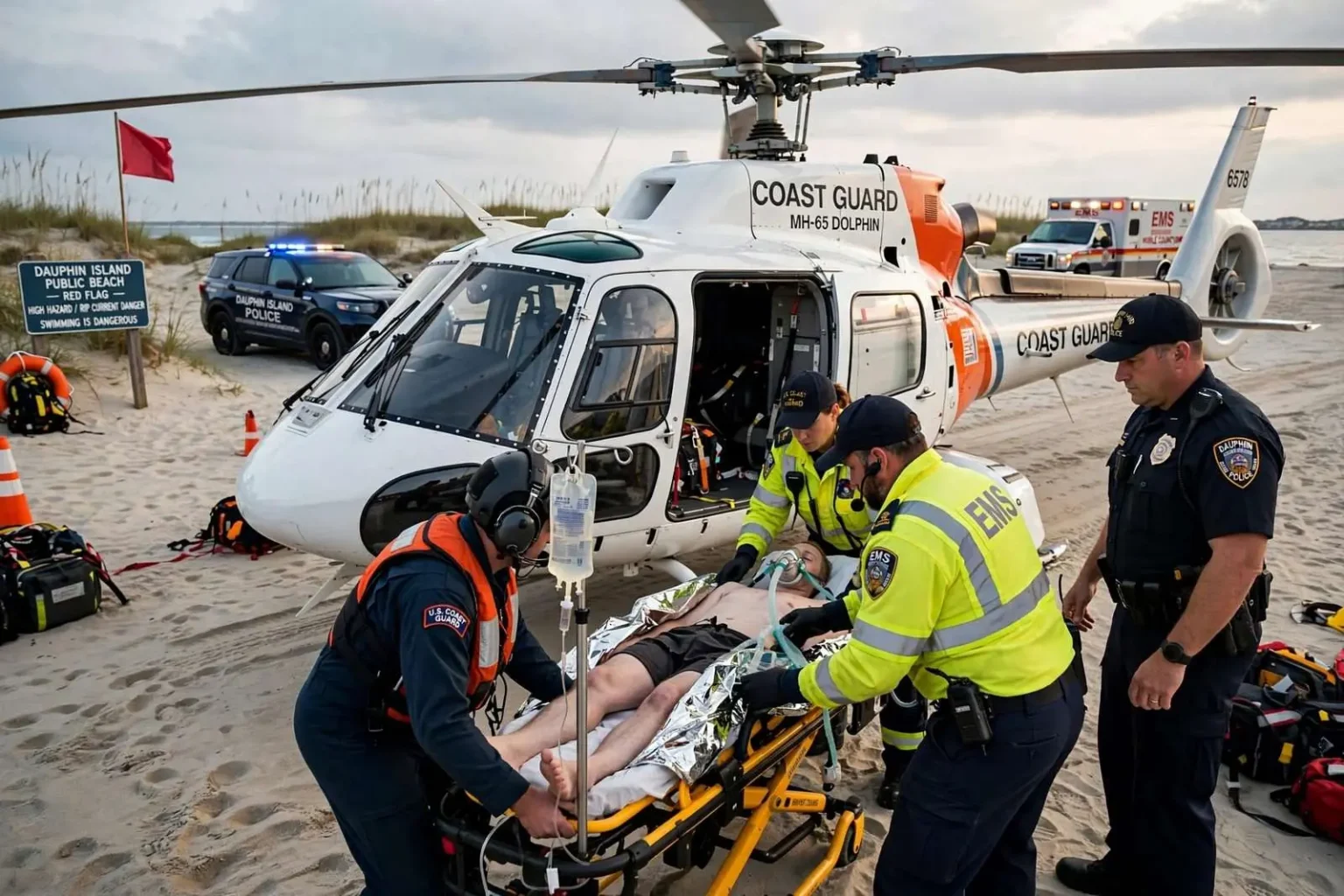
MOBILE, Ala. — A Coast Guard aircrew helped rescue a swimmer caught in a rip current off Dauphin Island on April 14, then flew the person to a Mobile hospital in critical condition. The rescue unfolded in the late afternoon, when conditions on the island’s Gulf beach turned dangerous for the swimmers in the water and set off a response that brought police, paramedics and a Coast Guard helicopter to the shore. The incident served as a sharp reminder of how quickly a routine swim can become a medical emergency along the Alabama coast.
Coast Guard Sector Mobile watchstanders received a call at 4:18 p.m. reporting three swimmers caught in a rip current off the beach. Rip currents are narrow channels of fast-moving water that pull away from the shore, and they are the leading hazard on Gulf beaches: a swimmer caught in one is carried away from land faster than most people can swim back, and the struggle against the current exhausts even strong swimmers within minutes. The report to the watchstanders set in motion the standard choreography of a coastal rescue, with responders dispatched while the situation in the water was still developing.
The swimmers were able to make it back to shore, where Dauphin Island Police officers and emergency medical services waited for the aircrew to arrive. Making it to the beach is not the end of such an ordeal — swimmers who have fought a rip current frequently arrive exhausted, having swallowed water and in some cases having gone without oxygen long enough to suffer serious injury. The presence of police and EMS on the sand meant that medical care could begin the moment the swimmers came out of the water, and that a landing zone could be organized for the helicopter that was on its way.
The flight to Mobile
The helicopter crew landed nearby and assisted emergency crews, transferring one swimmer in critical condition along with two EMS personnel to Providence Hospital in Mobile, according to the Coast Guard. Carrying EMS crew members along on the flight is standard practice when a patient’s condition requires in-flight care: the helicopter provides speed, but the paramedics and their equipment provide the monitoring and interventions that a critically injured or near-drowned patient needs between the beach and the emergency room.
The flight from Dauphin Island to Mobile is short — the island sits at the entrance to Mobile Bay, and the trip to the city’s hospitals crosses the water and lower bay in a matter of minutes by air. That speed is the point of air medical evacuation from the island, where ground transport to a trauma-level hospital can take substantially longer. For a patient in critical condition after a near-drowning, the difference between an air transfer and a ground ambulance run can be decisive, which is why the Coast Guard helicopter rather than a ground ambulance carried the swimmer to Providence Hospital.
Providence Hospital, in west Mobile, is one of the city’s established hospitals, and receiving a patient transferred by helicopter is an operation its emergency staff conducts as part of the region’s medical network. The two EMS personnel who flew with the swimmer would have given the receiving team a firsthand account of the patient’s condition and the care already provided, closing the loop on a rescue that involved four agencies in sequence: the Coast Guard, the island’s police department, the emergency medical service and the hospital.
Rip currents and the flag system
The Coast Guard urged the public to be cautious of rip currents and to heed posted beach flags and warning signs. The advice reflects the hard arithmetic of Gulf Coast rescues: swimmers caught in rip currents die every year along the northern Gulf, and the vast majority of those drownings happen on days when warnings were already posted. The flag system used on Alabama’s public beaches communicates water conditions in a form that can be read from the parking lot — green for calm, yellow for moderate surf, red for high hazard, double red for waters closed to the public, and purple for marine pests present.
Rip currents form when water piled up against the shore by waves and wind finds a channel back out to sea, often around sandbars, piers and jetties. The current itself does not pull a swimmer under; the danger comes from the swimmer’s instinct to fight directly back toward shore against a flow that can move faster than an Olympic swimmer. Safety guidance is consistent on the response: stay calm, float, and swim parallel to the beach until out of the narrow current, then angle back to land — and call or wave for help rather than exhausting yourself against the flow.
The geography of Dauphin Island shapes its exposure to that hazard. The barrier island faces the open Gulf on its south side, with a beach that changes shape as storms and currents move sand along the coast. On days when wind and swell line up against the shore, channels of outflow can open quickly at points along the beach, and swimmers who entered the water when conditions looked calm can find themselves in a current within minutes. The island’s public beaches draw visitors from across the Mobile area and beyond, many of whom are unfamiliar with Gulf surf conditions and the flag system that describes them.
How the response came together
The structure of the April 14 response shows how a coastal rescue actually works. The first call went to Coast Guard Sector Mobile, the command center responsible for coordinating maritime emergencies across a section of the central Gulf Coast that includes Mobile Bay and its approaches. Watchstanders there take the report, gather details on position and number of people in trouble, and dispatch the appropriate resource — in this case an aircrew, whose speed and overhead view make them the preferred responders for swimmers in distress offshore.
While the helicopter was en route, the response shifted to local hands. Dauphin Island Police officers and emergency medical services responded to the beach, prepared to receive the swimmers if they reached shore — which they did. That handoff, from federal maritime responder to local police and EMS, is the pattern for most distress calls off developed stretches of the Alabama coast: the agency with the aircraft or boat handles the water, and the local responders handle everything that happens on the sand, from first aid to organizing a landing zone on or near the beach.
Landing a helicopter near a public beach requires care. Crews look for open ground clear of people, vehicles and overhead obstructions, and police on the scene typically keep bystanders back while the aircraft comes in. On this April afternoon, the crew landed nearby, and the transfer of the critically injured swimmer onto the aircraft with two EMS personnel went ahead without reported complication. From the first call at 4:18 p.m., the interval between distress on the water and a hospital emergency room in Mobile was measured in well under an hour — the kind of timeline that only a coordinated, multi-agency response can produce.
A familiar warning
For the Coast Guard, the rescue was a routine call in one sense and a message in another. Sector Mobile and its aircrews run rescues like this one every season, and the outcome — three swimmers out of the water alive, one transferred for critical care — was better than many calls of its kind. The part of the agency’s statement that lingered was the warning: be cautious of rip currents, and heed the posted beach flags and warning signs.
The plea is repeated after nearly every rescue because it so often goes unheeded. Beach flags are posted at public access points precisely so that swimmers can check conditions before entering the water, and red or double-red flags mean the surf is beyond what even strong swimmers should attempt. Visitors who see a green or yellow flag in the morning and assume it will hold all day are caught out when conditions shift with the wind and tide, which is why safety officials pair the flags with a standing instruction to look for the warning signs and to swim near lifeguarded stretches where they exist.
The three swimmers on April 14 made it back to shore under their own power, which is the outcome every agency involved works toward and the one that rip-current safety advice is designed to make more common. One of the three left the island by helicopter in critical condition, headed for a Mobile hospital with two paramedics at the side. The difference between those outcomes — the two who walked off the beach and the one who had to be flown — is the difference that water safety officials spend every season trying to widen.
Living with the Gulf
Dauphin Island’s place at the mouth of Mobile Bay makes it the first landfall for weather moving in from the Gulf and a community that lives closely with the water. Its beaches are a regional destination, its fishing piers and boat launches draw year-round traffic, and its year-round population coexists with a summer surge of visitors. The island’s public safety agencies are sized for a small town but train for the emergencies that a waterfront community produces, and a distress call off the beach is among the calls they prepare for most seriously.
The April 14 rescue joined a long line of similar calls along the Alabama coast, where rip currents claim swimmers in most years and where the rescue network — Coast Guard aircrews, marine police, local fire and EMS, volunteer lifeguards where they exist — practices for the sequence that unfolded that afternoon. Each successful rescue depends on the same links holding: someone on the beach calling it in quickly, watchstanders dispatching the right resource, responders reaching the swimmers before exhaustion wins, and a hospital ready to receive the sickest patient.
For beachgoers, the lessons of the incident are the ones the Coast Guard repeated in its statement. Check the flags before swimming, read the warning signs at the access points, and understand that a calm morning sea can become hazardous by afternoon. Anyone caught in a rip current should not fight it head-on but float, signal for help and swim parallel to shore to escape the narrow band of outflow. And anyone who sees a swimmer in trouble should call for rescue immediately rather than entering the current in a second rescue attempt — a step that too often turns one emergency into two.
The Coast Guard does not identify the people involved in rescues like this one, and the agency’s account of the April 14 call focuses on the mechanics of the response rather than the condition of the patient after arrival at Providence Hospital. What the record shows is a system that worked as designed on a spring afternoon: a call taken at 4:18 p.m., three swimmers back on the sand, a helicopter on the beach, two paramedics in the cabin, and a critically injured patient in Mobile before the sun was far down the western sky.