Daphne Man Indicted on Sexual Abuse Charge in 2007
A 2007 WKRG report covered a Baldwin County grand-jury indictment and authorities' effort to locate the defendant.
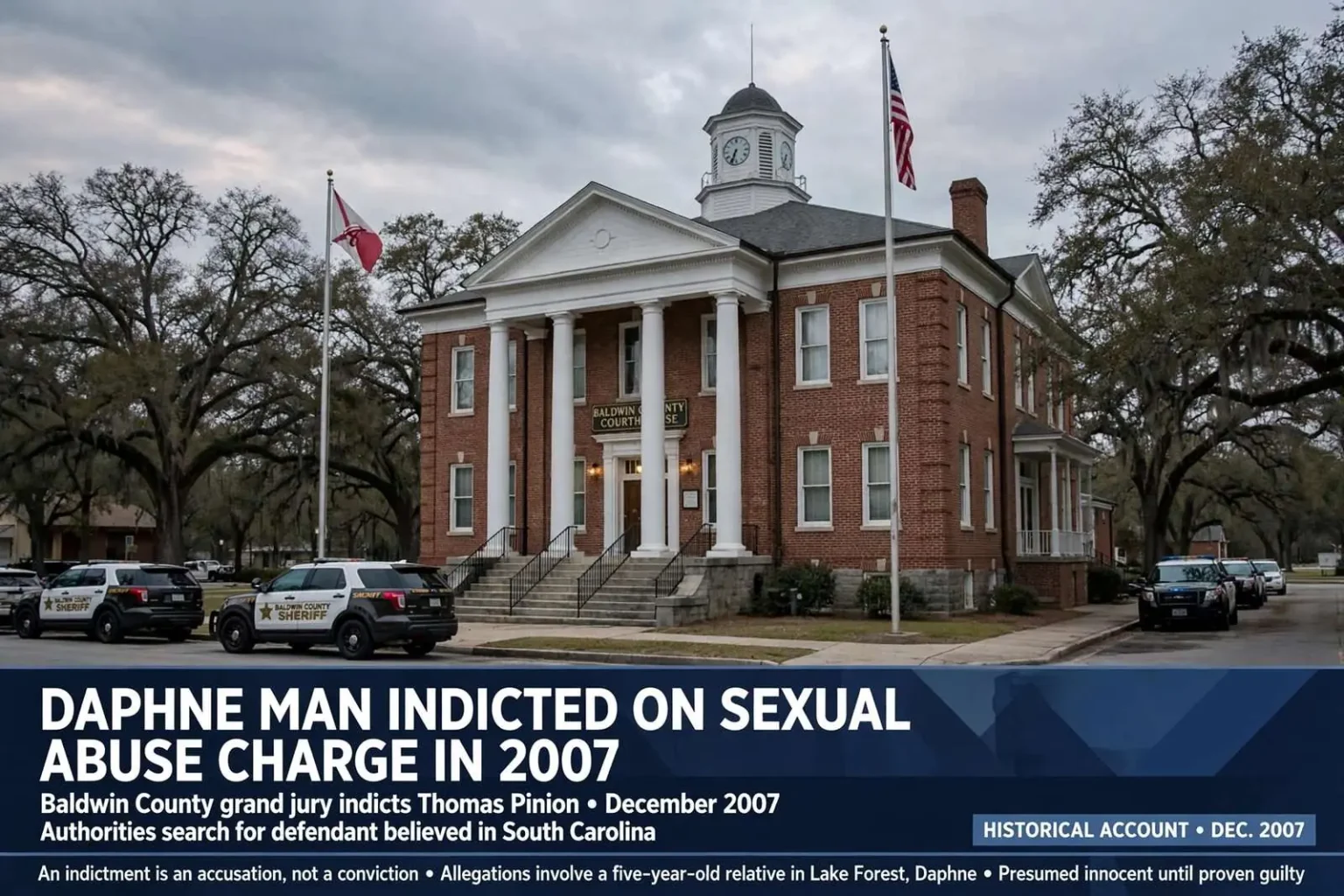
A Baldwin County grand jury indicted Thomas Pinion on one count of first-degree sexual abuse in December 2007, according to a local station. Investigators alleged that a five-year-old relative was abused at a home in the Lake Forest subdivision of Daphne. Authorities said they were trying to locate Pinion and believed he might be in South Carolina.
His attorney told the station that Pinion knew about the indictment and might turn himself in. The station reported that Pinion’s wife and Care House, the child-advocacy organization she had directed, were not part of the investigation.
This is a historical account of an indictment and investigators’ allegations reported in 2007. An indictment is not a conviction, and this report does not state a final court outcome.
What a First-Degree Sexual Abuse Charge Means
First-degree sexual abuse is among the most serious abuse classifications in Alabama law, reserved for conduct that involves forcible compulsion or, as in cases involving young children, victims who are legally incapable of consent because of their age. A conviction on the charge carries the potential for a lengthy prison sentence, which is why such cases receive attention from both prosecutors and defense counsel from the earliest stages. The statute’s structure means that the alleged victim’s age is itself a central element of the offense, independent of any other circumstance.
The charge in the 2007 indictment stemmed from allegations involving a five-year-old relative, an age so young that the case would have depended heavily on specialized interview techniques and expert testimony. Alabama’s courts, like those across the country, have developed procedures for handling testimony involving very young children, recognizing both the difficulty of the evidence and the heightened need to protect child witnesses from further trauma as a case moves forward.
It bears repeating that an indictment is an accusation, not a finding. A grand jury’s role is to determine whether probable cause exists to believe a crime was committed and that the accused committed it — a far lower threshold than the guilt standard a trial jury applies. Defendants are presumed innocent, and the disposition of the case against Pinion, whether by trial, plea or otherwise, is not stated in the archived coverage preserved here.
How the Baldwin County Grand Jury Works
Baldwin County’s grand jury convenes periodically in Bay Minette, the county seat, to hear evidence presented by the District Attorney’s office and decide whether charges should move forward. The panel hears from investigators and witnesses in sessions closed to the public, and its deliberations are secret. When a majority finds probable cause, it returns a “true bill” — the indictment that formally opens a felony case in circuit court.
The process is deliberately one-sided compared with a trial. Defense attorneys are not present, the accused has no right to testify, and hearsay that would be excluded at trial can inform the panel’s decision. Supporters of the system describe it as a screening mechanism that prevents weak cases from reaching trial; critics note that indictments return in the overwhelming majority of presentations. Either way, an indictment signals only that the prosecutor’s evidence cleared a minimal bar, not that guilt was established or even closely tested.
Locating a Defendant Across State Lines
Once indicted, a defendant must be located and arrested to face the charge. When a person indicted in Alabama is believed to have left the state, the case enters the interstate machinery that governs fugitive matters. Investigators coordinate through warrants entered into national databases, and if the individual is located in another state, extradition comes into play under the Uniform Criminal Extradition Act, which Alabama and South Carolina have both adopted. The state where the person is found may arrest and hold them while the charging state arranges return.
In practice, extradition depends on the seriousness of the charge, the resources of the agencies involved and whether the defendant contests return. A felony charge of this magnitude would ordinarily justify the process, though timelines can stretch for months. Attorneys sometimes negotiate a voluntary surrender in the interim, which is consistent with the report that Pinion’s lawyer said his client knew of the indictment and might turn himself in.
Voluntary surrender changes the practical course of a case significantly. It resolves the flight question, allows an initial appearance and bond hearing to proceed on a regular schedule, and often signals coordination between defense counsel and prosecutors. Whether that occurred in this case is not recorded in the archived report.
Care House and the Child Advocacy Model
The report that Pinion’s wife had directed Care House, and that neither she nor the organization was part of the investigation, touched on an institution that plays a central role in Baldwin County’s handling of child abuse cases. Care House is the county’s child advocacy center, the type of nonprofit established across Alabama under state enabling legislation to coordinate the professionals who respond when a child is alleged to have been abused. Its staff conduct forensic interviews, support child victims and families through investigations and court proceedings, and help coordinate law enforcement, prosecutors, child protective workers and medical providers so that a child tells their account once rather than repeatedly to a string of agencies.
The children’s advocacy center model emerged nationwide in the 1980s as a response to the fragmentation of abuse investigations, in which a child might be interviewed separately by patrol officers, detectives, social workers and prosecutors, each request adding trauma. Alabama formalized the model in law, and centers like Care House became the standard entry point for serious child abuse cases in their counties, operating alongside — but independently of — the law enforcement agencies that investigate.
Because of that separation, the station’s report that the organization and its former director were not part of the investigation is consistent with how the system is designed. Advocacy centers serve child victims; they do not investigate suspects. The distinction matters in any case, and especially in one where a person connected to the center’s leadership was named in allegations, since the integrity of the center’s work for other children depends on investigative responsibility resting squarely with law enforcement and prosecutors.
The Setting: Lake Forest and Daphne
The alleged abuse was reported to have occurred at a home in Lake Forest, one of Daphne’s largest and longest-established subdivisions. The neighborhood, built around a golf course and Lake Forest lake on the eastern shore of Mobile Bay, contains hundreds of homes across a sprawling network of streets and has been a familiar name in Baldwin County for decades. References to the subdivision in court records and news reports are routine simply because of its size; the community itself was the backdrop to the allegations, not a participant in them.
Daphne in 2007 was in the middle of the population boom that has defined Baldwin County for a generation. The city had grown from a small bay-front town into one of the Eastern Shore’s principal suburbs, drawing families with its schools, parks and proximity to Mobile across the bay. Growth of that kind brings more households, more children and, inevitably, more of the caseload — family court matters, dependency cases and abuse investigations — that follows population wherever it goes.
Agencies in the county responded to that growth by expanding the collaborative structures described above, with the District Attorney’s office, the Sheriff’s Department and municipal police departments all working through the child advocacy center on cases involving young victims. The 2007 indictment came out of that machinery, and its report reflected the system’s standard division of labor: police investigate, grand juries weigh, advocates support the child, and the courts decide.
Why the Account Ends Where It Does
The archived report preserves a moment in time: an indictment returned in December 2007, a defendant not yet in custody, an attorney’s statement about a possible surrender, and an explicit clarification about who was and was not under investigation. What the record does not contain is an outcome, and none should be assumed. Cases from this period are often difficult to trace in later public records, and responsible treatment of a decades-old allegation means stating exactly what was reported and no more.
That discipline serves several purposes at once. It protects the presumption of innocence that attaches to every criminal accusation; it respects the privacy of a child victim, who was five years old when the events were alleged and whose identity has never been public; and it avoids casting suspicion on people and institutions the reporting itself cleared. What remains is the documented fact of the indictment, the allegations as investigators presented them to the grand jury, and the historical record of how Baldwin County’s system responded when a child abuse case reached it.