Citronelle Court Dropped One Charge in 2007 Theft and Homicide-Related Case
Archived WKRG coverage reported that one charge was dropped against a Citronelle man who remained accused in a separate theft case and was a homicide suspect.
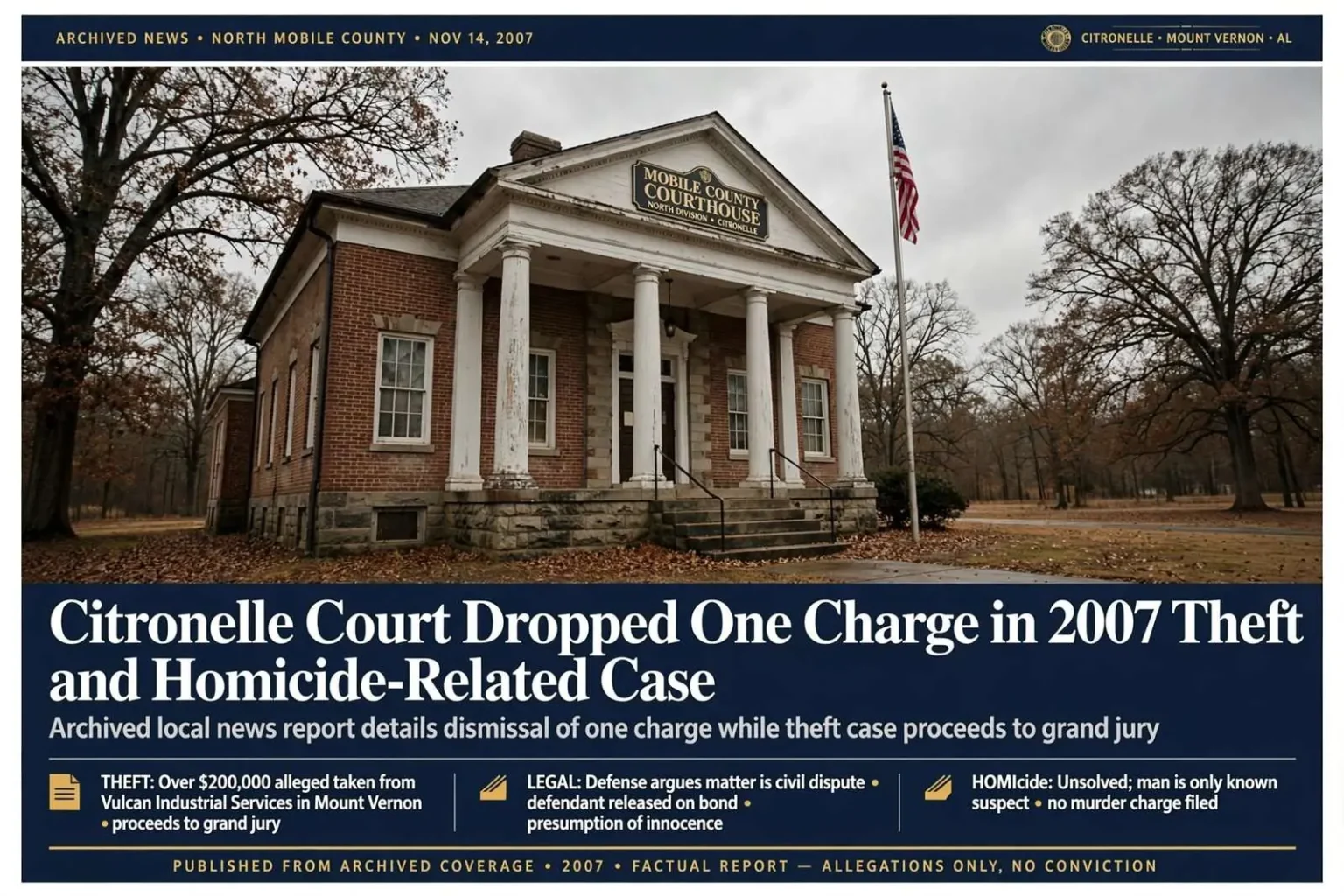
Historical court report, published from archived local news coverage.
A court dropped one charge against a Citronelle man in 2007, while a separate theft case against him continued, according to an archived local news report from the period. The ruling left the man still facing the theft allegations even as the dropped charge removed one piece of the legal jeopardy he faced that year.
Investigators alleged that more than $200,000 had been taken from Vulcan Industrial Services in Mount Vernon and placed in a personal account. The allegations tied the case to the north Mobile County industrial employer, and prosecutors pursued it as a criminal theft matter rather than a private financial dispute.
The defense position
The man’s attorney disputed the allegations, arguing that the matter belonged in civil court — a dispute over money between an employer and an individual, to be sorted out through litigation rather than prosecution. The civil-versus-criminal distinction was central to the defense’s challenge: civil cases require a lower standard of proof and end in judgments or repayment, while criminal charges carry the threat of conviction and incarceration and must be proven beyond a reasonable doubt.
The defense also argued that prosecutors were linking the theft allegations to an unsolved homicide involving a Vulcan plant manager. The station reported that the man was the only known suspect in the homicide investigation but had not been charged with murder. That linkage — connecting a financial case to a death investigation in which no murder charge had been filed — formed the backdrop to the proceedings and to the coverage of them.
What a dropped charge means
The charge that was dropped in 2007 did not amount to an acquittal. In Alabama practice, charges can be dismissed or not presented for a range of procedural reasons — evidentiary gaps, jurisdictional questions, or decisions by prosecutors about how to structure a case — and a dismissal of one count leaves the remaining counts fully alive. The archived report does not establish the reason the charge was dropped, only that the court removed it while the theft case moved forward.
That theft case was sent to a grand jury, the next procedural step for a felony matter in the Alabama court system. A grand jury hears the prosecution’s evidence in secret and decides whether probable cause exists to return an indictment; if it does, the case proceeds to arraignment and trial. At the time of the report, the man was out on bond while the process unfolded.
The setting: Citronelle and Mount Vernon
The case unfolded in the northern reaches of Mobile County, where the small city of Citronelle sits near the Mississippi line and the town of Mount Vernon lies to its southeast along the Mobile River corridor. The area is rural and close-knit, and serious criminal allegations there draw close attention; a case connecting a local industrial employer, a large alleged financial loss and an unsolved homicide was the kind of story that circulated through the community for years.
Vulcan Industrial Services operated in Mount Vernon as one of the area’s industrial employers, and the alleged loss of more than $200,000 from the company made the theft case a matter of local consequence rather than a routine docket entry. The unsolved homicide of a Vulcan plant manager hung over the proceedings, even though — as the report emphasized — the man facing the theft allegations had not been charged in the death.
Grand juries and pretrial process
The referral of the theft case to a grand jury placed it on the standard track for felony prosecution in Alabama. Grand jurors hear only the state’s side of the case: investigators and prosecutors present evidence, and the panel votes on whether the evidence shows probable cause to charge. Defendants and their attorneys generally do not present evidence at that stage, which is why defense arguments — including the claim that the matter was civil rather than criminal — are aimed at prosecutors and courts before and after the indictment decision rather than at the grand jury itself.
Being out on bond during that process is routine in non-capital matters, allowing a defendant to remain in the community while the case advances. Bond conditions, court dates and the pace of grand jury scheduling all shape how long the pretrial period lasts, and the archived report captured the case at exactly that in-between stage: one charge dropped, the theft case pending before the grand jury, the homicide investigation unresolved.
Bond, presumption and the pretrial stage
Every element of the case as reported sat at the pretrial stage where the presumption of innocence is at its strongest. An allegation is not evidence of guilt; a suspect designation is not a charge; a dismissed count is not a conviction; and release on bond is the ordinary condition of a defendant preparing to answer charges rather than a special accommodation. Local coverage of cases in small communities walks a careful line through that terrain, and the archived report did so by attributing every claim — to investigators, to the attorney, to the court’s action — rather than stating any of them as established fact.
That discipline matters most in cases like this one, where a homicide investigation without a charge supplied the emotional weight and a financial case supplied the actual legal proceedings. Readers following the coverage in 2007 were looking at two very different things reported side by side, and the record from the period is clearest when those threads are kept separate.
How to read this account
This historical account reflects law-enforcement allegations, a defense position and a pretrial update as they were reported in 2007. It does not establish guilt, it does not report any later court outcome, and it does not resolve the homicide investigation it references. Allegations in the story were exactly that — allegations — at the time of publication, and the defense’s position was part of the record in equal measure.
The stakes of the linkage argument
The defense’s complaint that prosecutors were linking the theft case to the unsolved homicide went to the heart of how the case was being handled. In criminal proceedings, prosecutors are bound to try charges on their own evidence, and defense attorneys routinely object when the atmosphere around a case — public suspicion connected to a separate, uncharged investigation — risks prejudicing the panel or pool from which jurors are drawn. A defendant who is publicly identified as a suspect in a homicide, without having been charged with murder, faces a reputational burden that no indictment yet supports.
For its part, the state’s position, as reported, was that the theft allegations stood on their own: more than $200,000 allegedly moved from an employer’s accounts into a personal account, documented through financial records that investigators assembled before sending the case to the grand jury. The dispute between those two framings — a criminal theft case versus a civil money dispute entangled with a death investigation — defined the case as it was reported in 2007.
Unsolved cases in rural Alabama
The homicide reference in the report reflects a familiar reality of rural Alabama criminal justice. Unsolved deaths in small communities remain open investigations for years, often with a single person of interest and no charge filed, because the standard for an arrest and a murder indictment is far higher than suspicion. Investigators continue working such cases as evidence and witnesses emerge, and the absence of a charge is not an exoneration any more than a person-of-interest designation is a conviction. The archived coverage of the Citronelle case captured that limbo precisely: an unsolved death, one known suspect not charged, and a separate financial case proceeding through the courts.
For the community around Citronelle and Mount Vernon, the two threads — the money and the death — were difficult to separate, even though the courts treat them as distinct matters requiring distinct proof. The report took care to keep them distinct as well, noting both the linkage the defense disputed and the fact that no murder charge had been brought.
What the record shows
Stripped to its documented facts, the case as reported in 2007 involved: a Citronelle man charged in connection with the alleged theft of more than $200,000 from Vulcan Industrial Services in Mount Vernon; allegations that the money was placed in a personal account; a defense argument that the dispute belonged in civil court; the court’s decision to drop one charge; the theft case’s referral to a grand jury; the man’s release on bond; and an unsolved homicide involving a Vulcan plant manager in which the man was the only known suspect but had not been charged.
Everything beyond that — the grand jury’s decision, any trial, the disposition of the theft allegations, and the eventual course of the homicide investigation — lies outside this account. The report stands as a snapshot of a case in motion, published from archived local news coverage of the north Mobile County courthouse beat.