Family of Citronelle Homicide Victim Sought Answers in 2007
A 2007 WKRG report featured the family of Stephen Perret after his shooting death in Citronelle.
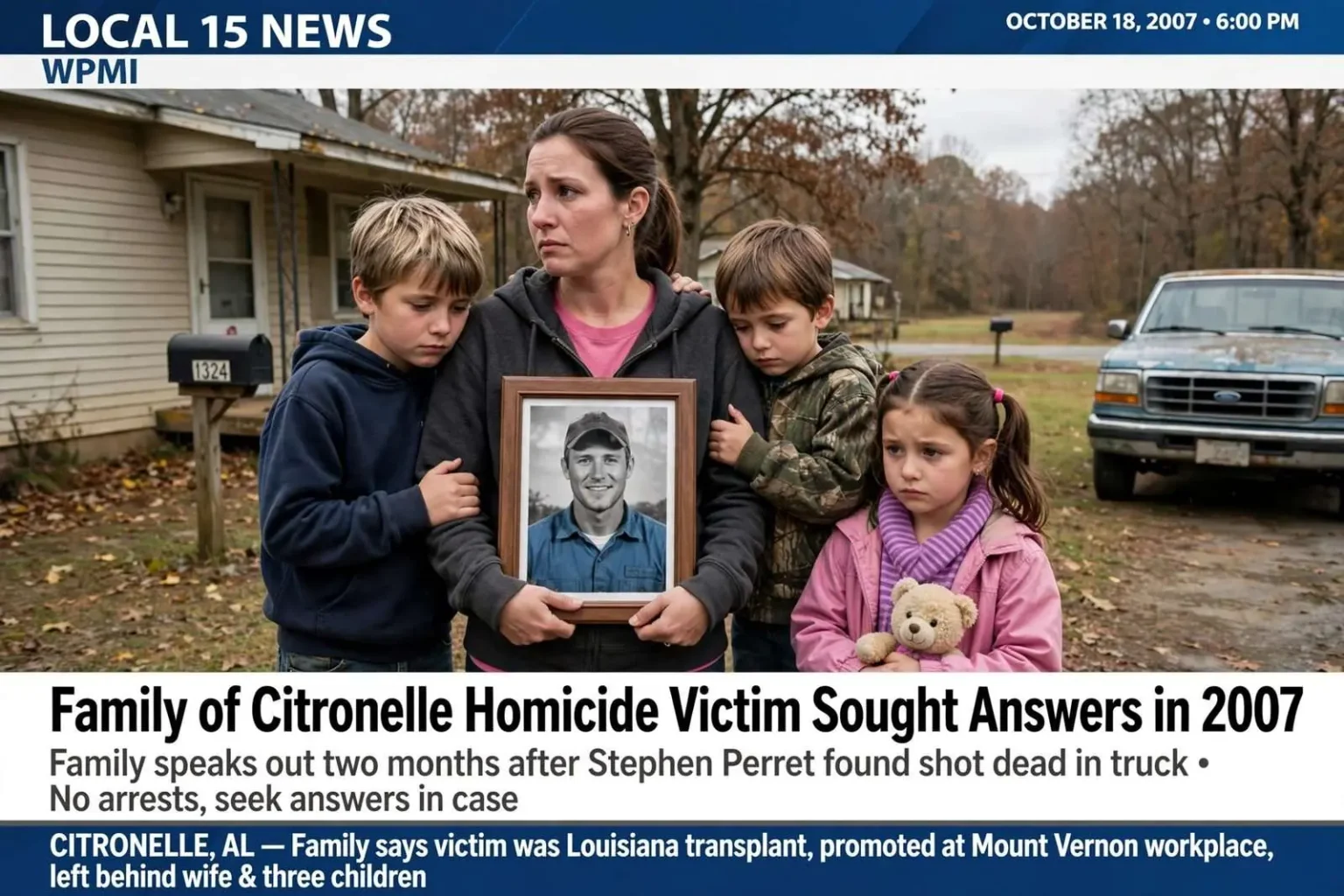
The family of Stephen Perret spoke to a local station in October 2007 about his shooting death in Citronelle and their search for answers. More than two months after Perret was found shot to death in a truck in August, the family went public with their frustration, describing a case that had produced no arrest and little visible progress from their perspective.
Perret was found shot to death in a truck in August. His family said he had relocated from Louisiana after Hurricane Katrina, was recently promoted at his Mount Vernon workplace, and left behind a wife and three children. The details sketch the life of a man rebuilding after the storm, one of the tens of thousands of Gulf Coast residents who crossed into southwest Alabama after Katrina scattered families and jobs in the late summer of 2005, and who had, by the account of his family, begun to put the disruption behind him with a promotion at his workplace in Mount Vernon, the small industrial town in north Mobile County.
The station reported that Mike Crocker, Perret’s boss and neighbor, was the only publicly known suspect at the time. The relationship between the two men, employer and employee, neighbor and neighbor, added a layer of complexity to the case that the family had to live with publicly: the person investigators focused on was someone Perret saw every day at work and lived beside at home.
The theft case and the alleged cover-up
Crocker had been charged with theft from Vulcan Industrial Services, and investigators alleged he had injured himself and misled police as part of an attempted cover-up. According to the account reported in 2007, the allegations tied the theft case to the homicide investigation: investigators alleged that injuries Crocker sustained were self-inflicted, and that he had provided false information to police as part of an effort to conceal his alleged involvement in the theft from the company where both men worked.
Vulcan Industrial Services operates in the industrial services sector around Mobile County, the kind of employer that draws workers from the small communities of north Mobile County, Mount Vernon, Citronelle, and Calvert, where industrial and plant-related jobs anchor the local economies. Perret’s recent promotion there was part of the life his family described: a steady job, a relocated family finding footing, and a future that his August death interrupted.
The allegations against Crocker, as reported at the time, were allegations. He had been charged with theft; investigators’ claims that he had staged his own injuries and misled police were part of the charging narrative and remained unproven unless tested in court. The reporting in 2007 did not describe a murder charge, an arrest in the homicide, or a trial, and the case as publicly documented stopped at the point of those allegations and the family’s search for answers.
This is a historical account of family statements, investigators’ allegations and charges reported in 2007. It does not state a final court outcome, and nothing in the historical record reviewed here indicates whether the theft case was resolved or whether any additional charges were ever brought in connection with Perret’s death.
Citronelle, where Perret was found, is the northernmost city in Mobile County, a community of a few thousand residents built on timber, rail, and the oil field that made it a drilling center in the early twentieth century. The kind of violent crime that draws regional attention is rare there, and a homicide with a family connection between victim and suspect, however alleged, rippled through a community where neighbors are also coworkers and the facts of the case were the talk of the town for months.
The Katrina connection in the family’s account is part of the broader demographic story of southwest Alabama in that era. The August 2005 storm displaced more than a million people across the Gulf Coast, and communities from Mobile County’s northern towns to the Baldwin County shore absorbed thousands of new residents from the New Orleans area and the Mississippi Gulf Coast. Families like the Perrets arrived with the storm’s losses behind them and the work of rebuilding ahead, and the two years between Katrina and the October 2007 interview encompassed exactly that period of resettlement and, in Perret’s case, career advancement.
The family’s decision to speak to a local station in October 2007 followed a pattern familiar in unsolved or stalled cases: after months without an arrest, families go public to keep attention on the case, to press investigators, and to ask anyone holding information to come forward. Local television coverage in cases like this serves as both a record of the family’s account and, sometimes, the trigger for tips that official channels had not produced.
What the 2007 reporting documented, and what remains the public core of the story, is the sequence: a Louisiana family transplanted by Katrina to Citronelle; a worker newly promoted at a Mount Vernon employer; a fatal shooting in August; a boss and neighbor charged with theft from the company and alleged by investigators to have staged injuries and misled police; a family going public in October with questions and grief; and no publicly reported resolution of the homicide itself.
The distinction between the theft charge and the homicide, and the way the 2007 reporting linked them through allegations rather than adjudication, is the kind of nuance that matters in historical accounts of criminal cases. A charge is an accusation; an investigator’s allegation of a staged injury or a misleading statement is a claim made in the course of building a case; neither is a finding of guilt, and none of the elements reported in 2007 carried the case through a trial to a verdict in the public record.
For the family, the public account ends where the reporting ended: a wife and three children left without answers, a community that knew the names and the relationships, and a set of allegations that were never, in the publicly available record, tested or resolved. Historical accounts of cases in this posture serve a purpose, they preserve the family’s account and the investigators’ documented allegations, but they cannot supply what the original reporting could not: an outcome.
The case stands as a snapshot of north Mobile County in 2007, a time when the county’s small towns were still absorbing the long tail of Katrina’s displacement and when a family’s grief played out in local television interviews rather than social media feeds. What happened to Stephen Perret in August 2007, and what became of the allegations against Mike Crocker, remain questions that the public record, as preserved, does not answer.
Anyone reviewing this account should read it within those limits: it is a report of what was said and charged in 2007, not a conclusion about what occurred or how the legal system resolved it.
The workplace setting of the story is worth grounding for readers unfamiliar with north Mobile County. Mount Vernon sits along the Tombigbee River at the county’s northern edge, a town whose economy has long been tied to industrial employers and the paper and chemical operations of the broader region. Vulcan Industrial Services operated in that industrial-services economy, and jobs there represented, for workers from Citronelle and Mount Vernon and the communities between them, the steady employment around which families built their lives. Perret’s recent promotion, in his family’s telling, was a milestone of the rebuilt life they had constructed in the two years after the storm.
The neighbor dimension of the case was, by the family’s account to the station in 2007, among the hardest parts. In a town like Citronelle, the allegation that a boss and neighbor was the publicly known suspect in a man’s killing is not an abstraction; it is a name everyone in the community recognizes, attached to a death everyone remembers. Families in such cases often describe the doubled burden of grief and proximity, the loss of a relative and the persistent presence, in the same small community, of the person investigators had focused on.
The 2007 interview also preserved the family’s account of who Perret was, which the procedural record does not: a father of three, a worker who had earned a promotion, a man who moved his family out of Katrina’s path and started over in a new state. Ten of the fifteen years between the storm and the reporting are compressed into that description, but it is the part of the story the family chose to tell in October 2007, alongside their unanswered questions about how he died.
Local stations that covered the family’s appeal in 2007 performed the record-keeping role that archival news serves in cold cases: the interview preserves, in the family’s own words, the state of the case as of that October, and any future review of the death would begin from exactly that documentation. It is also the only place the family’s account exists in their own words, which is why repeating it faithfully, rather than paraphrasing it into certainty, is the obligation of any later retelling.