Fairhope Homeowner’s Bid to Halt Bayside Sidewalk Rejected, Case Heads to Appeals Court
A Fairhope homeowner's bid to block a bayside sidewalk and undo a court judgment favoring the city has been denied by a Baldwin County judge, setting up an appeal to the Alabama Court of Civil Appeals over disputed parklands along Mobile Bay.
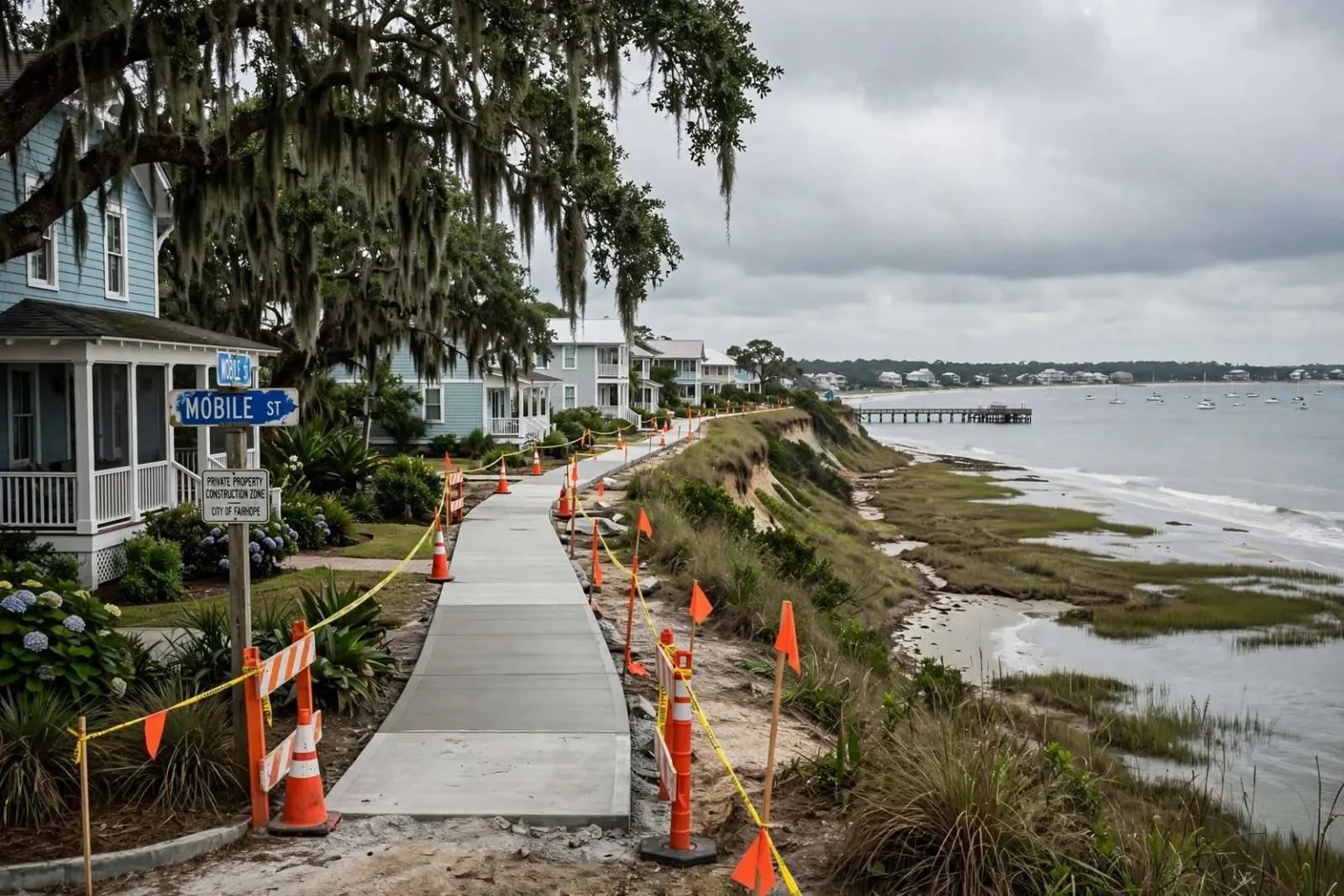
A Baldwin County judge has denied a Fairhope homeowner’s attempt to block construction of a public sidewalk behind his Mobile Street home, setting up an appeal to the Alabama Court of Civil Appeals in a long-running dispute over waterfront parklands along Mobile Bay. Special Baldwin County Circuit Court Judge George Elbrecht ruled last week against two post-trial motions filed by Fairhope resident Gene Warhurst, who had asked the court for relief from a previous judgment favoring the city and for a stay of construction on the sidewalk.
Elbrecht found that Warhurst had not shown the “exceptional circumstances” necessary to justify overturning the earlier ruling. Attorney Greg Buffalow, who represents Warhurst, his law partner, said the denial clears the way for the case to move to the state appeals court.
The hearing, held Friday, stretched roughly five hours as attorneys for Warhurst and the city sparred over the validity of a subdivision plat central to the case. The dispute traces back to Warhurst’s attempt to build a private pier next to the city’s White Avenue pier, which is deeded for public use.
The city sued, and Warhurst and five neighbors eventually reached a settlement allowing the city to build a sidewalk along land the residents contend was deeded to them by the Fairhope Single Tax Corporation in 1931. The land sits behind the homeowners’ properties along Mobile Bay.
According to Buffalow, the city subsequently subdivided the land and built a sidewalk that cuts through Warhurst’s and his neighbors’ backyards. Warhurst filed his most recent motions after discovering over the summer that the subdivision plat recorded by the city’s planning department did not match the plat the Planning Commission had approved on Dec. 2, 2013. During Friday’s hearing, Buffalow called Fairhope Planning Director Jonathan Smith to the stand and argued the subdivision plat the city has relied on is void because it was not recorded within the 60-day window required after Planning Commission approval.
Under cross-examination by City Attorney Tut Wynne, Smith acknowledged that he had signed the wrong plat. “It was placed in front of me two days after (Planning Commission approval),” Smith testified. “I didn’t look at it in great detail and signed it. The two plats look very similar.”
Wynne told the court the city intends to go back and correct the error. He said the plat mistakenly signed by Smith was the original version submitted by the engineering firm Preble-Rish. City Planner Nancy Milford later reviewed that plat, found several issues with it, and sent a letter back to the firm; Preble-Rish then submitted a revised plat, which the Planning Commission ultimately approved. Smith told Wynne the application was not typical, given that it stemmed from a complex lawsuit and an accompanying court order.
On redirect, Buffalow pressed Smith on the city’s planning regulations, including whether a 50-foot buffer zone is normally required on subdivided lots along the shoreline. Smith said it is. Buffalow then asked whether any notice sent to affected homeowners mentioned a waiver of that requirement; Smith said it did not.
Buffalow also raised a requirement that land considered a “park” must be at least three acres. Smith initially said he could not answer without the regulations in front of him, but after reviewing a copy already entered into evidence, he agreed the land in question appeared to fall short of that threshold, though he added he considered the three-acre figure “a guideline.”
Buffalow further argued that the individual lots created by the subdivision were smaller than typical and that some lacked access to a public right-of-way because they sit between a bluff and private homes — a requirement under the city’s planning regulations.
Smith agreed that, under normal circumstances, the land would not have been eligible for subdivision because it isn’t adjacent to a public right-of-way. Under questioning from Wynne, however, Smith said city planning regulations give the Planning Commission leeway for unique subdivisions.
“The subdivision layout was not something we’re used to seeing,” Smith said. “The size of the lots wouldn’t normally meet regulations. It’s unique that it’s on a bluff near the bay.”
Planning Commission member George Roberds also testified, telling the court the lots created in the subdivision are not typical of what the commission normally approves and that sidewalks are usually adjacent to a public right-of-way. Buffalow noted during questioning that Roberds’ own firm built the sidewalk at the center of the case.
Testimony also focused on the status of leases held by Warhurst and his neighbors with the Fairhope Single Tax Corporation. FSTC Secretary Leslie Stejskal testified that Warhurst and the five other affected leaseholders applied for new leases with the organization as part of their earlier settlement, with Warhurst paying $15,000 under a payment plan.
FSTC attorney Alan Chason asked Stejskal what would happen to those leases if the plat were found void. “The new leases will have to be recalled,” she said. “We’re going to be in a heck of a mess.”
Stejskal said the other five leaseholders have no objection to the sidewalk. She and Buffalow also disagreed over the location the settlement intended for the sidewalk, with Buffalow arguing the agreement called for an easement along the actual shoreline rather than on the bluff near the homes.
Stejskal countered that building on the shoreline itself was not practical and that there is room for differing interpretations of what “shoreline” means in the settlement. Buffalow maintained there is enough space along the shoreline to accommodate the sidewalk as originally intended.
With the post-trial motions denied, the case is now expected to proceed to the Alabama Court of Civil Appeals, where Warhurst and his neighbors will seek to overturn the underlying judgment that allowed the city to build the sidewalk.
About the Fairhope Single Tax Corporation
Fairhope was founded in 1894 as a “single tax” colony by followers of economist Henry George, who argued that land values, not labor or buildings, should be the main source of public revenue. The Fairhope Single Tax Corporation still owns a large share of land in the city. It leases the land to residents on 99-year renewable leases instead of selling it, and uses the rent to pay property taxes and fund community projects. That is why the status of the leaseholders’ agreements with the corporation became part of the sidewalk dispute.