University of South Alabama Mobile County
Federal Red Snapper Season Slashed to Nine Days, Sparking Outrage Along Alabama’s Gulf Coast
Federal regulators have cut the 2014 recreational red snapper season in the Gulf of Mexico to nine days, a move drawing sharp criticism from Alabama lawmakers, fishermen and a University of South Alabama marine scientist who blames the quota system itself.
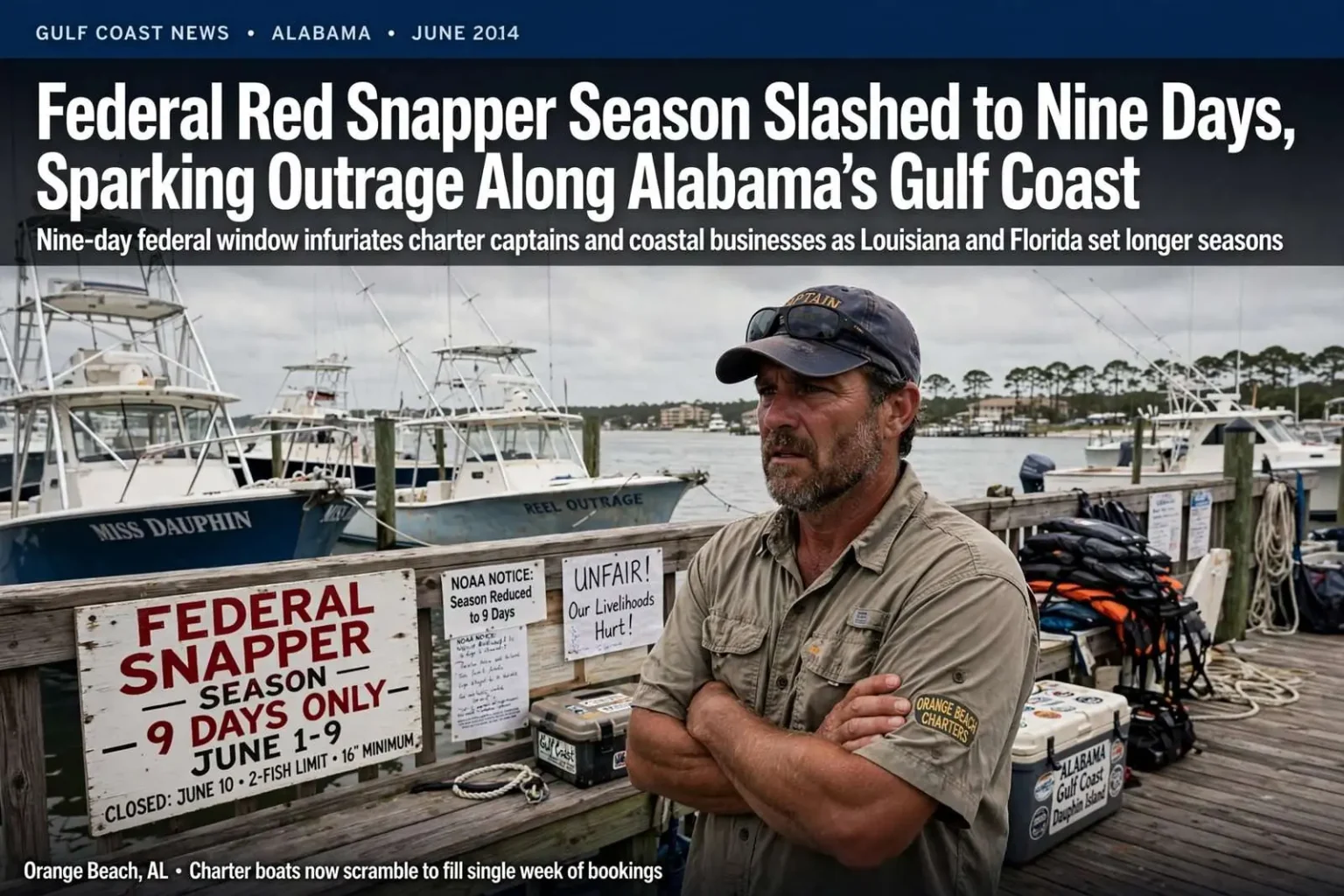
Federal regulators have cut the 2014 recreational red snapper season in the Gulf of Mexico to just nine days, a decision that has infuriated charter captains, recreational anglers and coastal business owners across Alabama’s Gulf Coast. The shortened season, announced by the National Oceanic and Atmospheric Administration, marks one of the tightest windows on record for private anglers hoping to catch the popular reef fish in federal waters.
The nine-day window is a dramatic drop from the roughly 40-day season Alabama fishing officials had projected as recently as late last year. In a single winter, the math behind the fishery changed, and with it the plans of hundreds of charter operators and thousands of anglers who measure their summer by the weeks they can run offshore for snapper.
The reduction comes after Louisiana and Florida both announced state-water seasons that will not align with federal rules. Louisiana plans to allow snapper fishing in its state waters for 265 days out of the year, while Florida, which has historically stuck close to federal guidelines, set a 52-day season of its own earlier this year. The gap between the neighboring states’ rules and the federal season has become a defining feature of the Gulf’s snapper wars, with each state claiming the latitude to manage the fish inside its own boundaries.
Alabama’s Gulf waters extend only a short distance offshore before anglers enter federal jurisdiction, leaving the state’s fishermen far more exposed to the shortened federal window than their neighbors. Because much of Alabama’s artificial reef habitat — the structure that draws snapper in numbers found almost nowhere else in the Gulf — sits within reach of small boats launched from Dauphin Island and Orange Beach, a short federal season bites harder here than in states where anglers can fish productive waters well inside the state line.
Despite the shorter season, the federal fishery will still open as scheduled on June 1. Anglers fishing in federal waters will continue to be held to a two-fish daily bag limit and a 16-inch minimum size requirement, both carried over from prior seasons.
The Anger on the Docks
Charter captains in Orange Beach and Dauphin Island read the announcement as the latest blow to a business that lives and dies by the calendar. A nine-day season, compressed into June, concentrates the entire year’s demand for a snapper trip into less than two weeks — crowding the ramps, straining the fleet, and leaving families who planned July or August trips with nothing to book. Coastal businesses that depend on the traffic a snapper season brings — bait shops, restaurants, marinas, tackle dealers — faced the same sudden contraction.
The cuts have also reignited a long-running fight over how NOAA calculates the health of Gulf red snapper stocks. Critics, including U.S. Rep. Bradley Byrne, argue the agency’s methodology dramatically understates the size of the snapper population and unfairly punishes Alabama’s coastal economy as a result.
“Alabama’s fishermen and coastal communities are being devastated by the federal government’s total inability to effectively regulate red snapper fishing,” Byrne said in a statement responding to the announcement. “Today’s development merely serves to highlight the fact that the federal regulatory framework is broken beyond repair.”
Byrne said the only lasting fix is to shift authority over the fishery away from federal regulators and give Gulf states control over managing their own snapper stocks. He noted that data gathered independently by marine scientists and working fishermen paints a far healthier picture of the snapper population than NOAA’s official assessments reflect, yet the federal agency’s numbers have repeatedly driven seasons shorter and quotas smaller in recent years.
The Court Ruling Behind the Cut
The current crunch traces back to a federal court ruling handed down in late March. U.S. District Judge Barbara J. Rothstein ruled against the National Marine Fisheries Service after finding that recreational anglers in the Gulf of Mexico had exceeded their share of the red snapper quota in six of the previous seven years. Rothstein’s order directed the Gulf of Mexico Fishery Management Council to take corrective action to offset those overages during the 2014 season, and with little time left before the season would normally open, an extremely short window emerged as the only practical way to comply.
The ruling placed the council in an unforgiving position. Federal law requires the council to hold recreational catch within its allocation, and a court order to make up for years of overage left only blunt instruments available: shorten the season, lower the bag limit, or both. Because the recreational quota is measured in pounds and counted after the fact, regulators cannot stop an angler mid-trip — they can only shape the window in which the fishing happens, and hope the total lands where the law requires.
A fresh assessment of the Gulf snapper population is currently underway and could be finished before the end of the year, but at least one member of the council overseeing the fishery isn’t convinced a new count will solve the underlying problem.
“Our Problem Is the Quota System”
Dr. Bob Shipp, chairman of the Department of Marine Sciences at the University of South Alabama and a member of the Gulf of Mexico Fishery Management Council, said the quota system itself, not the size of the snapper population, is driving the shorter seasons.
“This whole issue is insane,” Shipp said. “Our problem is the quota system. The healthier the stock, the quicker we blow through the quota. If the stocks were in trouble, we couldn’t meet the quota.”
Shipp explained that because red snapper in the Gulf have grown both larger and more numerous in recent years, anglers are able to reach the fishery’s weight-based catch limits far more quickly than the current rules anticipate, which in turn forces regulators to compress the season to keep the total harvest in check. A stock that recovers produces longer fish and heavier fish — and heavier fish burn through a poundage quota at a rate the quota’s designers never foresaw.
“Even if they raised the quota by 30 or 40 percent, that would only mean an extra four or five days,” he added. “There’s so many big fish, we’d still catch the quota in no time. We need to get away from this quota system.”
Shipp’s critique cuts to the central paradox of the Gulf snapper fight: by the federal government’s own accounting, the stock has been rebuilding for years, yet the reward for that recovery has been a shorter and shorter fishing year. Anglers and state managers argue that a healthier stock should mean more fishing; the federal framework, built around pounds landed within a fixed allocation, translates abundance into longer fish and a faster quota burn instead.
Alabama’s Position in the Fight
Alabama has argued for years that its artificial reef program makes its snapper fishery unlike any other in the Gulf. Since the 1950s, the state has deployed and permitted thousands of structures — culvert pipes, bridge rubble, deactivated Liberty ships, army tanks, and later specially designed reef pyramids — on the shelf off its coast, creating habitat that concentrates snapper within range of small center consoles. That concentration makes the fish easy to find and easy to catch, which is precisely what makes a pound-based quota burn so quickly when the season opens.
State fisheries managers have also pressed the argument that federal stock assessments survey broad stretches of Gulf habitat while largely missing the reef systems where Alabama’s fish live, producing population estimates that bear little resemblance to what anglers encounter on the water. The disagreement over data has become the engine of the broader dispute: state officials and congressional critics see assessments that lag behind reality, while federal managers defend the survey methods that set the quotas.
The states’ response has grown sharper as seasons have shrunk. Louisiana’s 265-day state season and Florida’s 52-day season signal a willingness to manage inside state boundaries on their own terms, and the same instinct runs through Alabama’s coastal politics. Proposals to give the Gulf states authority over red snapper out to nine miles — beyond the three-mile limit federal law recognizes — have circulated in Congress for years, backed by Gulf Coast delegations who argue that the states have better data, closer accountability and more flexible tools than the federal system allows.
Byrne’s call to shift authority to the states put Alabama squarely inside that camp. For Mobile and Baldwin county anglers, the pitch is simple: the people who live beside the fish, who run the reefs and staff the charter docks, will manage the fish better than an agency a thousand miles away working from surveys the fishermen do not trust.
What the Nine Days Mean
For now, Alabama anglers, charter operators and coastal businesses that depend on snapper season traffic are left planning around a nine-day window in June, with the broader fight over how the Gulf’s most popular reef fish is managed still far from resolved.
The economics of the compressed season fall unevenly across the coast. Charter boats that built their summer books around a season measured in weeks must now fit a year’s worth of snapper trips into a stretch of days, and those who cannot book that window lose the trip revenue entirely. Weekend anglers face ramp congestion, fuel prices that spike with demand, and a lottery-like scramble for open days when weather cooperates. Marina operators, bait houses and seafood restaurants that count on June traffic see the season’s economic footprint contract with the calendar.
The rule structure inside the window stays the same as recent years: two snapper per angler per day, sixteen inches at the minimum, and no fishing for the species in federal waters outside the open dates. Anglers who want more snapper than the window allows have few lawful options — state waters hold some habitat, but the bulk of Alabama’s reef system lies beyond the boundary, and the neighboring states’ longer seasons apply only inside their own lines.
Where the Fight Goes From Here
Three disputes now run in parallel over the same fish. The first is over data: whether the assessment now underway will produce numbers closer to what anglers see on the reefs, and whether federal managers will accept state-collected data in setting quotas. The second is over method: whether a pound-based quota tied to a fixed allocation can govern a fishery whose fish keep getting bigger, or whether the Gulf needs a different management tool altogether — a point Shipp pressed from his seat on the council. The third is over authority: whether the Gulf states should take over red snapper management inside a defined zone, as Byrne and other Gulf Coast lawmakers have proposed, or whether the fishery stays under federal law.
None of those questions will be answered by June 1. What the Gulf has instead is a nine-day season, a rebuilding stock that anglers describe as better than it has been in a generation, and a management framework both sides agree is failing — for opposite reasons. Federal managers see a quota system working exactly as designed, holding harvest to a court-ordered level. Fishermen and state officials see a system that punishes recovery, rewards bad data, and keeps shrinking the one thing Gulf families wait for all year.
The 2014 season will end the way the announcement said it would, in early June, almost before it starts. Whether the assessment due before year’s end changes the picture for 2015 — and whether the fight over state authority moves from proposals on paper to law — will determine whether the Gulf Coast’s snapper argument intensifies or finally finds a different way to count the fish.