

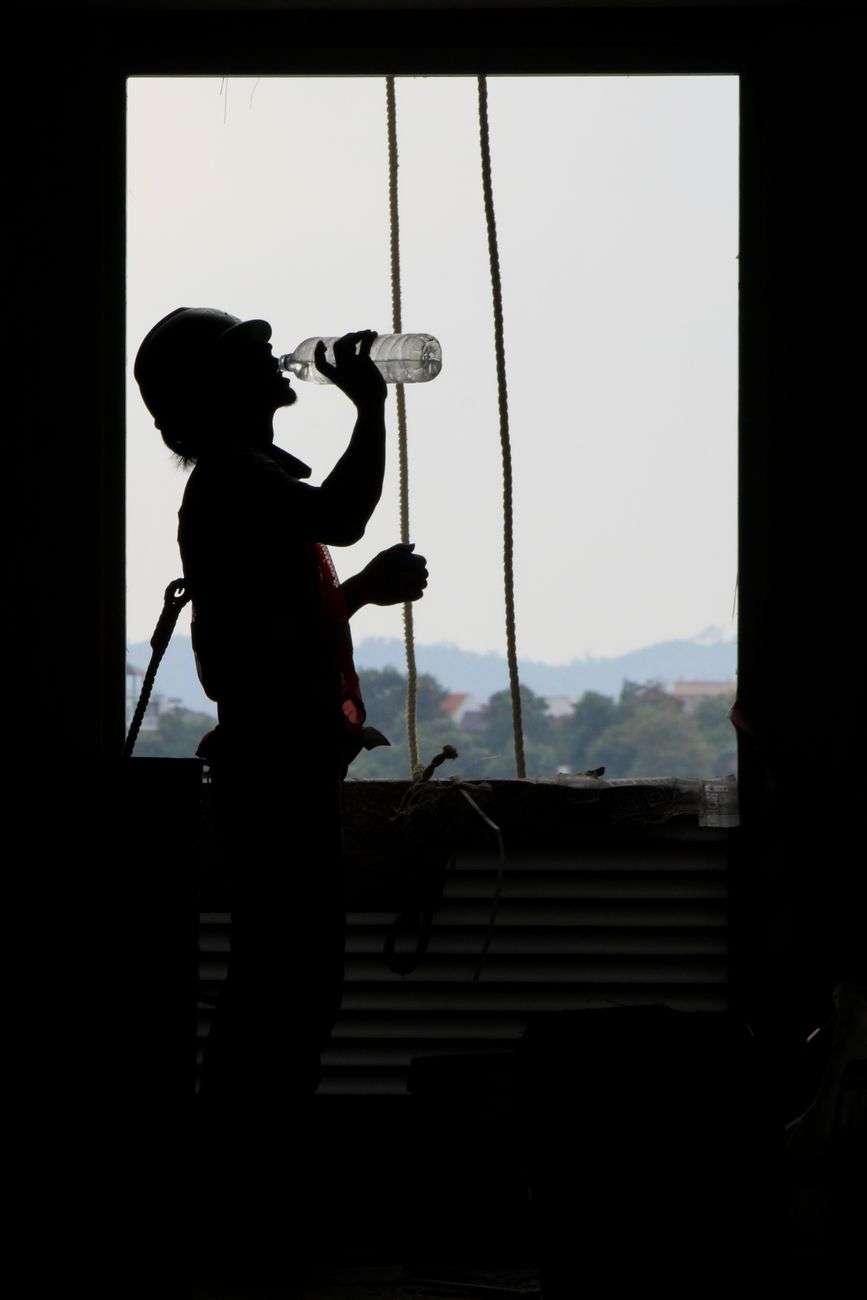
A wave of dangerous heat swept through a downtown Mobile job site Wednesday morning, sending at least five construction workers to the hospital and prompting a large-scale response from Mobile Fire-Rescue.
The mass casualty event occurred at the former downtown YMCA site on Water Street, where crews were rebuilding the structure under a punishing Gulf Coast heat wave. Workers had arrived as early as 3 a.m., hoping to complete as much physically demanding labor as possible before the sun and humidity reached their most brutal midday peak.
Even with that early start, the heat proved overwhelming. By mid-morning, paramedics and fire crews were treating multiple laborers for heat-related illness, with five requiring transport to area hospitals. Several additional workers were evaluated and treated on scene. Officials confirmed there were no fatalities.
What happened at the Water Street site
The former YMCA building on Water Street has been undergoing construction, and like many outdoor job sites across South Alabama this summer, crews have been racing the clock to avoid the most extreme afternoon temperatures. Despite the predawn start, the combination of high heat, thick humidity, and strenuous physical work proved too much for a number of workers, who began showing signs of heat exhaustion and possible heatstroke.
Mobile Fire-Rescue responded with a significant contingent of personnel and equipment, treating patients directly at the scene before transporting the most seriously affected workers to nearby hospitals for further evaluation and treatment.
A Mobile Fire-Rescue spokesperson described the scale of the incident as out of the ordinary, noting that while individual cases of heat exhaustion among outdoor workers are common during a Gulf Coast summer, having several people fall ill from the heat at the same site, at the same time, is unusual.
The designation of the response as a mass casualty event is a procedural marker rather than a measure of severity alone. When the number of patients exceeds what a normal response can handle, dispatch protocols bring in additional medic units, supervisors and support apparatus, which is what happened on Water Street as crews worked to evaluate every worker on the site.
A dangerous and sustained heat wave
The hospitalizations come amid what fire officials are calling an unforgiving stretch of summer weather, with heat and humidity combining to push the heat index well above what the body can shed on its own during heavy labor. Along the Gulf Coast, the true danger of a heat wave is rarely the air temperature alone. The region’s humidity prevents sweat from evaporating efficiently, which is the body’s primary cooling mechanism, so a worker who would manage a dry 95-degree day in another part of the country can be in serious trouble in Mobile at the same reading.
Heat-related illness progresses along a recognizable spectrum. Heat cramps and heat exhaustion come first, marked by heavy sweating, weakness, dizziness, nausea and headache. Heatstroke, the stage beyond that, is a life-threatening emergency in which the body’s cooling system fails entirely and core temperature climbs to dangerous levels. The five workers transported to hospitals Wednesday were believed to be suffering from conditions along that spectrum, with the most seriously affected sent for emergency treatment.
Fire officials have repeatedly urged employers and workers across the city to treat the warning signs seriously, because the difference between heat exhaustion and heatstroke often comes down to how quickly a worker is moved out of the heat, cooled down and given fluids.
Why construction sites are ground zero
Construction combines nearly every risk factor for heat illness at once. The work is heavy physical labor, often performed in direct sun on surfaces like concrete and asphalt that radiate heat upward. Workers wear long sleeves, hard hats and gloves for protection from other hazards, all of which trap heat. Rebuilding an existing structure adds enclosed and partially enclosed spaces where air movement is limited and radiant heat accumulates through the day.
The predawn start adopted at the Water Street site is one of the most widely recommended countermeasures in the industry. Shifting the workday to capture the coolest hours of the morning reduces exposure during the peak afternoon heat, when the heat index climbs highest. But even a 3 a.m. start only buys so much time. By mid-morning on a day like Wednesday, conditions on an active site can already exceed safe limits for sustained exertion, which is exactly the window in which the workers began to fail.
The rules that apply to employers
Federal workplace safety rules require employers to protect workers from recognized hazards, and heat is among the most clearly recognized. Federal safety investigators have repeatedly identified heat illness as a hazard that is entirely preventable when employers follow the basics: providing plenty of drinking water, giving workers regular breaks in shaded or air-conditioned spaces, allowing new workers to build up their heat tolerance gradually over a week or more, and training crews to recognize symptoms in themselves and their coworkers.
The practice known as acclimatization is a particular focus of safety experts. The body needs time to adjust to working in heat, and a disproportionate share of heat deaths nationally involve workers on their first days on a job. On a project like the Water Street rebuild, where crews and schedules can shift quickly, keeping new hires on a graduated workload during a heat wave is one of the most important protections an employer can provide.
Pairing workers so that each person watches for symptoms in a partner is another widely used practice, because heat illness can impair judgment before the affected worker realizes what is happening. Crews that speak up early, when a coworker first complains of dizziness or nausea, can prevent a medical emergency rather than respond to one.
What the response looked like
The scale of the Wednesday response reflected the number of patients rather than any single dramatic rescue. Medic units ferried the sickest workers to hospitals while other crews evaluated workers who were dizzy, cramping or exhausted but stable. Treating heat illness begins at the scene: patients are moved out of the sun, clothing is loosened, cooling measures are applied and fluids are given as the patient’s condition allows.
Hospitals across the city see a predictable rise in heat-related emergency visits during stretches like the current one, and not only from job sites. Roofers, landscapers, delivery drivers, warehouse workers and athletes all arrive in emergency rooms with the same diagnosis, and city officials use each spike to repeat the same warnings about hydration, shade and midday exertion.
The long Gulf Coast summer
South Alabama’s heat season is long by any standard. From late May into October, the combination of temperatures in the 90s and Gulf humidity routinely pushes heat index values past levels considered unsafe for sustained outdoor labor, and August typically brings the most punishing stretch of the year. The National Weather Service office serving Mobile issues heat advisories when the heat index crosses advisory thresholds, urging residents to limit outdoor activity, drink water before they feel thirsty, and check on those who work outside or lack air conditioning.
For the construction industry, those advisories shape scheduling decisions up and down the Gulf Coast. Contractors routinely move concrete pours and asphalt work to overnight hours, build midday rest periods into summer schedules, and station extra water and shade on sites. The workers at Water Street followed the playbook, arriving hours before sunrise to bank as much labor as possible in the cool window, and the fact that five still required hospital transport is a measure of just how extreme the conditions were on Wednesday.
Hydration guidance has also evolved in recent years. Safety experts now tell workers to drink water steadily throughout the shift rather than waiting until they feel thirsty, because thirst lags behind the body’s actual fluid loss. Drinks containing caffeine work against hydration, and heavy meals during a midday break add to the strain a hot afternoon puts on the body. On well-run sites, water coolers are placed within a short walk of every work area, because a water station too far away is a water station workers skip.
What happens next
The five workers transported to hospitals were expected to be evaluated and treated for heat-related illness, and officials said no fatalities were reported. The incident remains a reminder for every employer and crew working outdoors in the days ahead: the heat wave is not over, the afternoons are not getting cooler, and the precautions that failed to fully protect the Water Street crew are the same precautions that save lives when they are followed strictly and early.
City and fire officials urged residents to continue taking the heat seriously, to check on outdoor workers and elderly neighbors during the hottest hours, and to remember that heatstroke is a 911 emergency. In a Gulf Coast summer, the weather itself is the hazard, and the water, the shade and the midday break are not conveniences. They are the equipment that keeps people alive on the job.