Geneva County Commissioner Raises Alarm Over Unpermitted Flock Safety Cameras
Geneva County officials are questioning why the city of Slocomb installed a surveillance camera on county-maintained property without a permit, prompting a debate over privacy and government oversight.
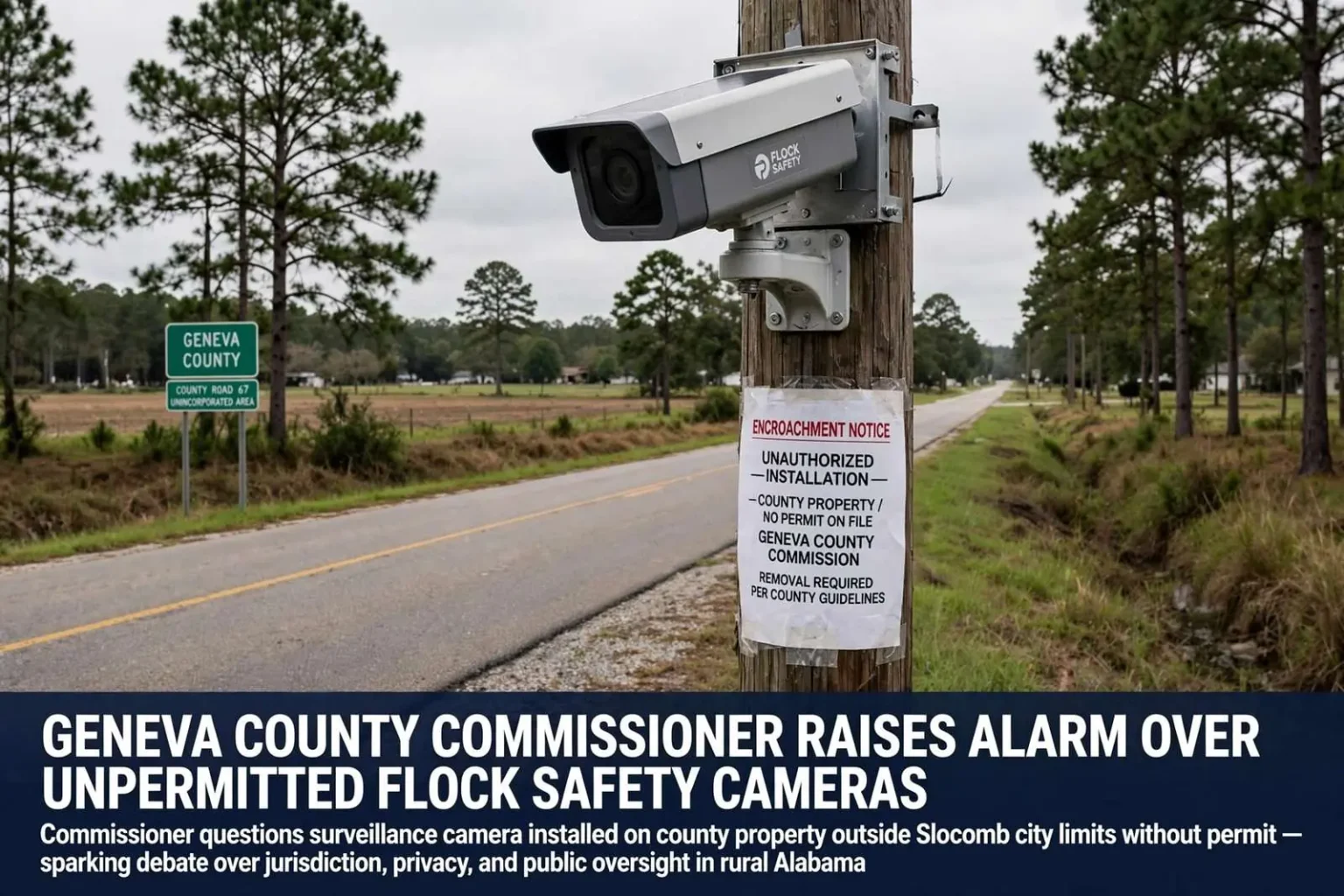
The Geneva County Commission has found itself at the center of a growing debate over surveillance technology after the city of Slocomb installed a Flock Safety camera on county-maintained property without securing a permit or the Commission’s approval. The dispute, aired publicly by one of the county’s commissioners, has raised questions about jurisdiction, transparency, and who gets to decide where automated cameras operate in rural Alabama counties.
How the Dispute Began
The camera was placed on county property in an unincorporated area outside Slocomb’s city limits, prompting the county to issue an encroachment notice. In practical terms, that means the device was mounted within a right-of-way or on other ground that the county maintains and controls, even though the land sits outside the municipal boundary of the city that installed it. An encroachment notice is the county’s formal way of flagging unauthorized use of public property and demanding that the installation be addressed.
Commissioner Weston Spivey said Slocomb should focus its public safety resources within its own city limits rather than installing surveillance equipment outside its jurisdiction. His argument gets at a basic principle of Alabama local government: municipalities generally exercise authority within their corporate limits, while the county commission governs unincorporated areas. A city extending its camera network beyond those limits, onto county ground, sits in a gray zone that the county was not willing to leave unaddressed.
County Rules on Surveillance Equipment
The county has established guidelines requiring approval before any surveillance equipment is placed on county property, a policy aimed at ensuring accountability and transparency. Those guidelines exist because devices mounted on public infrastructure — poles, towers, and rights-of-way maintained with public money — carry implications that go beyond the physical footprint of the equipment itself.
Spivey emphasized that county rights-of-way, which are maintained with taxpayer funds, should only accommodate items that serve important public purposes. Roads and roadside corridors are already put to many uses, from utility lines to signage, but each of those uses goes through a process. Allowing an unpermitted camera, he argued, cuts the public out of the decision about what belongs on public ground.
He also warned that allowing one unpermitted installation risks setting a troubling precedent for future requests. If the county looks the other way this time, the reasoning goes, other cities, agencies, or private interests may conclude that county approval is optional, and the commission would find it difficult to refuse the next request after letting the first one stand.
The Flock Safety Question
The camera at the center of the dispute is a Flock Safety unit, a type of automated license plate reader that has spread rapidly across communities of all sizes in recent years. The devices photograph vehicles passing their field of view, capture plate numbers, and can automatically alert police when a plate matches a vehicle connected to a stolen car report, a missing person case, or another investigation. Flock markets its systems heavily to small cities and counties precisely because they require little staffing to operate.
That convenience is exactly what has made the cameras controversial in many places. Privacy advocates and some local officials have raised concerns about the sheer volume of location data the devices generate — a record, in effect, of when and where ordinary residents drive. Spivey stressed the importance of transparency around what information the cameras collect, who has access to it, how long it is retained, and what oversight mechanisms are in place. Those are the standard questions that communities nationwide have asked as plate reader networks expand, and they are questions a county commission is well positioned to insist on before hardware goes up on public ground.
“Freedom Is Rarely Taken Away All at Once”
Spivey put his concerns in broader terms during the discussion. “Freedom is rarely taken away all at once,” Spivey said, calling for broader public discussion about the expansion of surveillance technology in the county. The remark framed the camera dispute not as a quarrel between two local governments but as a question the whole county should weigh: how much monitoring residents are willing to accept, and through what process that level gets decided.
He clarified that his opposition isn’t rooted in being anti-law enforcement, but rather centers on privacy, government accountability and adherence to established approval processes. That distinction matters in a rural county where support for law enforcement runs deep and where deputies, city police, and volunteer departments all rely on public goodwill. The commissioner’s argument was procedural as much as philosophical — that even tools used for good policing should follow the rules for what gets placed on public property.
He noted that many county residents intentionally choose to live outside municipal boundaries for a more rural, independent lifestyle. In Geneva County, as in much of south Alabama, the unincorporated countryside is home to people who specifically moved beyond city limits to be left alone, and those residents do not vote for city councils that make decisions about city equipment. A camera watching a county road was, in that light, a decision made about people who had no vote in it.
Why the Process Matters
Spivey said his responsibility includes representing taxpayers and ensuring that decisions involving public property are made lawfully and openly. The county’s permit requirement is not a barrier to public safety; it is the mechanism that ensures the commission, as the elected body accountable for county property, can examine where a device sits, what it does, and who answers for it before it starts collecting data.
The dispute also illustrates a friction point that has emerged in counties across the country as surveillance technology gets cheaper and easier to deploy. A single camera can be installed in an afternoon by a small city crew, but the questions it raises — about data storage, access by outside agencies, retention periods, and the boundaries of jurisdiction — are questions that deserve a deliberate public answer. County commissions, which control the roads and rights-of-way where such devices are mounted, have become the natural checkpoint.
What Comes Next
For Slocomb, the encroachment notice sets up a choice: seek the county approval that its guidelines require, relocate the camera within city limits, or remove it. Either of the first two paths could preserve whatever public safety benefit the city saw in the location while satisfying the commission’s demand for process.
For the county, the episode has already produced what Spivey called for — a public airing of how surveillance decisions should be made. Whether or not the camera stays, the case gives Geneva County a working precedent: equipment on county property requires county approval, and residents of unincorporated areas can expect that their roads and rights-of-way will not quietly become part of a city’s surveillance network without a vote and a discussion held in the open.
The conversation in Geneva County mirrors a debate underway in communities of every size, as automated readers, doorbell camera partnerships, and other monitoring tools spread. The difference here is that a rural county commission decided to draw its line early — at the moment a camera went up without permission — rather than after the network had grown too large to question.
Small Towns, Big Technology
The situation in Slocomb is a small-scale version of a decision that has faced city councils and county commissions across Alabama and the rest of the country in recent years. Flock-style cameras have been pitched as a force multiplier for small police departments that cannot staff around-the-clock patrols, promising automated alerts when a vehicle tied to a crime passes through town. Departments that use them credit the devices with helping recover stolen cars and locate suspects, and the systems are typically paid for through annual subscription contracts rather than large upfront costs, which makes adoption easy for even the smallest municipal budgets.
But the low cost of entry is also what lets installations outpace the public process. A subscription, a pole, and a mounting bracket are all it takes, and a city can have a functioning plate reader capturing traffic before any elected body beyond its own council has weighed in. Geneva County’s guidelines are an attempt to force that conversation at the county level, where the ground under the camera is controlled.
The County’s Role as Gatekeeper
County commissions occupy a particular position in Alabama government. They maintain the vast majority of rural road miles, they answer to voters who live outside any city, and they are often the only general-purpose government whose jurisdiction covers the unincorporated countryside. When Slocomb placed its camera outside the city limits, the commission was the government whose territory was being used, and its guidelines gave it the standing to object.
The encroachment notice is the mechanism that makes the objection official. By formally notifying the city that the installation violates county rules, the commission created a paper trail and a deadline for resolution, rather than leaving the matter to informal conversations. It also protects the county’s own exposure: equipment mounted on public rights-of-way can raise liability questions, and an unauthorized installation leaves the county with no record of who approved the device, who maintains it, or who is responsible if it fails.
Balancing Safety and Privacy
None of this means the camera will necessarily come down or that the two governments are headed for a lasting rift. Cities and counties cooperate on law enforcement constantly, sharing deputies, dispatch services, and equipment through mutual aid arrangements that have served rural Alabama well for decades. The question raised here is narrower: whether those cooperative instincts should extend to surveillance equipment placed on county ground without a permit.
Spivey’s position leaves room for exactly that conversation. His objections centered on process, transparency, and the rights of residents outside the city, not on the usefulness of the technology to police work. If Slocomb brings its request through the county’s approval process, the commission can weigh the public safety case alongside the privacy questions — data access, retention, and oversight — in an open meeting where county residents can hear the answers themselves.
That outcome would vindicate the guidelines the county already has on its books, and it would give both governments a template for the next request, which is likely to come as the technology continues to spread through the region’s small towns.