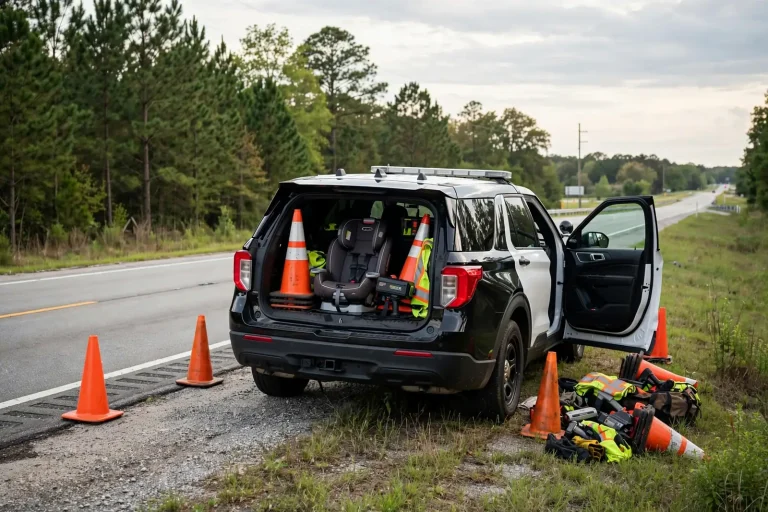
Grand Jury to Weigh Impersonation Case Against Mobile Mayor’s Son
A felony impersonation case against Mobile Mayor Sandy Stimpson's son will go to a grand jury after a judge found probable cause to proceed.
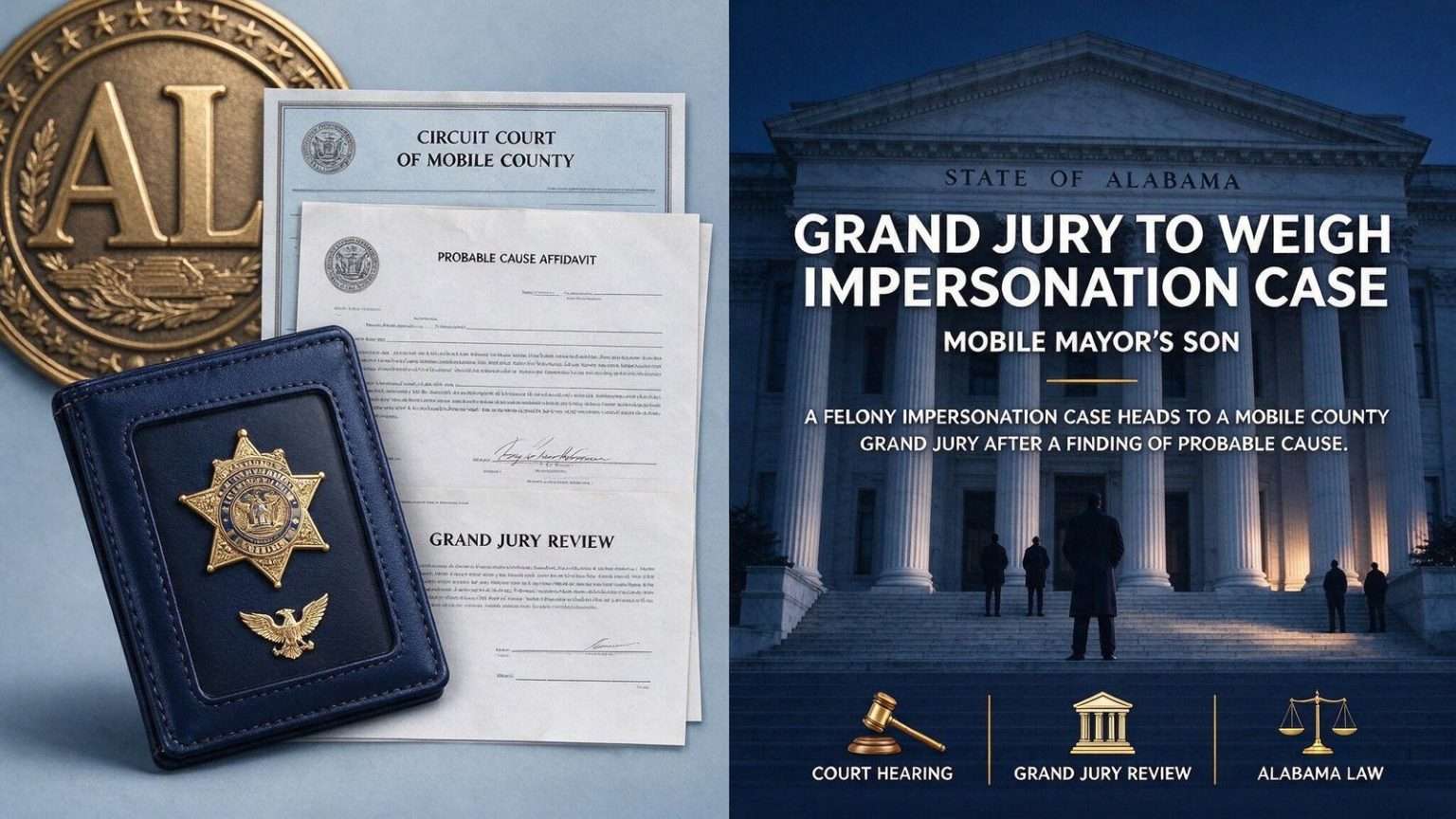
A felony case accusing the son of Mobile Mayor Sandy Stimpson of impersonating a police officer is headed to a grand jury after a judge found probable cause to move the charge forward this week.
Sands Stimpson was charged in May with impersonating a peace officer after showing an Alabama state trooper a deputy game and fish warden badge during a traffic stop on Bay Bridge Road. The trooper testified that Stimpson displayed a badge and identified himself as a “game and fish law enforcement officer,” but did not have the sworn officer identification card carried by certified law enforcement personnel.
Testimony at the hearing detailed how the trooper, suspicious of the discrepancy, contacted the state’s Wildlife and Freshwater Fisheries office and was told there was no record of Stimpson serving as a game warden. That phone call, prosecutors argued, turned a routine traffic stop into a felony case: the credential displayed during the stop did not match any active commission the state could find, and the difference matters under the law that forbids private citizens from holding themselves out as police officers.
What the deputy game warden program actually is
A district conservation officer who responded to the scene testified about the state’s deputy game warden program, which allows qualifying individuals to help protect game and fish on private property but does not grant them law enforcement equipment, badges or arrest powers. The program has existed for decades in Alabama, pairing landowners and sportsmen with the state’s wildlife agency so that hunting rules are observed on private tracts far from the districts where few conservation officers patrol.
That officer said he had previously administered the written test for the program to Stimpson but did not recall his face — an admission defense attorneys seized on, since it showed Stimpson had at least interacted officially with the program rather than fabricating a credential from nothing. The distinction between holding an old authorization and serving as a current, credentialed warden sat at the center of the hearing’s testimony.
Stimpson’s attorney argued there was no probable cause to support the charge, saying his client never identified himself as a police officer or acted in that capacity, and characterized the incident as a misunderstanding. The presiding judge acknowledged it may have been a misunderstanding but said it could have been avoided with more straightforward representation during the stop — reasoning that led to the finding that the case should proceed.
The mayor’s son and a very public arrest
The case drew immediate attention because of the defendant’s last name. Sandy Stimpson has served as Mobile’s mayor since 2013, and any felony case involving his family was certain to be scrutinized in a city where city hall and the police department work side by side. The mayor has kept his distance from the matter publicly, and the case has been handled through the normal channels — a state trooper’s arrest, a district court hearing, and now a grand jury review — rather than anything out of the ordinary.
Stimpson previously released a written statement along with a 2007 letter from a state wildlife official authorizing him to carry a deputy game warden badge, saying his commission applies to private property in Clarke County and that he is the third generation of his family to hold the designation. In the statement, he said he never represented himself as something he was not and that he behaved professionally during the stop, framing the episode as a good-faith interaction that escalated because of what the badge was assumed to mean rather than what was said.
The case will now proceed to a Mobile County grand jury, which will determine whether formal charges move forward.
How the grand jury stage works
A grand jury is not a trial. In Alabama, the panel — a group of county residents seated by a circuit judge — hears a prosecutor’s summary of the evidence and decides only whether probable cause exists to return an indictment, the formal charge that allows a case to proceed toward trial. Defense attorneys are not permitted to present witnesses, and the standard of proof is far lower than the beyond-a-reasonable-doubt standard a trial jury would apply.
For Stimpson, the grand jury stage means prosecutors from the Mobile County District Attorney’s Office will lay out the trooper’s account, the conservation officer’s testimony about the deputy warden program, and the paperwork surrounding the 2007 authorization. The panel’s options are straightforward: return an indictment on the impersonation charge, decline to indict, or in some circumstances issue a lesser charge if the evidence points that way. Grand juries in Mobile County meet in scheduled terms, so the decision will come on the panel’s calendar rather than the court hearing’s.
Impersonating a peace officer is a felony under Alabama law, reflecting the legislature’s judgment that citizens who claim police authority — even briefly, even during a traffic stop — create risks that the state cannot tolerate, from fraudulent stops to tainted investigations. Prosecutors will have to show more than possession of a badge; the question will be what Stimpson said and did, and whether a reasonable trooper could believe he was being told he was dealing with a fellow officer.
The law behind the charge
The statute at issue is aimed at conduct that undermines public trust in law enforcement. Impersonation cases in Alabama have ranged from fake traffic stops to unauthorized “rescue” interventions, and courts have treated the display of a badge or uniform as evidence that a defendant was presenting himself as an officer, even without an explicit verbal claim. That is why the trooper’s recollection of the words used during the stop matters so much — and why the defense has pressed the point that “game and fish law enforcement officer” was a description of a private commission, not a claim of police authority.
The Wildlife and Freshwater Fisheries Division, part of the Alabama Department of Conservation and Natural Resources, keeps the records of who holds commissions and under what terms. The discrepancy the trooper uncovered — no record of Stimpson serving as a game warden, against a badge carried under a 2007 letter — will likely be documented in the state’s file when the grand jury reviews the case. The age of the authorization, and what it permitted on private property in Clarke County versus what it permitted on a public highway, are the two questions the paperwork will be asked to answer.
What to watch next
If the grand jury indicts, the case moves to circuit court for arraignment and, eventually, trial — a process that would keep the matter in public view well beyond the current news cycle. If the panel declines, the case ends there, as most do at that stage, and the episode becomes a cautionary tale about the gap between an old commission and a current credential.
Either way, the hearing has already clarified the terrain: the state does not dispute that Stimpson once held a deputy game warden authorization, and the defense does not dispute that a badge was shown. What remains contested is meaning and intent — whether a misunderstanding about an outdated credential amounts to a felony, or whether, as his attorney argued, it was simply a stop that spiraled because nobody on the roadside knew what a deputy game warden badge actually was.
The traffic stop on Bay Bridge Road
The stop itself happened on Bay Bridge Road, the strip of highway that runs along the Mobile Bay causeway connecting Mobile to the Eastern Shore — a corridor troopers patrol constantly and where speed enforcement stops are routine. What was not routine was the credential produced when the driver was asked for identification. Rather than simply handing over a license, Stimpson showed a metal badge identifying him as connected to game and fish enforcement, setting off the chain of questions that ended with a felony charge.
Troopers are trained to verify any claim of law enforcement status on a stop, both for their own safety and because impersonation is a known tactic in traffic-stop ambushes across the country. The verification call to Wildlife and Freshwater Fisheries headquarters followed that training: if a driver claims warden status, the state can check in minutes whether the commission is real and current. In this case, the answer came back negative, and the arrest followed.
The interaction between a state trooper and a local official’s family member also crossed jurisdictional lines that made the case awkward from the start. The arresting agency was the Alabama Law Enforcement Agency’s highway patrol division, not Mobile police, keeping the city’s own department out of the arrest decision entirely — a separation that mattered given the defendant’s relationship to the mayor who oversees that department.
A family legacy in Clarke County
The deputy game warden commission Stimpson pointed to runs in his family. In his statement, he noted he is the third generation of the Stimpson family to hold the designation, tied to private property in Clarke County, the heavily forested county north of Mobile where the family’s land interests have long included timber and recreational tracts. In rural Alabama, such commissions were once common among large landowners who wanted standing to enforce hunting rules against poachers on their own acreage.
The program’s terms, though, have narrowed over the years, and the conservation officer’s testimony underscored the limits: deputies may assist in protecting game and fish on private property, but they are not equipped, badged or empowered as law enforcement in any general sense. A 2007 letter authorizing a badge, eighteen years before a traffic stop, is precisely the kind of document whose meaning changes with time and context — current when signed, ambiguous at a roadside encounter.
That gap between what the commission once meant and what the badge now signifies is likely to frame whatever the grand jury hears. The state’s position is that the gap itself is the problem: a citizen cannot carry a badge that implies police authority on a public highway, whatever its vintage. The defense’s position is that a family legacy, honestly displayed and honestly described, is not impersonation — and that the trooper’s assumption, not Stimpson’s statement, created the misunderstanding the judge said could have been avoided with more straightforward representation.