Mobile Council Committee Debates Infrastructure Spending Priorities
A Mobile City Council finance committee sparred over which infrastructure projects should be shared citywide as a $63 million capital plan takes shape.
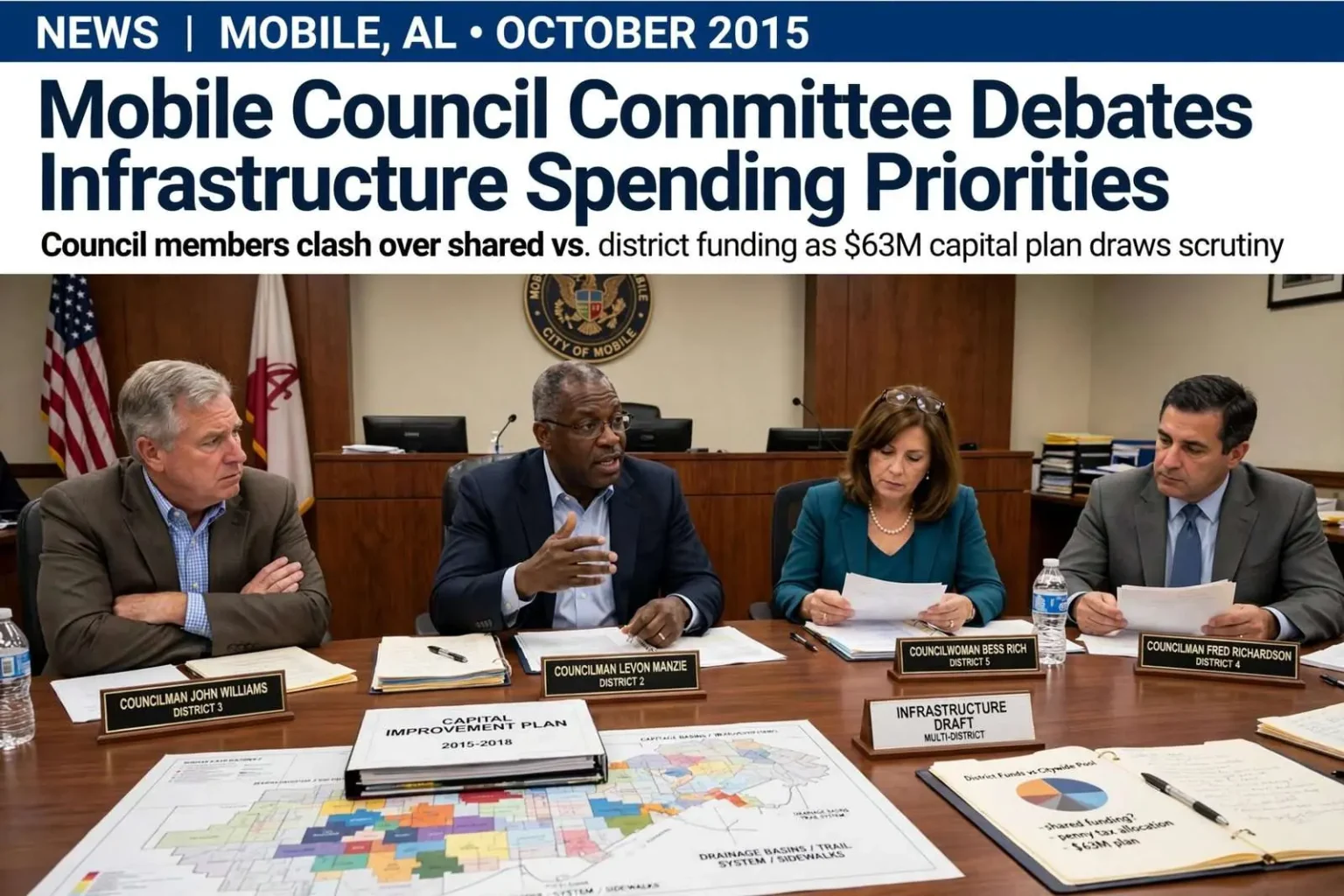
A finance committee of the Mobile City Council spent part of this week hashing out the fine points of a multi-year infrastructure overhaul, and not every council member liked what they saw in the latest draft. The city is paying an outside consulting firm up to $600,000 to help carry out a $63 million capital improvement plan expected to stretch into 2018, the largest infrastructure investment the city has made in years. Council members previously voted to direct proceeds from a penny sales tax toward sidewalks, road repairs and other basic infrastructure needs, but Tuesday’s meeting focused on a thornier question: which projects should be funded citywide rather than charged to an individual council district.
The distinction matters because the penny tax money is divided among the council’s seven districts, and every dollar assigned to a multi-district project is a dollar unavailable for the potholes, drains and sidewalks in a member’s own backyard. That arithmetic turned a routine review of the draft plan into a running negotiation over fairness, geography and the meaning of the word “shared.”
Councilman Levon Manzie, whose district includes several of the city’s museums and Ladd-Peebles Stadium, argued that upkeep costs for shared civic assets should be spread across all districts rather than falling on his alone. He pointed to a draft plan that listed funding for a citywide trail system, park signage, security cameras and soccer field upgrades as multi-district projects, and said stadiums and museums used by the whole community deserve the same treatment. In his view, a family from any district that attends a game at Ladd-Peebles or visits a downtown museum benefits from facilities his district helps house.
The Counterargument: Runoff Doesn’t Respect District Lines Either
Not everyone agreed with how far that logic should extend. Councilman John Williams countered that stormwater drainage improvements benefiting multiple districts could just as easily be classified as shared costs, noting that runoff from several districts flows through his own. Drainage basins, Williams’s point made clear, pay no attention to the maps drawn on the council chamber wall; water that falls in one member’s district ends up flooding ditches and pipes in another’s. If museums and stadiums qualify as shared assets because people cross district lines to use them, drainage infrastructure arguably qualifies for the same reason.
The exchange illustrated why capital improvement planning is as much politics as engineering. Every category of project — streets, parks, public safety equipment, drainage — can be described as serving one district or many depending on where the accounting line is drawn, and each drawing of the line shifts millions of dollars between neighborhoods. The consulting firm’s draft is meant to give the process a technical foundation, but the final calls rest with elected officials who answer to specific constituencies.
Councilwoman Bess Rich raised concerns about revisiting how the city financed earlier signature projects, including bonds issued for the GulfQuest National Maritime Museum and the Alabama Cruise Terminal, warning that neglecting maintenance on big-ticket investments would only create bigger problems down the line. Her point was aimed at a familiar pattern in municipal budgeting: new buildings get ribbon cuttings while the money to maintain them competes with everything else for scarce operating funds.
Looking to BP Money to Close the Gap
Councilman Fred Richardson suggested tapping money from a pending settlement with BP tied to the 2010 Gulf oil spill to help close funding gaps. City officials confirmed a tentative settlement agreement had been reached in principle, giving Mobile a potential stream of money separate from the penny tax that could relieve pressure on the capital plan. Richardson’s suggestion reflects a broader hope along the Gulf Coast that spill-related compensation can fund projects, like drainage and waterfront infrastructure, that local budgets have long deferred.
The BP discussion carries real weight for a city like Mobile. The 2010 spill damaged the tourism and seafood economies of the entire Gulf region, and the legal settlements that followed were designed in part to repair economic and environmental damage beyond the immediate shoreline. Money dedicated through those frameworks typically comes with rules about how it can be spent, which is why city officials and council members were careful to describe the funds as a possibility rather than a promise.
Why the Penny Tax Changed the Conversation
Before the council committed the penny sales tax to infrastructure, capital projects in Mobile lived at the mercy of the annual operating budget, competing with public safety, parks and everything else in years when revenue was tight. Dedicating a recurring revenue stream to sidewalks and roads changed that, giving the city its first dependable pipeline for work that had been deferred across multiple budget cycles. The $63 million plan that grew out of the decision is the largest such commitment the city has made in years, which is precisely why its allocation details are being fought over line by line.
The consulting firm’s role is also a departure from past practice. Rather than assembling the project list entirely inside City Hall, the city is paying up to $600,000 for outside help with the plan, a decision that buys professional assessments of street conditions, sidewalk gaps and drainage needs across all seven districts. That outside analysis is meant to blunt accusations of favoritism, though as this week’s debate shows, no analysis can settle the underlying question of which projects count as shared.
Residents watching the process should understand what citywide funding means in practice. A project charged to the citywide pool draws on money every district might otherwise claim, so each such project effectively spends a slice of every district’s allocation. Multi-district designations in the current draft include the trail system, park signage, security cameras and soccer field upgrades — items that serve residents across the city but sit physically in particular places.
Manzie’s Case for Shared Civic Assets
The argument at the center of Manzie’s position is that the city’s civic institutions function as a shared inheritance. Ladd-Peebles Stadium has hosted high school football championships, college games and community events for decades, drawing crowds from every corner of Mobile County. The museums clustered in Manzie’s district serve school groups and tourists alike. If the stadium needs a roof repair or a museum needs a systems upgrade, he argues, charging that cost solely to the district where the building sits taxes one neighborhood for a facility everyone uses — and drains the district’s penny tax share away from its own streets and sidewalks in the bargain.
The draft plan’s treatment of other amenities sharpens the comparison. A citywide trail system and soccer field upgrades are being counted as multi-district projects, and Manzie’s question is essentially one of consistency: why should a soccer field be shared but a stadium not? Critics of his view could answer that stadiums and museums carry dedicated revenue and boards of their own, while neighborhood parks and fields do not. That debate — between facilities that generate their own support and those that depend entirely on city money — is likely to recur as the plan moves forward.
Rich’s Warning About Deferred Maintenance
Bess Rich’s concerns reach beyond the current allocation fight to a structural habit of city government. Bond issues financed GulfQuest and the cruise terminal, and those debt payments now occupy fixed lines in the budget. If the city treats the buildings those bonds created as someone else’s maintenance problem, she warned, the eventual repair bill arrives larger and more urgent than a steady schedule of upkeep would have cost. Municipal finance experts make the same argument routinely: deferred maintenance compounds like unpaid interest.
Her warning lands at a moment when Mobile has invested heavily in waterfront and downtown amenities as part of its economic development strategy. The cruise terminal’s difficult history and GulfQuest’s rocky opening are cautionary examples in local memory of what happens when ambitious projects meet thin operating support. Applying that lesson to the $63 million plan means resisting the temptation to fund only visible new construction while letting existing assets quietly deteriorate.
What Comes Next for the Plan
The committee’s work continues as the consulting firm refines project costs and the council weighs the citywide-versus-district question item by item. The plan stretches into 2018, meaning the decisions made in these sessions will shape construction schedules and street resurfacing crews for years. Whatever allocation formula the council settles on will also set a precedent for how the city handles the next windfall, whether it comes from BP-related funds or future revenue.
For residents, the practical stakes are visible at the curb: whether the sidewalk in front of their house makes the list, whether the drainage ditch that floods after a heavy rain gets re-engineered, and whether the stadiums, museums and parks they use are maintained with citywide money or district-by-district spare change. Those outcomes will be decided not in one dramatic vote but in the accumulating compromises of committee meetings like Tuesday’s, where a $63 million promise gets translated into specific streets and specific projects.