Company Agrees to $1.3 Million Payout Over 2011 Mobile River Oil Spill
A company has agreed to pay more than $1.3 million in penalties and restitution for a 2011 fuel-oil spill that closed part of the Mobile River and killed wildlife.
A company that once operated a fuel storage facility in Mobile has reached a plea agreement requiring it to pay more than $1.3 million in criminal penalties and restitution stemming from a 2011 spill that sent thousands of gallons of fuel oil into the Mobile River. The resolution, entered in federal court, closes a case that has stretched on for years and offers a measure of accountability for one of the more visible industrial accidents on the lower Mobile River in recent memory.
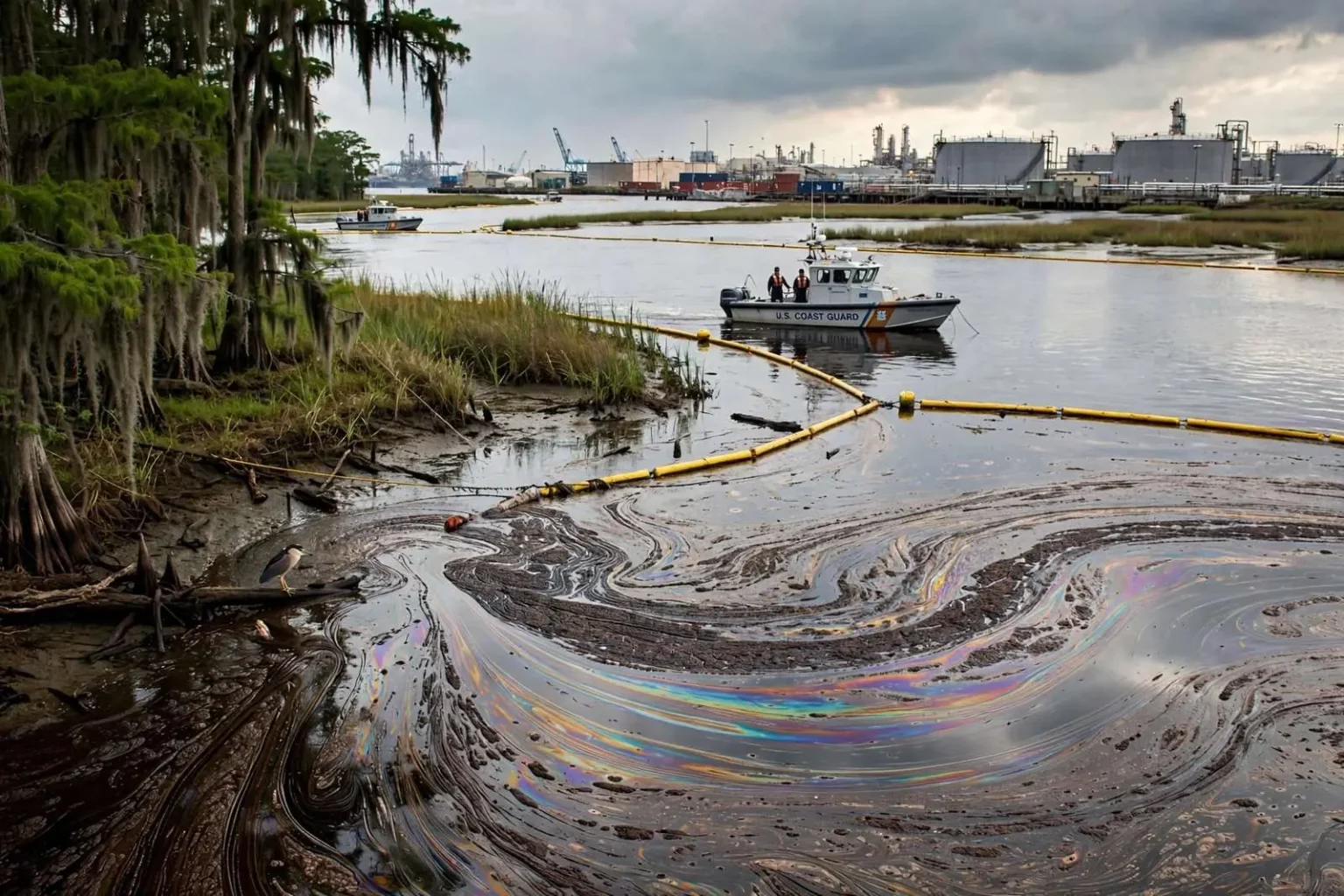
According to federal court documents, the incident occurred in September 2011 when employees miscalculated available space in a storage tank during a routine transfer, causing a receiving tank to rupture. What began as an ordinary fuel movement at the storage terminal quickly became an emergency. An estimated 6,000 gallons of fuel oil escaped into a containment area before ultimately reaching the Mobile River through a series of drainage canals that connect the industrial waterfront to the waterway itself.
A River Closed to Traffic
The spill forced the U.S. Coast Guard to close nearly five miles of the lower Mobile River to ship and vessel traffic for 18 hours while crews worked to contain the damage. The closure was no small matter on a river that serves as a working artery for the Port of Alabama — one of the busiest deepwater ports on the Gulf of Mexico — carrying barge traffic, cargo ships and service vessels through the heart of Mobile’s industrial district. Even a single day of restricted navigation carries real costs for terminals, towboat operators and shippers up and down the channel.
Containment crews deployed boom to trap the oil and worked to keep the product from spreading farther downriver toward Mobile Bay. Spill response on the Mobile River is complicated by the waterway’s current, its tidal mixing and the sheer number of docks, slips and industrial outfalls along its banks, all of which give escaping product places to hide and complicate recovery efforts.
Wildlife officials confirmed that several animals died as a result of oil exposure, including two laughing gulls, a black-crowned night heron and at least one Alabama redbelly turtle, a species found primarily along the Gulf Coast. The Alabama redbelly turtle, which favors the fresh and brackish waters of the Mobile-Tensaw Delta, has long concerned conservationists because so much of its range sits in the path of the region’s industrial and shipping activity.
The Terms of the Plea Agreement
Under the plea agreement reached in federal court, the company agreed to pay roughly $1 million in criminal penalties, split between a direct fine and a community service payment earmarked for the National Fish and Wildlife Foundation to fund waterway and wildlife restoration projects across the region. The foundation, a congressionally chartered nonprofit that pairs public agencies with private donors, channels such payments into on-the-ground restoration work rather than general government coffers.
The company also agreed to pay restitution to the U.S. Coast Guard for its response costs, along with a separate payment to the Alabama Department of Conservation and Natural Resources’ wildlife division. Those payments are meant to make the government and the public whole for the direct expenses of the response — vessels, personnel, equipment and monitoring — and for the harm done to natural resources the state holds in trust.
The company no longer operates in Mobile and is now based solely out of state, a fact that underscores how the industrial landscape along the river has shifted since 2011 as terminals and storage operations have changed hands or consolidated elsewhere.
How the Case Was Built
The case was investigated jointly by the U.S. Environmental Protection Agency’s criminal enforcement division and the U.S. Fish and Wildlife Service, and prosecuted by the U.S. Attorney’s Office for the Southern District of Alabama. Criminal referrals of spill cases typically turn on whether operators followed required procedures: investigators reconstruct tank gauging records, transfer logs and training files to determine whether the overflow resulted from a simple mistake or from shortcuts that made a mistake inevitable.
Federal officials said the case underscores the consequences of failing to follow safety procedures at industrial facilities along the river, which supports both commercial shipping and sensitive wildlife habitat. Officials noted that operators who fail to follow required safety procedures and equipment protocols not only harm natural resources and communities, but also break the law — a point prosecutors in spill cases throughout the Gulf region have made repeatedly in the years since the 2010 Deepwater Horizon disaster raised the stakes for petroleum handling everywhere along the coast.
Officials say the restoration funding from the settlement will support ongoing efforts to protect waterways in and around Mobile in the years ahead. Payments of this kind have gone toward shoreline stabilization, habitat projects and monitoring in the Mobile-Tensaw Delta and along the river corridors that feed Mobile Bay, work that continues long after the cleanup crews and news coverage have moved on.
Why the Mobile River Matters
The Mobile River sits at the bottom of the fourth-largest river system in the United States by flow, collecting water from the Alabama, Tombigbee and Black Warrior rivers before it discharges into Mobile Bay and, eventually, the Gulf of Mexico. Everything that goes wrong upstream — every spilled product, every mishandled transfer — eventually moves through the same funnel. That geography is the reason the river’s industrial waterfront and the delta’s wetlands exist in such close and sometimes uneasy proximity.
The delta just north of the city is one of the largest expanses of tidal marsh and cypress-tupelo swamp in the country, and biologists have catalogued hundreds of species of fish, birds, reptiles and plants there. The Alabama redbelly turtle that died in the 2011 spill is emblematic of what is at stake: a creature whose survival depends on the same waterways that industry uses daily. Balancing the two — commerce and habitat — is the central management challenge of the lower Mobile River system.
For the terminals and tank farms that line the river, the case is a reminder of the operating environment they work in. Tank overfills are among the most common incidents in bulk liquid storage, and the industry standard practices that prevent them — level alarms, independent high-level shutoffs, pre-transfer calculations and clear communication between the transferring and receiving operators — exist precisely because a miscalculation like the one in September 2011 has consequences measured in miles of closed river, dead wildlife and more than a million dollars in penalties.
What Residents Should Take From the Settlement
For people who live and work around Mobile, the plea agreement resolves a case that began with an odor of fuel over the river in September 2011 and ends with funding directed at the waterways the spill touched. The direct fine punishes the violation, the Coast Guard restitution repays the public cost of the response, the wildlife payment compensates harm to state resources, and the community service payment through the National Fish and Wildlife Foundation turns part of the penalty into restoration work that residents will be able to see in the delta and along the river for years.
The case also illustrates how environmental enforcement works in practice on the Gulf Coast. A spill that lasts hours can take years to resolve in court, involving multiple federal and state agencies with different claims. When the payments are finally made, most of the money returns to the water and the wildlife affected — a cycle designed so that the cost of a spill ultimately pays for repairing what the spill damaged.
A History of Industrial Incidents on the River
The 2011 fuel oil spill was not an isolated event in the river’s history. The lower Mobile River and its approaches have seen a string of incidents over the decades — barge collisions, tank overflows and transfer mishaps — that shaped the modern regulatory framework now in force along the waterfront. Federal rules adopted after the Exxon Valdez disaster require spill prevention plans, secondary containment and regular drills for facilities that store oil above threshold quantities, and the Coast Guard’s Captain of the Port holds authority to close the river exactly as it did in September 2011.
What made the 2011 case unusual was not its size — spills of comparable volume have occurred elsewhere on the Gulf Coast — but the path the product took to the water. Containment areas around storage tanks are designed to hold a tank’s full contents in the event of a rupture, and they worked as intended here at first. The failure came when fuel escaped the containment area through a series of drainage canals, which is precisely the pathway that operators are required to manage with valves, plugs and inspection routines. That detail is what elevated the incident from an industrial accident with a cleanup bill into a federal criminal case.
The closure of nearly five miles of the river also illustrated the operational weight of the Coast Guard’s role in Mobile. Sector Mobile oversees waterways that stretch from the delta to the Gulf, and its response posture on the river involves not just pollution responders but also vessel traffic management, since tugs, barges and cruise vessels must be held, rerouted or anchored while a spill zone is active. Eighteen hours of closure in 2011 was a manageable disruption by port standards, but it demonstrated how quickly an incident on the river ripples through schedules that span the entire Gulf.
The Longer Cleanup Ledger
For the agencies involved, the payments in the plea agreement close the legal account but not the ecological one. Oil that reaches a tidal river does not simply disappear with the boom; residue settles into sediments, collects along riprap and pilings, and can resurface after high water for months afterward. Monitoring teams from the state wildlife division track such effects as part of the damage assessment process, and the restoration payments are sized, in principle, to cover both the response costs and the longer-term harm.
Local environmental groups have long pointed to cases like this one when arguing for stronger inspection presence along the waterfront, particularly as tank farms age and shipping traffic grows with port expansions. The practical lesson the federal officials drew from the 2011 spill — that routine transfers demand the same discipline as unusual operations — is one the agencies hope stays with every operator on the river, because the alternative is measured in the currency this case made explicit: dead wildlife, closed waterways and a seven-figure bill paid years after the mistake was made.