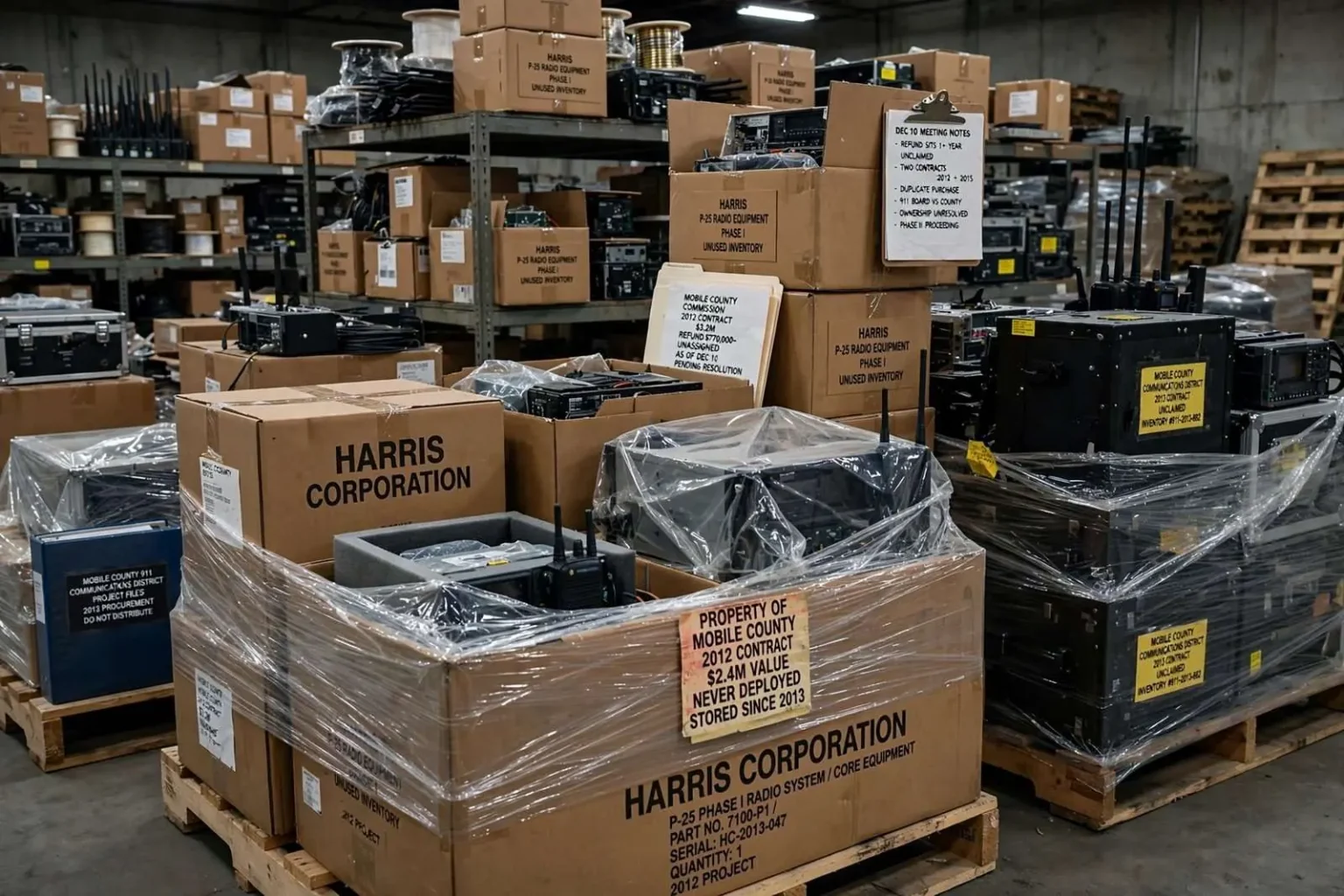
Attorneys for the Mobile County Commission and the Mobile County Communications District, the local 911 board, are trying to work out what to do with a $770,000 refund that has sat untouched in the bank for more than a year, money returned from a $3.2 million project the county awarded to Harris Corporation back in 2012. The refund — and a related pile of equipment valued at roughly $2.4 million that nobody has ever put on the air — has become the sticking point between two public bodies that both claim a stake in the region’s emergency radio future.
“Nobody has ever used the [Mobile County] system or made any connectivity to it,” Selvaratnam said. “Somewhere, somebody dropped the ball. So now that system is no longer needed, and what you’re building today is an upgraded system to what you’ve already bought.” His assessment reduced years of planning and millions of dollars to a blunt conclusion: the Phase I equipment bought for Mobile County never went into service, and the region is now building a newer system on top of a foundation that was never switched on.
The county’s position has rested on the contract it signed and the money it spent in 2012: the refund came back to the county’s project, and the equipment purchased under the county’s award sits in the county’s possession. The board’s position has emphasized that the duplicated 2013 purchases were made with 911 fee revenue, that the equipment was bought to serve the region’s responders, and that a system no one has ever used should not simply revert to the county without accounting for how the failure occurred.
Regional interoperability failures are a familiar chapter in American public safety communications. The communication breakdowns during major disasters — most famously the response to the September 11 attacks — drove federal funding into regional radio projects for a decade, and the results have been mixed across the country: some regions achieved seamless shared networks, while others, like Mobile and Baldwin’s first attempt, bought the hardware and never completed the connection. The lesson repeatedly drawn from those experiences is that governance and coordination, not procurement, are the hard part.
For the county commission, the Dec. 10 discussion was partly a matter of accounting and partly a matter of principle. A refund that sits in a bank account for more than a year is money the county’s finance office cannot simply leave unassigned, and commissioners have pressed for a resolution that closes out the 2012 project’s finances cleanly. The commission’s attorney has been negotiating with the board’s counsel to define what happens to the refund and to the duplicated equipment, with options that range from transferring gear to the Phase II project to liquidating it, crediting the board, or splitting the value between the two bodies.
The refund became the focus of a lengthy discussion at a Dec. 10 meeting that ultimately ended with 911 board member Trey Oliver walking out. The walkout underscored how far apart the two sides had drifted, even though both agree on the underlying facts: the equipment was bought twice, the system it was meant to serve was never connected, and somebody has to decide who owns the results of a project that never accomplished its purpose.
Baldwin County used its share to install a server supporting its P-25 Phase I radio system, which Commissioner Skip Gruber said allowed the county’s various public safety agencies to operate on one unified system. Baldwin’s move onto a common digital platform meant that sheriff’s deputies, municipal police, fire departments and emergency medical crews in Alabama’s fastest-growing county could coordinate on the same network instead of juggling incompatible radio fleets.
The irony at the center of the dispute is hard to miss: federal money meant to knit two counties’ responders together produced a completed system in Baldwin and a warehouse full of unused equipment in Mobile County, and the replacement effort — far larger than the original — is now the region’s real path to shared communications. The $770,000 refund and the $2.4 million in never-used gear are the physical residue of that first, failed attempt.
Harris Corporation, the vendor at the center of both contracts, is one of the country’s largest suppliers of public safety communications equipment, and P-25 systems of the kind purchased in the two contracts are the standard digital platform for large public safety radio networks across the United States. The refund the county received came from the company’s handling of the 2012 project, and the 2013 contract remains the legal instrument governing the duplicated equipment.
The Phase II system’s design promises what Phase I never delivered: a common platform for police, fire and EMS agencies across both counties, with modern capacity and the spectrum efficiency that comes with the standard’s second generation. As the system’s sites go up and its costs accumulate, the $2.4 million question — who owns the gear that the new system will replace before it was ever used — has become the symbolic test of whether the two sides can manage the new project’s coordination better than they managed the old one.
The broader stakes reach beyond the two agencies’ ledgers. South Alabama’s first responders still depend on a patchwork of systems — county sheriff’s networks, municipal fleets, fire department radios and the state’s own platforms — that do not all interconnect. Until the Phase II system is complete, officers pursuing a suspect across the bay, fire crews responding to a mutual-aid call, and medical teams coordinating with hospital systems must work through dispatchers and channels arranged case by case, the very inefficiency the 2012 grant was written to eliminate.
At the heart of the dispute is a breakdown in communication between the county and the 911 board that appears to have led to a number of duplicate equipment purchases under the board’s 2013 contract with Harris, some of it covering equipment that had already been funded through an earlier deal with the same company. Neither side disputes that the duplication occurred; the argument is over who is responsible for it, and who takes possession of gear that has spent years sitting unused in storage rather than in service.
What went wrong on the Mobile County side
On the Mobile County side, the $3.2 million project awarded to Harris Corporation was meant to build an equivalent P-25 Phase I system. The equipment purchased under that contract was intended to form the core of a countywide digital network that would mirror Baldwin’s, giving the two counties’ systems the technical foundation to connect. But according to Jeya Selvaratnam, a consultant working with the 911 board, the interoperability the grant was designed to achieve between the two counties never materialized.
How the duplicate purchases happened is a story of two parallel procurement tracks that stopped talking to each other. The county awarded its 2012 contract and bought Phase I core equipment; the communications district, which administers 911 fees and had its own relationship with Harris, later entered a 2013 contract that included items already bought with the grant money. Because the two bodies did not reconcile their purchase lists, gear that was already funded and delivered was ordered again, and the duplication went unnoticed until the projects were reviewed after the fact.
The technical goal was straightforward: P-25 Phase I systems in both counties, sharing talkgroups so that a Mobile County deputy and a Baldwin County deputy on the same incident could communicate directly. Achieving that required coordination between two separately governed systems — coverage design, frequency coordination, gateway configuration and, above all, an agreed interoperability plan between the counties’ technical staffs. The equipment alone, as the Mobile County experience shows, does not deliver interoperability; the systems must actually be configured and connected to each other, and in this case that final step never happened.
The 911 board’s members have their own pressures. The district’s revenue comes from the 911 fees county residents and businesses pay, and board members answer for how that money is spent. Buying equipment that duplicated an existing purchase — even innocently, through the communication breakdown — is a hard outcome to explain to fee payers, and the board’s insistence on a formal accounting of the duplication reflects that accountability. Oliver’s walkout from the December meeting signaled the frustration of members who felt the discussion was circling without resolution.
According to board attorney Jeff Hartley, the original 2012 contract stemmed from a $7 million homeland security grant split between Mobile and Baldwin counties, intended to build a radio system that would let first responders in both counties communicate with each other in real time. Interoperability — the ability of a police officer, firefighter or paramedic from one jurisdiction to talk directly to counterparts across the county line on a shared channel — was the grant’s entire purpose, and the two counties received shares of the federal money to build toward that goal on their own sides of the bay.
Selvaratnam was referring to the $40 million P-25 Phase II radio system now under construction, a project that has drawn scrutiny of its own as its costs and schedule have unfolded. Phase II represents the next generation of the P-25 digital standard, bringing greater capacity and better spectrum efficiency than the Phase I equipment purchased under the 2012 arrangement, and it is the system the region’s agencies are counting on to deliver the interoperability the earlier project never achieved.
The Communications District occupies a distinctive role in Mobile County’s public safety funding. The district collects the 911 fees attached to telephone service across the county and distributes that revenue to support the emergency call centers and communications infrastructure that dispatch police, fire and medical responders. Because its money funds the backbone that every agency’s calls travel over, the board has a standing interest in the radio systems that responders carry into the field — and a seat at the table for exactly the kind of dispute now underway.
Why interoperability failed the first time
That lesson is embedded in the current effort. The $40 million Phase II project now under construction is a far larger undertaking than the 2012 arrangement, and its success depends on the same ingredient the first attempt lacked: sustained coordination between the counties, the municipalities and the state agencies that will share the network. Officials involved in the current project have acknowledged that the Phase I experience hangs over the Phase II build, and the dispute over the unused equipment keeps that history in front of both counties’ leadership.
The two bodies’ attorneys have the practical task of converting a dispute about blame into a settlement about property. Options under discussion include documenting the duplicated purchases, assigning ownership of the unused gear in exchange for credits or payments, and setting the terms for any equipment that the Phase II project can absorb. Whatever they sign will close a chapter that began in 2012, when federal homeland security money first put the two counties on parallel paths that never converged.
The Dec. 10 meeting’s unresolved ending — refund still in the bank, equipment still unclaimed, board member out the door — captures the state of a decade-long effort: the money and the hardware exist, the plan exists, but the coordination that was supposed to bind them together has yet to happen. The attorneys’ negotiations are the next chance to change that, and the outcome will be measured not only by who gets the refund, but by whether the two counties can finally turn purchased equipment into working, shared communications for the responders who were promised it.