Mobile County DA Drops Charges Against Orange Beach Businessman Austin Tanner
Prosecutors dropped four theft and insurance fraud charges against Orange Beach consultant Austin Tanner after discovering errors in a 2024 indictment, though his firm agreed to a two-year ban from doing business in Mobile County.
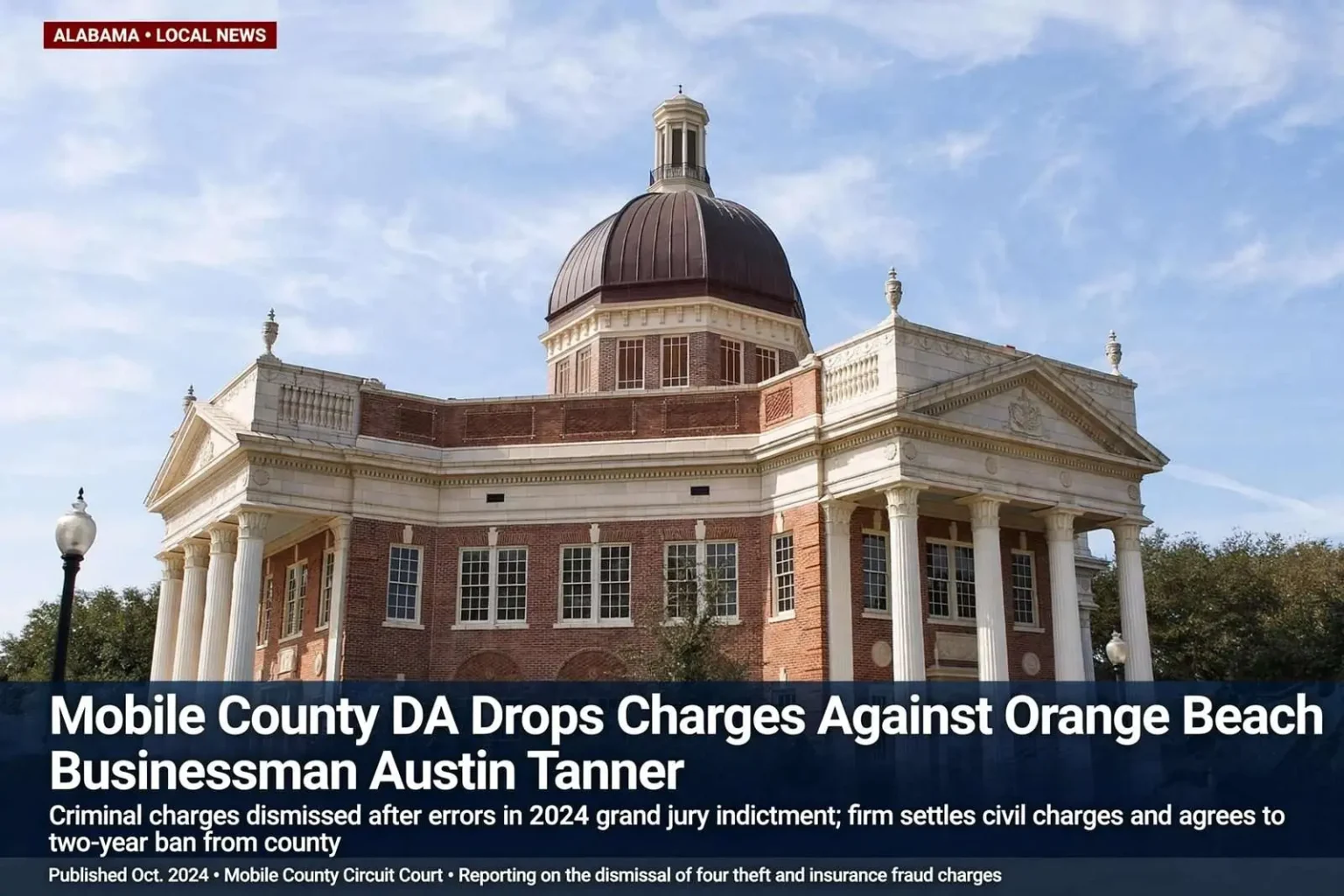
Prosecutors in the Mobile County District Attorney’s Office have dropped four criminal charges of theft and insurance fraud against Austin Tanner, the president of Orange Beach consulting firm ATA Loss Consulting, after discovering errors in a 2024 grand jury indictment. The reversal — a full dismissal of the criminal case that had put the Baldwin County businessman’s liberty at risk — came with an unusual coda: while Tanner walked away personally, his firm did not, settling new civil charges the same day with penalties that will keep it out of the county’s courts for years.
Mobile County Circuit Court Judge Michael Windom ordered Tanner’s charges dismissed and recalled a warrant that had been issued for his arrest the previous week. The warrant, signed after prosecutors briefly believed Tanner had violated conditions of his release, had put him at risk of being taken into custody over a case that was already unraveling on the prosecutors’ side of the file. Windom’s order erased both — the warrant and the underlying charges — closing the criminal chapter of the matter within minutes of the hearing.
Assistant District Attorney Clay Rossi said the case unraveled after prosecutors learned that a Satsuma church at the center of one allegation, First Baptist Church of Satsuma, had never actually paid Tanner’s firm, and that Tanner did not personally receive unlawful payments, contradicting information in the original indictment. The church had been named in court documents as one of ATA’s clients whose money supported the theft allegations, and its removal pulled a load-bearing element out of the indictment’s structure. Rossi said a review of the company’s billing records also turned up inconsistencies that had a reasonable explanation once examined further, including hours logged under a single employee’s name that actually represented a full work crew. The records showed Tanner’s father, who worked as a crew manager, logging more than 24 hours in a single day; the defense explained that the firm’s system listed a three-person crew under the manager’s name, so the entries reflected three people working eight hours each. With two of the counts resting on jobs where no money ever changed hands, the office concluded it could not prove the charges.
“Their record keeping was trash,” Rossi said, describing the confusion that led to the original charges. The admission — from the office that had won the indictment in the first place — laid out the difference between sloppy books and criminal conduct as prosecutors came to see it: a consulting firm whose time logs, invoices and client records were so disorganized that the very reviewers who studied them disagreed about what they showed.
How the case fell apart
The dismissal sequence reflects how carefully prosecutors must handle cases built on business records. An insurance-consulting company operates at the intersection of homeowners, contractors, adjusters and insurers, generating hundreds of documents that all have to line up — engagement letters, time entries, invoices, payment records. When the Mobile County DA’s office re-examined ATA’s records in preparation for trial, the review turned up the kind of discrepancies that a grand jury had read as fraud but that closer scrutiny explained as incompetence in bookkeeping.
The Satsuma church allegation illustrated the problem in its clearest form. The indictment had treated payments from the church as money Tanner’s firm had improperly taken; the re-investigation established that the church had never paid the firm at all, leaving the alleged theft with no money behind it. Once that element dissolved, prosecutors were left reassessing the remaining counts against records they no longer trusted to prove criminal intent beyond a reasonable doubt — the standard that separates a civil dispute over billing from a felony conviction.
For Tanner, the dismissals capped months of uncertainty during which he had disputed the original allegations and seen prosecutors twice seek to revoke his bond while the case was pending. He had pleaded not guilty to two counts of first-degree insurance fraud along with theft and attempted theft charges, and his attorneys had called the allegations “utterly false and untrue.” An aspiring country singer with a growing social media following, Tanner was arrested in April 2024 and released on a $20,000 bond; after he attended the Country Music Association Awards in Nashville without court permission, Windom ordered him to wear an ankle monitor rather than sending him to jail. Bond disputes in high-profile cases often compound the stress of the underlying charges, subjecting defendants to hearings, travel restrictions and the threat of jail even before trial — and Tanner’s case had produced more than one.
The civil charges that survived
While charges against Tanner personally were dropped, prosecutors did file new civil charges against ATA Loss Consulting, alleging the firm used an illegal flat-fee billing model to collect payments from clients’ insurance claims. The civil track targets the company’s business model rather than any individual’s criminal intent: instead of billing for hours worked, the firm was accused of charging clients a flat percentage or fee against their claim proceeds — a structure the DA’s office said violates the rules governing who may collect fees from insurance claims in Alabama. The complaint, filed in Mobile County Circuit Court, also alleged the company failed to maintain adequate records and misrepresented its services to customers. The firm practices the flat-fee model legally in other states.
The firm settled those charges immediately, agreeing to a consent order that bars it from doing business in Mobile County for two years and requires it to pay roughly $50,000 in fines, court and investigation costs, attorney fees and the cost of a previous Alabama Department of Insurance investigation into the company. The order, signed by Windom, also bars the firm from representing that it can offer services that are illegal under Alabama law. Consent orders of this kind function as binding contracts with the court or the enforcing agency: the company admits no liability but agrees to the restrictions and the payment schedule, and a violation of the order can trigger fresh enforcement. As part of the settlement, ATA Loss Consulting denied any wrongdoing — the standard formulation in negotiated resolutions where the defendant weighs the cost of fighting against the certainty of a signed agreement.
The result split the case down the middle in a way that left both sides claiming something. Tanner and his company avoided criminal convictions entirely — the theft and fraud counts dismissed as product of an indictment built on bad records — while the DA’s office extracted a two-year ban from Mobile County business and a five-figure payment that funds the office’s investigation costs. For clients of the firm, the practical effect is a restructuring of how loss-consulting services can be sold to them in Mobile County going forward.
Who Tanner is and why the case drew attention
Tanner built his public profile in Baldwin County’s insurance-adjusting world, where ATA Loss Consulting operated as an advocate for property owners negotiating claims after storms — a service that grew in demand along the Gulf Coast, where hurricanes regularly generate waves of claims disputes. The firm’s president became a known figure in Orange Beach business circles, and his arrest in the 2024 indictment made headlines across the two-county area, in part because it coincided with his growing visibility as a businessman with political connections and ambitions.
The original indictment had alleged a pattern in which the firm collected money from clients in ways that violated the state’s rules about insurance claims — allegations that, at the time, prosecutors presented with the confidence of a grand jury’s endorsement. The dismissal now stands as a public record on the other side: an acknowledgment from the state that the criminal theory did not survive contact with the underlying documents.
The bond fights that ran alongside
The most recent bond dispute arose after Tanner was charged with assault in connection with a fight during a June concert at The Wharf Amphitheater in Orange Beach, a charge that remains pending separately from the theft and fraud case that has now been dismissed. The Wharf, the large entertainment complex on the Intracoastal Waterway in Orange Beach, draws national touring acts through the summer, and the June incident — a fight that resulted in the new charge — handed prosecutors grounds to argue that Tanner’s release conditions should be revisited even as his criminal case was collapsing.
Bond revocation motions serve as a pressure point in any pending case: prosecutors use them when they believe a defendant’s conduct shows disregard for the court’s conditions, and defendants experience them as a second prosecution running parallel to the first. In Tanner’s matter, the two revocation attempts meant that even as the theft and fraud counts were being re-examined and ultimately dropped, he was still appearing in courtrooms to defend his freedom on the terms of his release. The recall of the latest warrant removed that immediate threat, but the June assault charge remains an open matter in Baldwin County, unchanged by the Mobile County outcome.
The parallel tracks illustrate how a defendant’s legal exposure can accumulate across county lines. The Mobile County case is over — dismissed with the warrant recalled — but the Baldwin County charge follows its own calendar, and the consent order restricting ATA’s business follows its own. A single year of headlines now resolves into three separate instruments: a dismissal, a pending assault case and a civil settlement that will keep the firm out of Mobile County through the two-year term.
What the dismissal means for insurance-consulting clients
For homeowners and business owners who hire loss consultants after storm damage, the case clarifies the legal line the industry operates along. Consultants who advocate for property owners in insurance disputes are paid for their expertise, and Alabama’s rules draw boundaries around how they may collect — directly from claim proceeds under a percentage arrangement being the practice the DA’s office targeted in its civil case. Clients reviewing their own agreements with consulting firms now have a clearer signal about which fee structures the state considers off-limits.
The resolution also demonstrates the role that record-keeping plays when disputes reach courtrooms. A firm’s invoices and time logs are the evidence in any billing dispute, and prosecutors’ own description of ATA’s records as unreliable cut both ways: the same sloppiness that prevented criminal proof of fraud also made the firm’s legitimate work harder to distinguish from its questionable billing. Businesses in the industry took note of the outcome’s structure — criminal dismissal, civil consent order — as the template the DA’s office may apply to similar firms in the future. Rossi made that explicit, noting that Alabama is among the minority of states that do not allow the flat-fee claims model and saying the office has sent a message to other estimating companies: the practice is not allowed here, and using it will bring trouble with prosecutors.
For Tanner personally, the dismissed charges allow him to turn his attention to the pending assault case in Baldwin County and to the business questions raised by the two-year Mobile County ban. The firm continues to operate outside the restricted jurisdiction, and the civil settlement — with its denial of wrongdoing and its $50,000 payment — closes the state’s action without any finding of fraud. Tanner’s attorney, Frederick Helmsing, did not respond to a request for comment. What began with a grand jury indictment in 2024 ended, in a single hearing before Judge Windom, as a case about records too messy to prove a crime and a business model the state enforced against by other means.