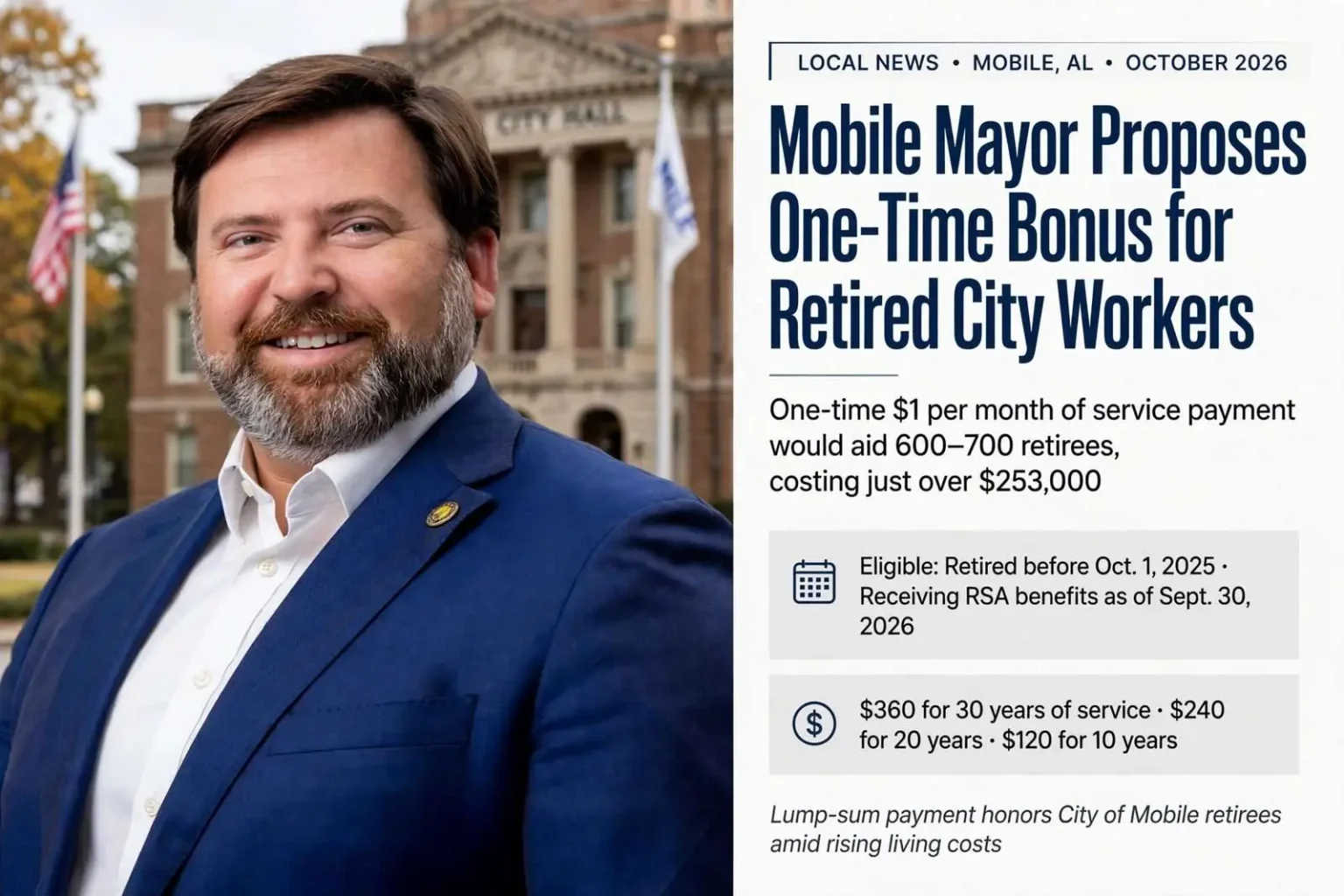
Mobile Mayor Spiro Cheriogotis is pushing for a one-time bonus payment for city retirees enrolled in the Retirement Systems of Alabama, citing the toll of rising costs on residents who spent their careers working for the city. Cheriogotis is sponsoring a resolution that would provide eligible retirees, and beneficiaries of retirees who have died, with a lump-sum payment equal to one dollar for every month they worked for the city. Altogether, the proposal represents an investment of more than $250,000.
Who would qualify matters as much as the amount. A retiree who spent thirty years on the city payroll would receive $360 under the formula; a retiree with twenty years would receive $240; a decade of service brings $120. The payment is not a pension increase — it does not change the monthly benefit a retiree receives — but a single, one-time payment whose size tracks each person’s length of service to the city.
For the retirees on the receiving end, the amounts are meaningful rather than transformative. Fixed retirement incomes have absorbed several years of rising prices on groceries, insurance, utilities and health care, and a several-hundred-dollar payment arrives the way such payments always do: as help with a bill, a prescription, a car repair or the accumulated small shortfalls that a fixed budget cannot always cover.
Who would qualify
If the Mobile City Council approves the measure, payments would go to retirees and eligible beneficiaries of deceased retirees who left city service before Oct. 1, 2025, and who are still receiving RSA benefits as of Sept. 30, 2026. The two dates frame the eligible population precisely: anyone who retired after the cutoff date is not yet part of the current retiree rolls, and anyone who dies before the qualifying date leaves the payment to be handled through their beneficiary instead.
The bonuses are made possible by state legislation passed during the most recent legislative session, which gives Alabama municipalities the authority to provide these one-time payments to eligible RSA retirees. Before the legislation, cities that wanted to help their retirees had no clean mechanism for doing so; pension benefits are set through the state-managed retirement system, and direct bonuses to retirees raised legal questions cities were not equipped to answer. The new law gives municipalities a defined, authorized path — a lump-sum payment, distinct from ongoing benefits, funded by the city itself.
“This is about honoring the people who dedicated years of service to help make this city the wonderful place it is,” Cheriogotis said. “It’s important that we continue to stand by them. As families across the community face rising costs, I’m pleased to support this measure that provides for those who faithfully served our residents.”
The mayor’s framing reflects the population the payments reach. City retirees live in every part of Mobile — the police officers and firefighters who spent careers on the streets and trucks, the public works crews who maintained the infrastructure, the clerks and administrative staff who ran the offices — and most remain part of the city’s civic life long after their last shift.
How RSA fits in
The Retirement Systems of Alabama administers the pensions of most public employees in the state, including members of the Employees’ Retirement System that covers city workers. A Mobile city employee’s pension is a lifetime monthly benefit calculated from years of service and final average salary — the product of a career, paid from a fund supported by employee contributions, city contributions and investment returns. Because the system is statewide, the city cannot simply vote to raise an individual retiree’s check; that is the structural gap the new state law and this resolution fill.
A one-time payment keeps the retirement system’s architecture intact while letting the city act directly. The bonus is paid by Mobile, not by RSA, and it does not compound into future benefits or change any other retiree’s entitlement. Cities across Alabama that choose to use the new authority can size their payments to their own budgets and their own retiree populations, which is why Mobile’s formula — a dollar per month of service — produces a payment that recognizes tenure without requiring any new administrative machinery beyond verifying who qualifies.
Verification is straightforward under the eligibility dates. RSA’s records establish who left city service before Oct. 1, 2025, who is still receiving benefits as of Sept. 30, 2026, and who the eligible beneficiaries of deceased retirees are. The city does not have to reconstruct employment histories; the retirement system’s data does that work, and the payment follows the record.
More retiree support possible
City officials say the RSA bonus proposal is part of a broader effort to support both current and former city employees. The administration is also exploring additional ways to assist retirees as it works through the city’s fiscal year 2027 budget process.
That budget context matters for what comes next. A one-time payment is easy to absorb in a single year; recurring support — a lasting increase in retiree benefits, an ongoing stipend, expanded services for former employees — carries permanent costs that have to be balanced against everything else a city budget funds. The fiscal year 2027 process is where those decisions get weighed, and the bonus resolution establishes both the mechanism and the precedent for whatever the administration proposes next.
The timing also matters to the retirees themselves. Between 600 and 700 people are expected to qualify, and for a population living on fixed incomes, payments that arrive in October land in the stretch of the year when insurance renewals, holiday expenses and the tail of hurricane-season utility bills all arrive together. The city’s payment schedule matches the help to the season when fixed budgets feel it most.
Council and commission give final approval
The Mobile City Council and the Mobile County Commission both signed off on the one-time bonus proposal Tuesday, clearing the way for eligible retirees to receive the payments. Between 600 and 700 city retirees are expected to see the extra money in October, at a total cost of a little more than $253,000 to city taxpayers.
The county’s involvement reflects the way retiree benefits connect the two governments. Many city retirees are also county residents and taxpayers, and the two bodies’ simultaneous action gives the measure a formal, public record of support at both levels of local government — a signal, officials say, that the recognition of public service is not a partisan question or a jurisdictional one.
The final cost figure of a little more than $253,000 landed slightly above the mayor’s original estimate of more than $250,000, which is expected when an eligibility window draws the exact population. The difference between the estimate and the final number is the arithmetic of 600 to 700 retirees at one dollar per month of service — a formula whose total depends on the exact mix of career lengths in the retiree rolls.
What it means for retirees
For the retirees themselves, the payment carries a meaning beyond the dollars. Public employees retire into a system that pays a defined benefit but rarely hears from the employer again; the relationship ends with a final paycheck and a pension statement. A city that sends a payment expressly “in honor” of a career of service reopens that relationship for a moment, and the retirees who receive it will know the gesture was aimed specifically at them — the people who left city service before the current fiscal year and stayed part of the RSA rolls since.
The beneficiaries of deceased retirees are included by design. When a retiree dies, the surviving beneficiary continues to receive some portion of the benefit under RSA’s rules, and the same households face the same rising costs. Extending the one-time payment to those beneficiaries closes the loophole that would otherwise have excluded the widows and widowers of the longest-serving employees from a gesture meant for their family’s service.
The resolution now stands as the first use of the state’s new municipal authority in Mobile, and its October delivery will be watched by other cities considering the same step. The mechanics Mobile chose — a dollar per month of service, eligibility tied to the two fiscal-year dates, payment through a single October distribution — form a template any other Alabama municipality can copy, scaled to its own budget and its own retiree population.
For between 600 and 700 households across the city, the result arrives this fall: a payment of a few hundred dollars, computed from the months they gave the city, delivered as the community’s answer to the rising costs they did not choose. It is a modest sum with a long memory behind it — one dollar for every month of a working life spent in public service.