

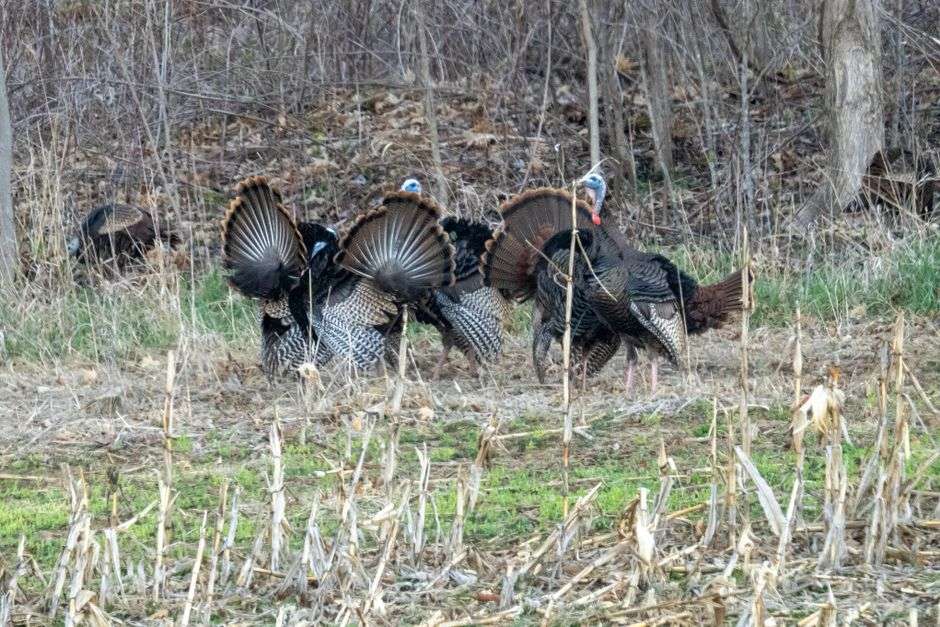
Every April, when turkey season opens and the woods fill with hunters listening for gobbles, it is worth remembering that one of the outdoor industry’s most famous brands traces straight back to a big post oak tree in Clarke County, Alabama — and that the two men who did as much as anyone to save the wild turkey grew up less than three miles apart in Mobile.
The Mossy Oak story is well known in outline. Its founder, Toxey Haas, incorporated the camouflage company in 1986 at age 26, and it grew from a hand-printed pattern into an empire of apparel, seed, real estate, media, and even dog kennels. Less well known is the family history behind it — four generations rooted in Mobile — and the company’s newest act of memory: a full-length documentary, “The Colonel & The Fox: The Greatest Generation’s Fight to Save America’s Greatest Game Bird,” which premiered free on the Mossy Oak YouTube channel in April 2024.
From Mobile to West Point
The family story begins with Toxey Daniel Haas, the founder’s grandfather, a two-sport athlete in track and basketball at the University of Alabama who met and married Maureen Cottrell of West Point, Mississippi. Dr. Haas practiced medicine in Mobile, and the couple raised three sons: Albert, Fox, and Toxey — the youngest carrying his father’s name and, eventually, the family business.
When it came time for young Fox Haas to choose a college, he wanted an agriculture degree. Two schools offered programs, Auburn and Mississippi State, and family legend holds that his father, a staunch Alabama fan, told him he would have to pay his own way if he chose Auburn. Mississippi State it was. There he met and married Evelyn Nash, also of West Point.
After earning his agriculture business degree, Fox went to work for Bryan Foods in West Point — the food company later absorbed by Sara Lee — and rose to vice president of procurement, traveling the South and Midwest buying farm products from growers he contracted on a handshake. The scale was enormous; the operation he ran did north of $100 million a year in purchasing, and across an entire career only one contract ever fell through. To his grandsons, Neill and Daniel Haas, that record says everything about how their grandfather did business: loyalty, trust, and the value of being a man of his word.
The tree that named a company
Fox Haas’s travels put him close friends with Bud Nixon, who knew the land around Livingston, Alabama, and when finances allowed, Nixon helped him buy ground that became the family’s beloved Turkey Camp. Fox also belonged to the Choctaw Bluff hunting club in Clarke County, and it was there that the Mossy Oak name was born — literally under a tree. Less than a mile from the camp house stood a large post oak in sandy bottomland, draped in Spanish moss, that hunters used as a landmark when describing how far away they had heard or seen birds. They simply called it the mossy oak.
It was also where the product idea crystallized. Young Toxey, hunting with his father and uncles, noticed that the standard hunting clothes of the day made it nearly impossible to hide from a turkey’s legendary eyesight when leaning against a tree. Hunters built blinds to compensate, but blinds pinned a hunter in place — no repositioning for a clean shot. At 25, Toxey designed a pattern meant to dissolve a hunter into the bark and shadow of the woods themselves: sit still against a tree, call a bird into range, and stay invisible even if you had to shift. With his mother’s help he began producing the pattern on the basics — shirt, pants, vest, gloves, and hat — and called the design Bottomland.
Driving down the road with his father one day, wondering aloud what to call the business, he got the obvious answer. “It’s a no-brainer,” Fox said. “It’s gotta be Mossy Oak.” The company incorporated in 1986.
From a fistful of dirt to a national brand
Growth came fast once hunters saw the pattern work. The original Bottomland design was built for turkeys but proved itself bowhunting deer and duck hunting, and within a year the company added Greenleaf, followed in 1988 by the darker Treestand pattern for late fall. Within three years, Toxey liked to say, they offered everything a hunter could need — all of it, as he put it, started with “a fistful of dirt.”
The brand’s national explosion came between the mid-1990s and 2000, powered by a licensing strategy that put the Mossy Oak pattern on the technical outdoor brands hunters already trusted. Tellingly, the licensing boom began in 1990 — the same year Neill and Daniel were born. Nearly four decades later, original Mossy Oak garments from those first years have become collector’s items, with enthusiasts paying thousands of dollars for the earliest pieces. Every pattern the company has designed since keeps the original Bottomland texture in its background, a deliberate nod to its roots.
The brand also branched, sometimes with a nudge. Mossy Oak Nativ Nurseries, the native tree nursery the twins worked at as teenagers planting acorns in the summer heat, was created by Toxey in 2006 — and, as the family tells it, was really his wife Diane’s idea, born of a yard full of oak seedlings that needed somewhere to go. Mossy Oak Biologic grew the food-plot and wildlife-forage side. Mossy Oak Properties, the land real estate company Toxey started with friend Chris Hawley in Livingston as a single office, filled its voicemail with franchise inquiries the day after its first print ads ran — and today counts nearly 100 offices across 30 states. There is GameKeepers magazine, television shows, podcasts, and Mossy Oak Kennels, where Kennel Master Bill Gibson, officially the Director of Gun Dog Operations, breeds and trains British Labrador retrievers for duck hunting. “Mom calls it Hobbies Gone Wild,” Daniel jokes.
Ask Neill and Daniel where the ideas come from and they point to the playbook — a dusty one, from 1986 to 1999, written by their father. “We just ask ourselves, ‘What would Dad do?'”
The Colonel and the Fox
The documentary that premiered in April 2024 tells the older story, the one that makes the brand’s conservation mission make sense. A few years ago, the Haas family learned that Fox Haas and Col. Tom Kelly — the forester, author, and turkey-hunting icon honored with a lifetime achievement award at the Monroeville Literary Festival — had grown up less than three miles from each other in Mobile and had never shared a hunting camp. Both are now in their 90s, and both belong to the generation that pulled the wild turkey back from the brink.
That brink was real. By the 1930s, wild turkey populations had been hammered to dangerously low levels across most of their range, surviving in scattered pockets. The birds were restored not by luck but by thousands of passionate trappers, biologists, and landowners who moved turkeys into suitable habitat, state by state, over decades. Kelly, who began hunting turkeys as a young man before he was old enough to serve in World War II, became one of the greatest voices of that restoration; his writing — “Tenth Legion” among other works — made him a legend among turkey hunters. Fox Haas lived the same restoration from the land side, his life organized around turkey camps and the birds themselves.
Neill and Daniel set out to put the two men together at Turkey Camp, and the visit grew into a professionally produced feature film. The premiere, free to all, aired on the Mossy Oak YouTube channel on the evening of April 3, 2024. The title’s pairing is apt: Kelly the colonel, Haas the fox, the last living links to turkey hunting’s Greatest Generation.
Stewards first
The company’s commitment to conservation shows up in the ledger as well as the legend, and it long predates the current wave of corporate environmental messaging. Toxey Haas’s formulation is simple: without the critters, there is nothing to hunt; without good land, there are no critters. Mossy Oak is the official camouflage of both the National Wild Turkey Federation and Ducks Unlimited, and in recent years the company revived the old tradition of conservation stamps, selling a $15 stamp designed from a painting that hangs above the fireplace at Turkey Camp — two longbeards in the woods, a father and son with their backs against a tree. Every dollar flows through Gamekeeper Grants to volunteers and biologists, and last year the program gave out more than $100,000.
At company headquarters, opening day of turkey season is a company-wide holiday — an unusual perk that only makes sense for a business built, literally, on a tree in turkey woods. From a Mobile doctor’s family to a Mississippi kitchen table to a worldwide brand, the through-line has stayed the same: take care of the land, take care of the wildlife, and leave both better than you found them.