New 493-Lot Pandion Ridge RV Resort to Expand Orange Beach Lodging Options
A new 493-lot RV resort planned near Gulf State Park in Orange Beach will add to a growing lineup of motorcoach and RV lodging options along the Alabama Gulf Coast.
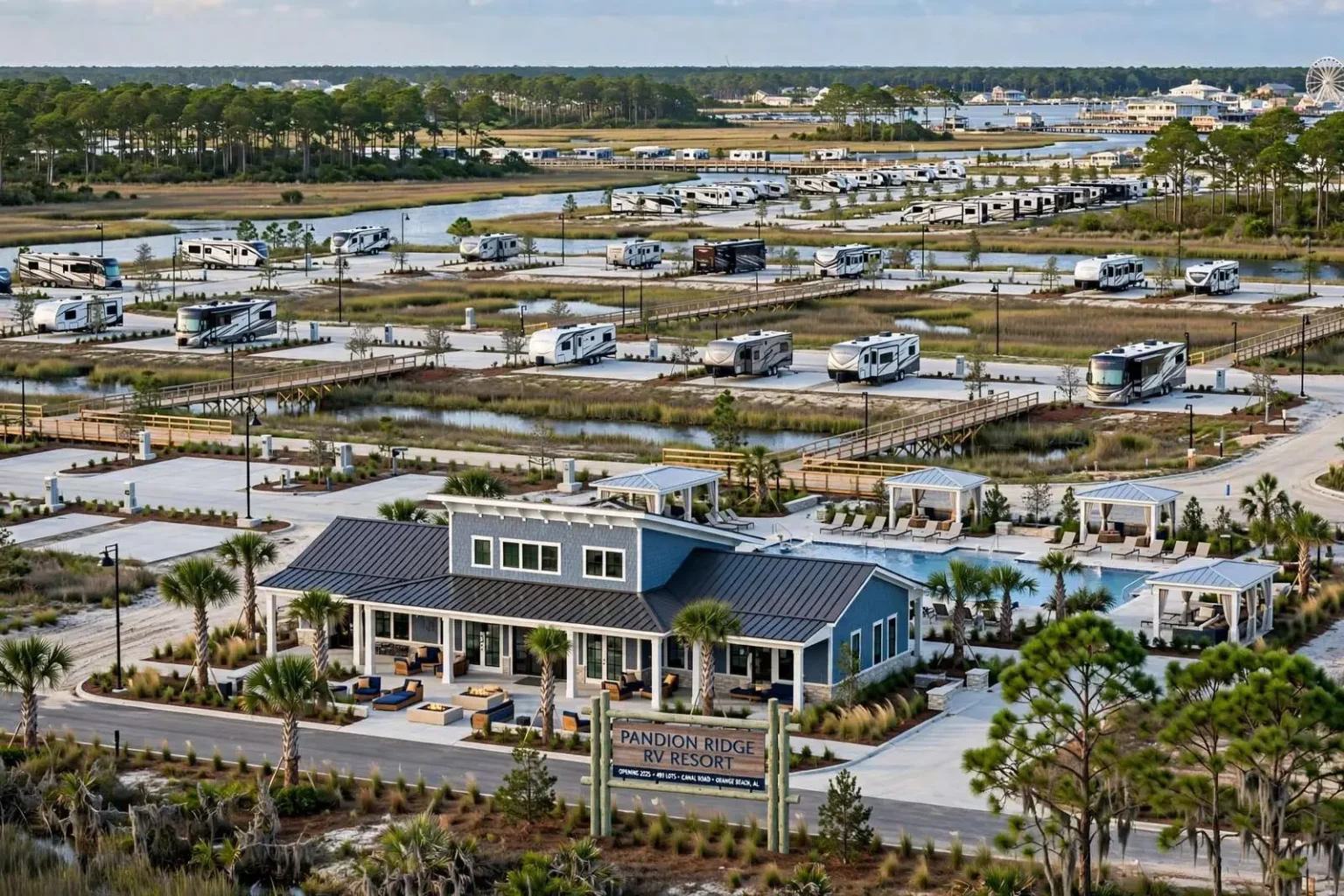
A large recreational vehicle resort under development near Gulf State Park in Orange Beach is set to expand a growing segment of the region’s beach tourism industry, one aimed at both winter snowbirds and touring families visiting during the summer. Pandion Ridge LLC is building a master-planned, high-density maritime RV resort community on Canal Road, about three-tenths of a mile west of the Foley Beach Express and next to the west entrance of The Wharf in Orange Beach. Spread across 221 acres, the Pandion Ridge development includes plans for clubhouse buildings, swimming pools, pile-supported walkways, electric and sewer infrastructure, and paved RV parking pads. According to Gulf Shores and Orange Beach Tourism, Pandion Ridge will join a list of 14 RV resorts and campgrounds already operating around Gulf Shores and Orange Beach.
Market Dynamics and Visitor Patterns
Kay Maghan, a spokesperson for the tourism bureau, said there isn’t a precise way to track the direct economic impact of RV-based lodging, but noted these resorts still contribute meaningfully to the local economy through lodging-tax revenue. Visitor surveys posted on the tourism bureau’s website show RV resorts and campsites see heavier use during the summer and winter months than in spring or fall. A survey of 646 visitors between November 2014 and February 2015 found 16 percent staying in RV resorts or campgrounds, while 15 percent of respondents used RV lodging during the summer of 2014. That figure dropped to just 6 percent in the fall of the same year. “[RV resorts] are very popular options with our snowbirds in the winter and with families in spring and summer,” Maghan said. “As we continue our focus to grow out our spring and fall shoulder seasons, we expect to see a rise in popularity of RV parks in the fall increase.”
Pandion Ridge’s Positioning
Pandion Ridge’s location — on Canal Road near the Foley Beach Express and adjacent to The Wharf — positions it to capture both segments. The Wharf, a 232-acre mixed-use development with retail, dining, a marina, and an amphitheater, is a major draw for visitors staying in the area. The Foley Beach Express provides a direct connection to the beach and to Interstate 10, making the site accessible for both fly-in visitors renting RVs and drive-in visitors towing their own. The resort’s master-planned design, with clubhouse amenities and pile-supported walkways over wetland areas, targets the upper end of the RV resort market — “glamping” adjacent, with paved pads, full hookups, and resort-style amenities rather than the basic gravel lots of traditional campgrounds.
The 493-lot density — roughly 2.2 lots per acre — reflects a high-density approach that maximizes revenue per acre but requires careful site planning to avoid the crowded feel that drives negative reviews. Modern RV resorts mitigate density through landscaping buffers, angled pads for privacy, and abundant common amenities that draw guests out of their units. Pandion Ridge’s plans for swimming pools, clubhouse buildings, and walkways suggest the developer understands this dynamic. The maritime setting — near Gulf State Park and the Intracoastal Waterway — adds a natural amenity that basic campgrounds lack.
Economic Impact and Tax Revenue
The economic impact of RV resorts extends beyond lodging taxes. RV travelers spend on groceries, fuel, dining, fishing charters, water sports rentals, and retail — often at higher daily rates than hotel guests because they stay longer and have more storage capacity for purchases. The tourism bureau’s lodging tax collections from RV resorts have grown steadily as the inventory has expanded. In fiscal year 2023, Gulf Shores and Orange Beach combined collected over $25 million in lodging taxes, a record driven by both rate increases and inventory growth. RV resorts, while a smaller segment than hotels and condos, contribute disproportionately to winter collections when hotel occupancy dips.
The 221-acre Pandion Ridge site represents a significant addition to the area’s RV inventory. At 493 lots, assuming an average nightly rate of $65-85 (typical for premium Gulf Coast RV resorts) and 70% annual occupancy, the resort could generate $8-11 million in annual gross revenue, translating to $800,000-$1.1 million in lodging taxes at the current 10% rate (5% city, 5% county/state). The construction phase alone — infrastructure, utilities, amenities, 493 paved pads — represents a capital investment likely in the $15-25 million range, creating construction jobs and permanent positions for resort management, maintenance, and hospitality staff.
Gulf State Park and the Public-Private Dynamic
Pandion Ridge’s proximity to Gulf State Park — Alabama’s most-visited state park at 2.5 million annual visitors — creates both opportunity and tension. The park operates its own campground: 496 sites (191 improved, 305 primitive) across multiple loops, with a nature center, fishing pier, and 28 miles of trails. The park’s rates ($33-45/night for improved sites) are significantly below private resort pricing, making it a direct competitor for price-sensitive travelers. However, the park’s sites book solid months in advance for peak seasons, creating overflow demand that private resorts capture.
The Alabama State Parks system, chronically underfunded, has pursued public-private partnerships to upgrade facilities. The Gulf State Park Lodge and Conference Center, opened in 2018 after the original lodge was destroyed by Hurricane Ivan in 2004, was developed through a concession agreement with a private operator. Pandion Ridge, as a purely private development on private land, represents a different model: the public benefits through tax revenue and visitor spending, while the developer assumes the capital risk. The tourism bureau views both models as complementary — the park provides affordable access, private resorts provide premium amenities, and together they expand the total addressable market.
Environmental Considerations and Coastal Resilience
Building a 221-acre RV resort on the Gulf Coast requires navigating a complex regulatory landscape. The site’s proximity to wetlands, the Intracoastal Waterway, and Gulf State Park triggers review by the Alabama Department of Environmental Management (ADEM), the U.S. Army Corps of Engineers (for any dredge-and-fill in jurisdictional waters), and the U.S. Fish and Wildlife Service (for potential impacts on protected species like the Alabama beach mouse, piping plover, and sea turtles). The developer’s mention of “pile-supported walkways” suggests an intent to minimize wetland fill by elevating pedestrian infrastructure on pilings rather than building on fill — a design approach favored by regulators but more expensive than traditional construction.
Coastal resilience is a growing concern for any beach-adjacent development. The site lies in FEMA flood zones AE and VE, subject to storm surge and wave action. Orange Beach’s building codes, strengthened after Hurricanes Ivan (2004) and Katrina (2005), require elevation above base flood elevation, wind-resistant construction, and impact-resistant glazing. For an RV resort, where the primary “structures” are the RVs themselves — mobile by definition — the resilience challenge is different. The resort’s infrastructure (clubhouses, utility pedestals, sewage lift stations) must be hardened, while the evacuation plan for hundreds of RVs in the face of an approaching hurricane is an operational requirement that the developer must coordinate with Baldwin County Emergency Management.
The tourism bureau’s 2015 visitor surveys coincided with a period of relative calm — the last major hurricane strike on Alabama had been Ivan in 2004. The subsequent years would bring Hurricane Sally (2020), Hurricane Zeta (2020), and Hurricane Ida (2021), each causing varying degrees of damage to coastal RV infrastructure. The industry has adapted: newer resorts are built with underground utilities, quick-disconnect pedestals, and designated hurricane-rated shelter structures. Pandion Ridge, as a ground-up development in the 2020s, would incorporate these lessons by default.
The RV Industry’s Evolution and Demographic Shifts
The RV industry has undergone a profound transformation over the past decade, accelerated by the COVID-19 pandemic. RV shipments from manufacturers hit record highs in 2021 (600,000+ units) and 2022, driven by younger buyers — Millennials and Gen Z — entering the market. The traditional snowbird demographic (retirees 65+) remains the backbone of winter occupancy, but the summer family segment has grown younger and more diverse. “Workamping” — remote workers living in RVs while traveling — has emerged as a year-round segment that could fill the spring and fall shoulder seasons the tourism bureau is targeting.
Pandion Ridge’s design — with clubhouse buildings suitable for co-working, high-speed internet infrastructure implied by modern resort standards, and proximity to The Wharf’s amenities — positions it to capture this evolving demand. The 493-lot scale allows for segmentation: premium pull-through pads for large Class A motorhomes, back-in sites for towables, and potentially a dedicated area for long-term snowbird tenants. The maritime setting, with walkways connecting to the Intracoastal Waterway, could support kayak launches, fishing piers, and nature trails that enhance the “experience economy” appeal.
Competitive Landscape and Future Outlook
The 14 existing RV resorts and campgrounds around Gulf Shores and Orange Beach range from basic county parks (Gulf State Park, Fort Morgan RV Park) to premium private resorts (The Wharf RV Resort, Luxury RV Resort, Doc’s RV Park). Pandion Ridge enters a market where the upper tier is increasingly differentiated by amenities: resort-style pools, fitness centers, dog parks, golf cart rentals, scheduled activities, and concierge services. The developer’s “master-planned, high-density maritime RV resort community” language signals an aspiration to the top of this tier.
The Foley Beach Express corridor, where Pandion Ridge is located, has become a spine of tourism development. The Tanger Outlets, The Wharf, the OWA amusement park in Foley, and numerous hotels and condos line the route. Pandion Ridge’s location — three-tenths of a mile west of the Beach Express — gives it visibility without the noise and traffic of the main thoroughfare. As the tourism bureau pushes to extend the season, the resort’s success will depend on marketing that reaches the snowbird decision-makers in July (when they book winter stays) and the family planners in January (when they book summer vacations). The economics are compelling: 493 lots at scale, in a market with proven demand and limited new supply, represents a rare opportunity in a mature beach destination.
Infrastructure and Utility Considerations
A 493-lot RV resort requires infrastructure equivalent to a small town. The electrical system must deliver 50-amp service to each pedestal — roughly 25,000 amps of connected load at full occupancy — requiring a dedicated substation or primary metering arrangement with Baldwin EMC or Alabama Power. The sewer system, likely a package treatment plant given the distance from municipal trunk lines, must handle peak flows of 50-75 gallons per site per day, with redundancy for hurricane-related power outages. Water supply, stormwater management, and high-speed fiber connectivity complete the utility picture. These systems represent a significant portion of the $15-25 million capital budget and must be engineered for the corrosive salt-air environment.
The pile-supported walkways mentioned in the development plans serve a dual purpose: they minimize wetland impacts (a regulatory necessity) and they provide elevated pedestrian circulation that remains functional during minor flooding events. The walkways connect the RV loops to the clubhouse, pools, and waterfront amenities, creating a pedestrian-first layout that differentiates the resort from the drive-up, park-at-your-site model of older campgrounds. This design philosophy — common in modern “RV resorts” but rare in the Gulf Shores/Orange Beach inventory — could justify premium rates and longer stays.