South Baldwin Bridge Land Cases Head to Trial as State Raises Offers
Trial dates are now set for several South Baldwin County land condemnation cases tied to the new Intracoastal Waterway bridge project, with the state raising its offers on at least two parcels since last fall.
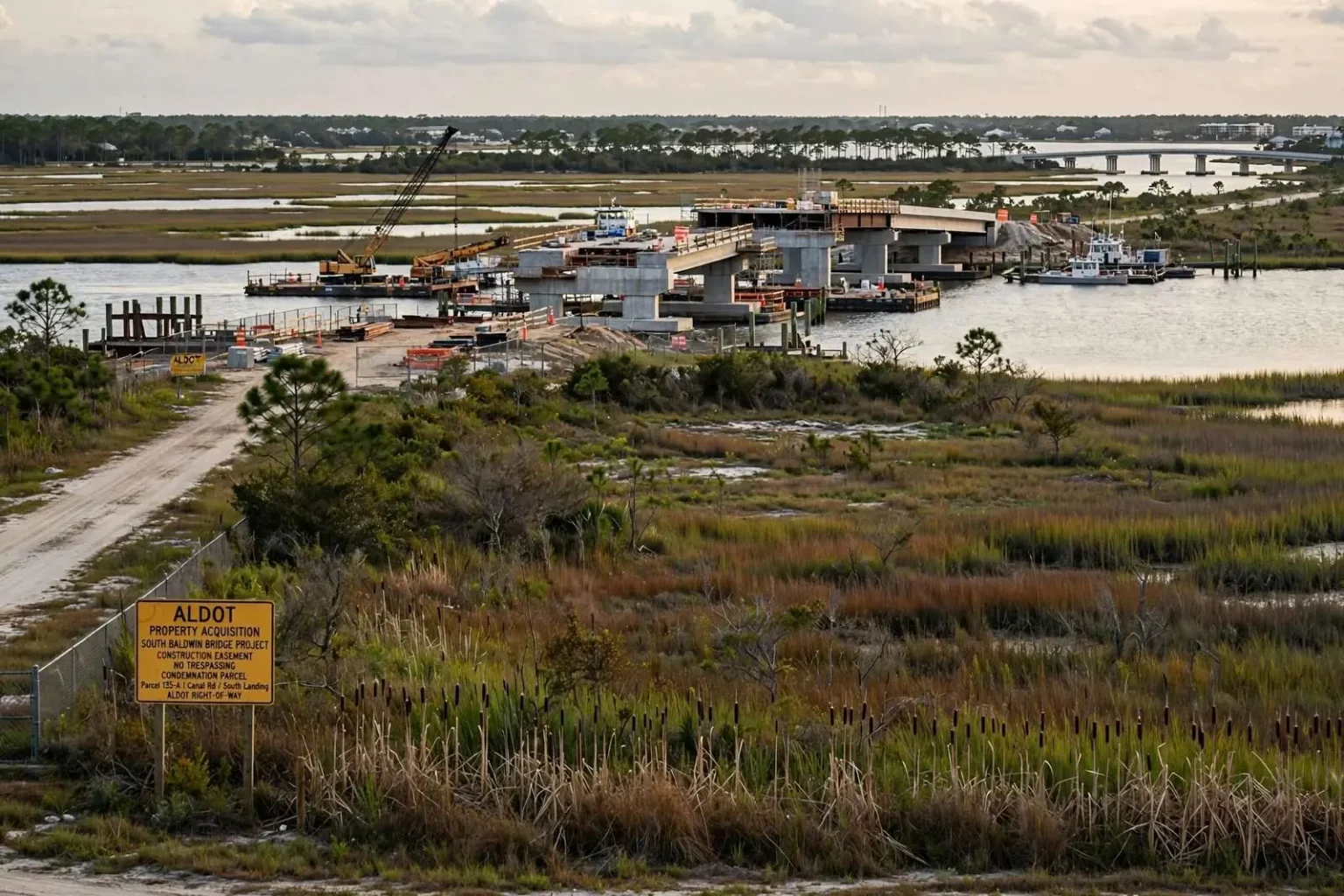
Several landowners along the route of a new South Baldwin County bridge project are headed to court this year as the state and property owners continue to negotiate compensation for land the Alabama Department of Transportation needs to complete the crossing. Court records show trial dates now set for multiple parcels, and in at least two cases the state has raised its offer since the fall.
The litigation is the inevitable byproduct of one of the largest public works efforts Baldwin County has seen in years. A new crossing of that scale cannot be built without taking private land, and when a state agency and a landowner cannot agree on what the land is worth, the disagreement does not go away — it moves to a Baldwin County courtroom, where a jury is ultimately asked to decide what just compensation should be.
A third span over the waterway
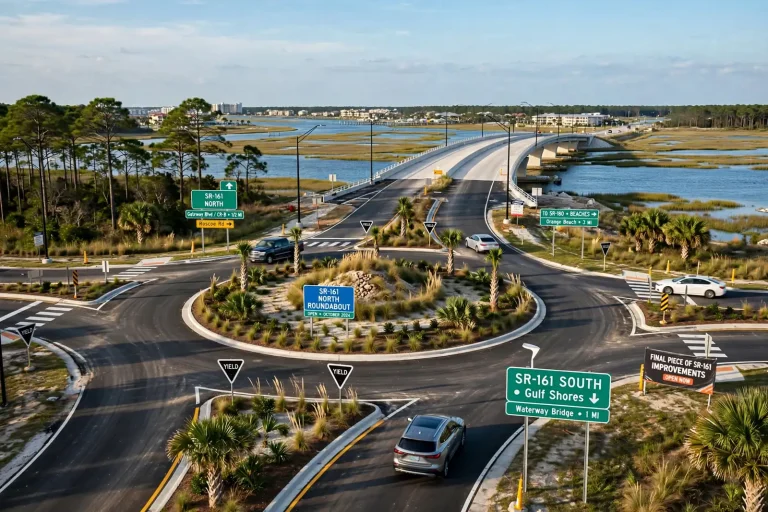
The road and bridge project will create a third span over the Intracoastal Waterway connecting Gulf Shores and Orange Beach, a long-sought addition intended to ease traffic bottlenecks along the coast during peak tourist season. For decades, residents and visitors funneling between the two beach cities have depended on the existing crossings, which choke with summer traffic as tens of thousands of visitors converge on the barrier island communities each weekend between Memorial Day and Labor Day.
The problem is one of geography as much as growth. Gulf Shores and Orange Beach sit on a narrow strip of land bounded by the Gulf of Mexico to the south and the Gulf Intracoastal Waterway to the north, so nearly every trip in and out of the beach communities crosses the same constrained choke points. Baldwin County’s population boom and the steady expansion of the tourism economy have multiplied the load, and planners have long identified an additional crossing as the single most effective way to relieve the crunch.
Building the new route has required the state to acquire dozens of parcels through eminent domain, a process that often ends in condemnation lawsuits when landowners and the state cannot agree on a price. Under Alabama law, ALDOT may take property it needs for a public road once it offers what it judges to be just compensation, and a landowner who believes the offer falls short may accept the money while still contesting the amount in circuit court. The land transfers to the state either way; the fight is over the price, and juries routinely hear appraisals from both sides before setting a figure.
The parcels headed for trial
Attorney Warren Herlong, who represents owners of several of the affected properties, said he initially handled condemnation cases involving seven parcels taken by the state for the project. Four of those cases remain open, with two currently scheduled for trial. In both of those pending cases, Herlong said, the state has slightly increased its offer since September.
The pattern is a familiar one in condemnation work. ALDOT’s initial offers are set by its appraisers, based on the agency’s valuation of the property as the state sees it. Owners, with their own appraisers and attorneys, frequently dispute those figures — particularly when a highway project does more than carve off a corner of a tract, and instead changes what the remainder of the land can be used for. A negotiated increase before trial, such as the ones recorded in these cases, reflects the two sides converging on value as trial dates approach, even when they have not closed the gap completely.
One of the most significant parcels in the project is a roughly 135-acre tract that will serve as the bridge’s south landing and its intersection with Canal Road. The property is owned by Laura Almaroad, Wanda Dickman and Joy Sprunger, who are represented by Herlong. The state’s initial offer of about $3.8 million has since been revised upward to $4.3 million.
“What is happening there is they are taking a certain amount of acres, but then they are denying access to the remaining acreage,” Herlong said. “The state is offering compensation for that denial of access, and we certainly want to be compensated.”
The access question at the center
The access dispute sits at the heart of many of the cases along the new route. When a highway takes part of a tract but leaves the rest behind, severed from the road system by a limited-access facility, the remainder can lose much of its practical value even though it still exists on paper. Alabama condemnation law recognizes damages to the remainder as a component of just compensation, and owners argue that figure — the loss of access, the changed character of what is left, the difficulty of developing land that can no longer be reached as it once was — along with the value of the acres actually taken.
For a tract the size of the 135-acre property at the bridge’s south landing, the stakes are large in every sense. Land along Canal Road and the approaches to a new Intracoastal crossing is among the most commercially valuable in South Baldwin County, sitting in the corridor that will carry bridge traffic between Gulf Shores and Orange Beach. How the land is valued — as raw acreage, as developable commercial frontage, or as property left with impaired access — can swing the appraisal by millions of dollars, which is why the offers in that case have already moved substantially.
A second case involving 8.38 acres owned by Tony and Patricia Diliberto has also seen its offer rise, from an initial $405,000 to $440,000. The property includes a large house, and the taking affects land close to the heart of the new route’s footprint. The movement in that offer, like the movement in the larger tract’s, shows how the state’s numbers have shifted as the cases have matured — a sign that negotiations are continuing on both sides even as trial dates are fixed.
Why these cases matter to the coast
The condemnation fight is the least visible part of a project that will reshape daily life in Alabama’s beach communities. Once the third span is complete, drivers between Gulf Shores and Orange Beach will have a new option for crossing the Intracoastal Waterway, relieving pressure on the existing bridges that today back up for miles on summer afternoons. Businesses along the route, neighborhoods behind it, and the tens of thousands of visitors who crowd the island each season all stand to feel the effect, whether through shorter drive times or through the physical change of a new highway corridor cutting through land that has been privately held for years.
For the landowners themselves, the cases determine how the cost of progress is shared. Route alignments are debated at public meetings, but the price of the right of way is set one parcel at a time, in appraisals, negotiation letters and eventually in courtrooms where a Baldwin County jury hears both sides. Outcomes in one case often become reference points in negotiations over neighboring parcels along the same route.
A longer pattern of takings on the waterway
The bridge land cases are part of a longer arc of public acquisition along Baldwin County’s waterways. The Gulf Intracoastal Waterway itself was a federal navigation project, and the bridges that span it — along with the causeways, ferry landings and channel improvements that serve the Gulf Coast — were all built on land taken from private owners. Each generation of coastal infrastructure has required a new round of takings, and each has produced its own set of valuation disputes between the state and the families and businesses whose property stood in the path.
What makes the current round different is scale. South Baldwin County is one of the fastest-growing regions in Alabama, with property values that have climbed with the tourism economy. Land that might have been appraised in modest figures a generation ago is now measured in millions, and both sides in the cases now headed to trial are operating with experts who know exactly how valuable the corridor has become.
What happens next
With trial dates set, the remaining cases will move along a well-worn path. The parties will continue to exchange appraisals and negotiate, and any case that does not settle will be tried before a Baldwin County jury, which will hear evidence on the value of the land taken and the damages to what remains. Verdicts, when they come, become part of the record that shapes the state’s offers in the parcels still open — including the other cases of Herlong’s that have not yet reached a trial date.
For now, the state has shown a willingness to move its numbers upward as the trials approach, and the owners’ attorneys have made clear they intend to press for full compensation not just for the acreage taken but for the access denied to what remains. Between the rising offers and the fixed trial dates, the two sides are converging — slowly, parcel by parcel — on the price of the land that will carry Baldwin County’s third bridge over the Intracoastal Waterway.