Panel to Weigh Damages as ALDOT Presses Land Fight With Foley Beach Express Owner
A Baldwin County probate judge has cleared the way for a panel to determine damages owed to the Foley Beach Express toll bridge's owner as ALDOT presses ahead with condemning land for a new bridge and road project.
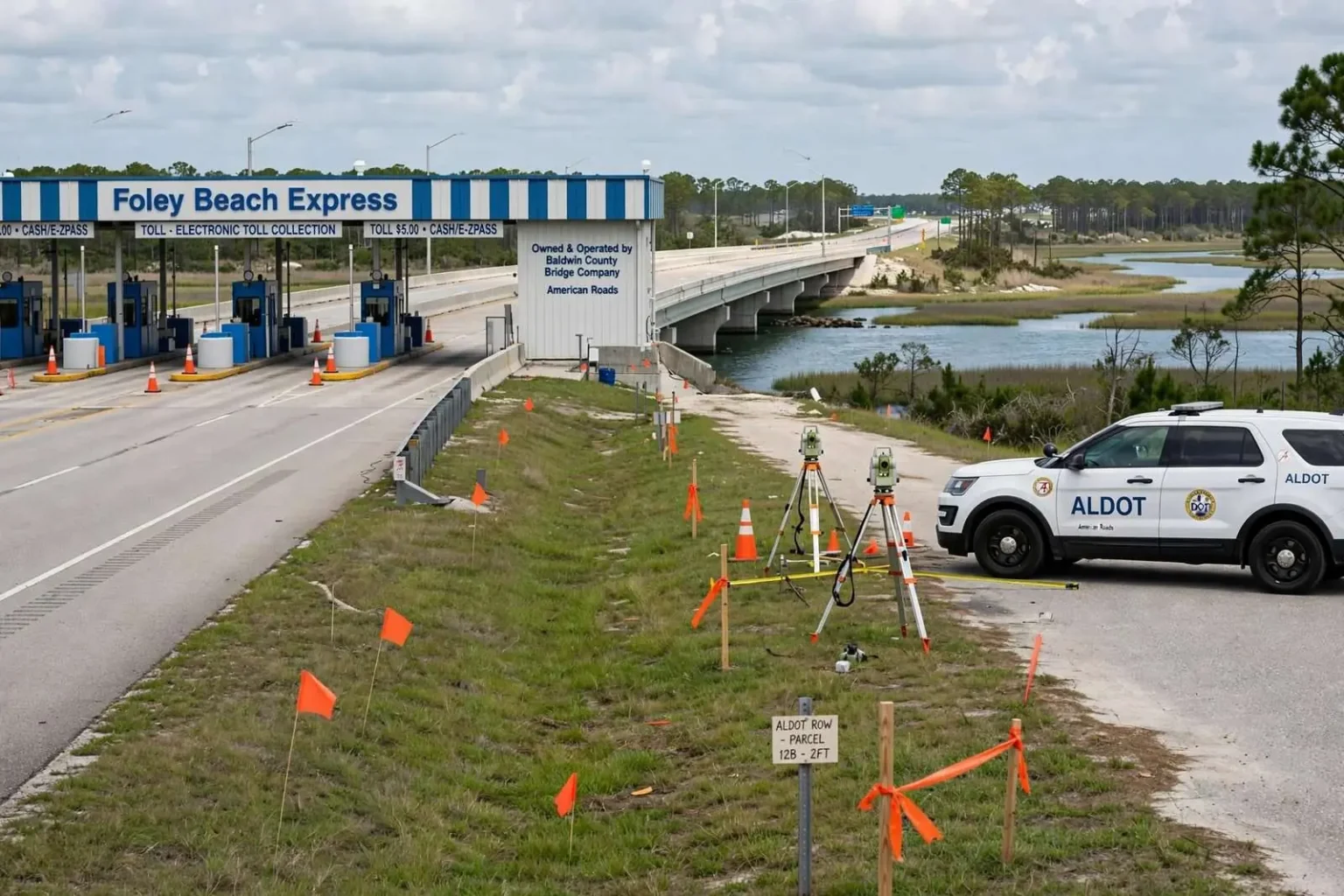
A long-running property dispute between the Alabama Department of Transportation and the company that owns the Foley Beach Express toll bridge has cleared an early legal hurdle, moving the case toward a panel that will determine how much the state must pay for land it wants to take in south Baldwin County.
The dispute centers on a narrow, two-foot-wide strip of right of way running alongside the Foley Beach Express from County Road 12 to an area near Cotton Creek.
That strip is owned by the Baldwin County Bridge Company, a subsidiary of American Roads, which also owns and operates the toll bridge itself. ALDOT wants to condemn part of that strip so it can build flyover bridges just south of County Road 8, the first piece of a new state road that would eventually extend south to a planned bridge over the Intracoastal Waterway near the Gulf Shores Airport.
The judge’s ruling
Baldwin County Probate Judge James Reid ruled that ALDOT can advance to the next phase of the condemnation proceeding, appointing a three-member panel of commissioners to assess damages and compensation owed to the property owners.
Reid’s order was dated May 14 but was not released until May 21, and it names Sam Davis, Tim Barnhill and Tommy Harris as the commissioners tasked with reporting back on the amount due.
The appointment of commissioners is the standard next step in an Alabama condemnation case once a probate judge finds the taking serves a public purpose. The panel hears evidence from both sides about the value of the land and any damages the taking causes to the remainder of the property, then files a report setting the compensation the state must deposit before it can proceed with construction.
Two feet of right of way sounds trivial, but in a corridor built around a tolled facility, every foot of frontage matters. The strip runs for miles along the Beach Express, and the flyover bridges ALDOT plans to build require both the physical space and the legal authority to occupy ground the bridge company holds.
The project behind the taking
The flyovers south of County Road 8 are the first construction piece of a larger ALDOT plan for a new state road that would eventually run south to a bridge over the Intracoastal Waterway near the Gulf Shores Airport, creating a direct connection between the Beach Express corridor and the coast.
That connection is the missing link in decades of planning for south Baldwin County traffic. The Intracoastal Waterway cuts the beach towns off from the mainland funnel of Alabama 59, and every summer the two-lane bridge crossings and the Highway 59 corridor grind under tourist traffic that the local road network cannot absorb.
ALDOT’s plan — a new road running south from the Beach Express to a new Intracoastal crossing near the airport in Gulf Shores — is designed to give summer visitors and residents a second way to reach the beaches, bypassing the Highway 59 bottleneck through Foley entirely.
American Roads pushes back
American Roads has fought the state’s case at every stage. In a statement responding to the ruling, company CEO Neal Belitsky said the outcome was not a surprise given how probate courts typically handle early-stage condemnation requests, but he argued that testimony from ALDOT personnel during the proceeding undercuts the state’s justification for the taking.
“In our view, the admissions ALDOT personnel made in the probate proceeding show that the taking is unjustified and contrary to the public interest,” Belitsky said.
He added that American Roads and the Baldwin County Bridge Company intend to keep fighting the condemnation, including pursuing a new trial in Alabama Circuit Court once both sides have exhausted the probate process.
The company’s argument rests on more than sentiment about its property. The Beach Express toll bridge was financed as a private venture, and the toll revenue that supports it depends on traffic volume. A free state road running parallel to the tolled crossing — and ultimately a free bridge over the Intracoastal — would give drivers an alternative they do not currently have, and the company has long argued that the state’s project would undermine the investment the toll bridge represents.
That tension between a private tolled facility and a public transportation project is what makes the case unusual. Condemnation cases usually turn on the value of the land taken; this one turns on whether the public project itself is justified when it competes with the very facility whose owner holds the ground ALDOT needs.
The toll bridge’s role in the region
The Foley Beach Express was built to solve a problem that still defines the region: getting summer traffic from Interstate 10 down to the Gulf Shores and Orange Beach beaches without pushing it through downtown Foley on Highway 59. The toll bridge over the Intracoastal Waterway opened more than two decades ago and has carried a share of beach traffic ever since, funded by the tolls drivers pay at the booth.
Baldwin County has grown explosively since the bridge was built, and the traffic volumes the corridor was designed for have multiplied. The county’s population has climbed past 230,000, beach visitation has grown with it, and every project that touches the corridor — from new interchanges on Interstate 10 to the widening of the Beach Express itself — has been sized for demand that keeps outrunning the roads.
How condemnation works in Alabama probate court
Alabama law lets government bodies condemn private property for public use through a probate court proceeding that is deliberately quick at the front end. The condemning authority files a petition describing the land and the public purpose, and if the judge finds the taking lawful, commissioners are appointed to value it — a process designed to let public projects move forward while compensation is sorted out later.
That structure is why Reid’s ruling was described as unsurprising by the bridge company’s own chief executive. The early stages of condemnation almost always favor the condemning authority, because the court’s job at that point is to confirm the public purpose, not to weigh the wisdom of the project.
The real fight comes in two places: the commissioners’ valuation, which determines what the state pays for the strip and any damages to the rest of the company’s property, and the circuit court trial the company says it will pursue, where the fairness and necessity of the taking itself can be litigated with a full record.
The three commissioners named in the order — Sam Davis, Tim Barnhill and Tommy Harris — will gather evidence from ALDOT appraisers and the company’s experts, view the corridor, and file a report. Either side can challenge that report in circuit court, which is typically where condemnation disputes over significant commercial property actually get resolved.
What the flyover project involves
The flyover bridges ALDOT wants to build south of County Road 8 are grade-separation structures — bridges that carry one road over another so traffic never has to stop. In a corridor where the Beach Express intersects local county roads at grade, those crossings create both delay and crash risk as summer traffic builds, and the state’s plan treats them as the first fixes before the longer road south is built.
Constructing flyovers in a corridor lined with utility easements, drainage paths and private right of way like the two-foot strip the bridge company owns requires precision more than land quantity. The easements and strips along the road carry utilities, drainage and access rights, and disturbing them means negotiating with, or condemning from, multiple owners before the first pile is driven.
The two-foot strip from County Road 12 toward Cotton Creek is one piece of that puzzle. Its narrow width reflects the way the corridor was assembled — long, thin pieces of land purchased or reserved as the toll road was built — and ALDOT’s need to occupy even a sliver of it shows how tightly held the corridor’s edges are.
The stakes for beach traffic
Every step in this case matters to anyone who has sat in summer traffic on Highway 59 through Foley. The new state road and the planned Intracoastal bridge near the Gulf Shores Airport are the most significant answer the region has to beach-bound congestion since the Beach Express itself opened, and delays in the condemnation fight ripple directly into the construction schedule.
South Baldwin County’s summer traffic has become an annual story: two-lane roads, a single major Intracoastal crossing open to general traffic at the Foley end, and a tide of visitors that grows every year. The county and the state have responded with a series of projects — widened sections of the Beach Express, improved interchanges, and now the road-and-bridge combination at the center of this dispute.
The commissioners’ valuation of the two-foot strip will be watched less for its dollar amount than for what comes after it. If the company follows through on its promise of a circuit court trial, the case will become a referendum on whether the state can take ground from a competing tolled facility to build a free alternative — a question with implications for every toll road operator and every road-building government in Alabama.
For now, the case sits with the three commissioners named in Judge Reid’s order. Their report will set a compensation figure, the state will deposit it, and ALDOT can move toward construction — unless the bridge company’s threatened circuit court fight pauses the project once more.
Either way, the two-foot strip along the Beach Express has become the narrowest of battlegrounds for one of south Baldwin County’s biggest transportation questions.