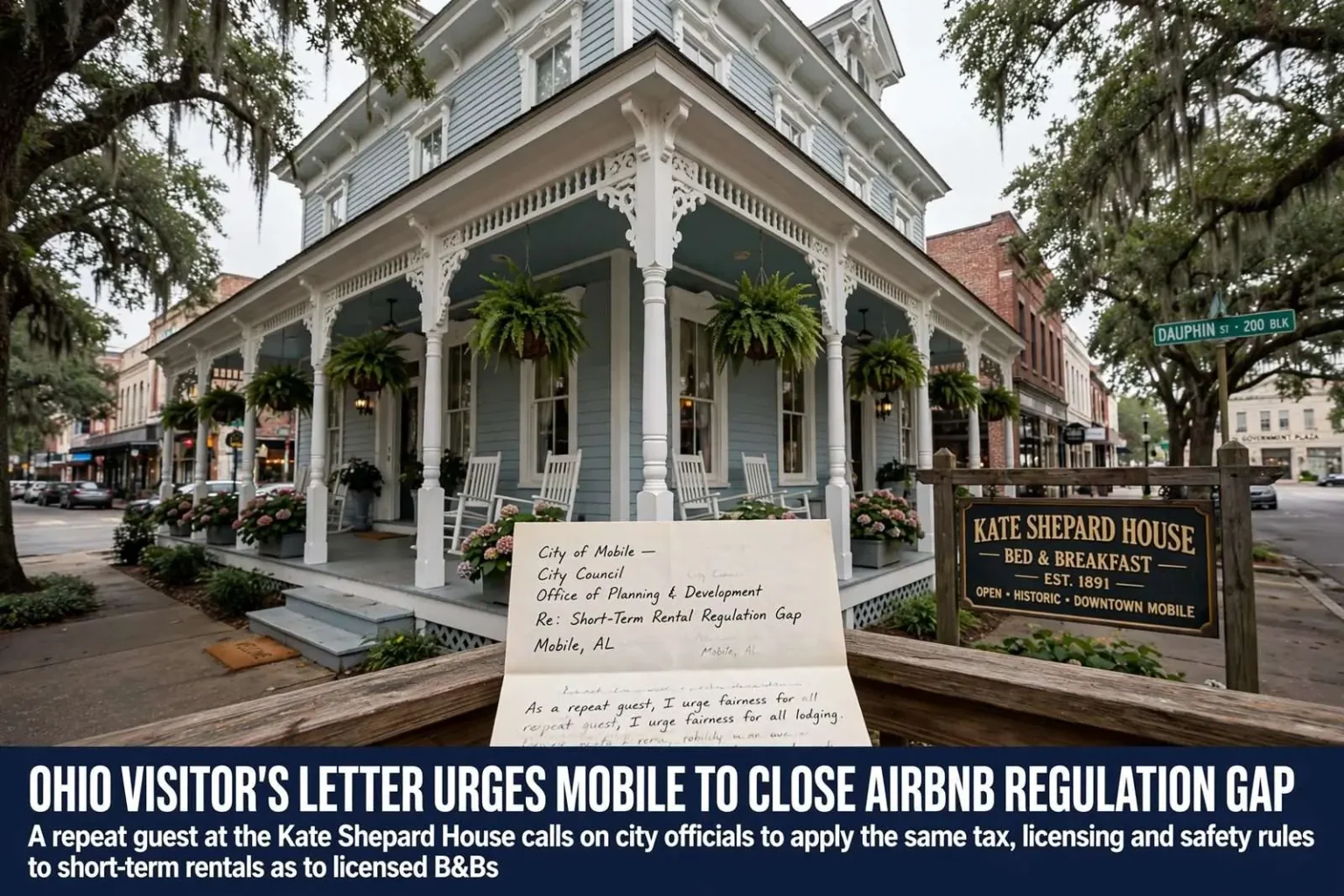
A traveler from Ohio who has twice made the trip to Mobile for the First Light Marathon has written to city officials, asking them to close a regulatory gap she says gives short-term rental hosts an unfair advantage over the bed-and-breakfast owners who follow the rules. Her letter is unusual in that it comes not from a local business owner or a neighborhood association, but from a repeat visitor with no financial stake in the dispute. It arrives as cities across the country continue to wrestle with how — and whether — to regulate the explosion of home-sharing rentals that has reshaped the lodging market over the past decade.
The visitor, who has stayed at the Kate Shepard House Bed and Breakfast downtown during both of her trips, said her concern is not with the inn itself but with the widening difference between how licensed lodging businesses are regulated and how the growing number of Airbnb-style rentals operate with far less oversight. She said the inn’s innkeepers, and the personal attention they give guests, are the reason she keeps coming back to the city. Her twice-yearly routine — training through an Ohio winter, then traveling south to run Mobile’s streets — has made her a familiar guest at the inn and an unlikely voice in a policy debate that mostly plays out among locals.
Her letter argues that many short-term rental hosts in Mobile are not held to the same tax collection, licensing and safety requirements that apply to hotels and bed-and-breakfast operations. Those businesses typically must register with the city, collect and remit lodging taxes, and meet inspection standards tied to their occupancy permits. Homeowners renting out spare rooms or entire houses through online platforms can often sidestep those same obligations, even though they are competing for the same guests. The result, she argues, is a tilted playing field in which compliant businesses effectively subsidize their own disadvantage.
The arithmetic behind her complaint is straightforward. A bed-and-breakfast that charges a guest for a weekend stay collects lodging taxes on top of its room rate, keeps its permit current, and opens its doors to inspections. A neighboring house listed on a booking app may host the same visitor for the same number of nights without any of those steps. The guest may notice no difference at all — except, perhaps, in the final bill — but the cumulative effect on city revenue and on the businesses that play by the rules grows with every booking.
A Familiar Debate in Cities Across the Country
The gap has become a familiar point of friction in cities across the country as home-sharing platforms have expanded rapidly over the past decade. What began as a way for homeowners to occasional-rent a spare room has grown into a market that includes full-time rentals, multi-property operators and professionally managed units, blurring the line between home-sharing and unlicensed lodging. City halls everywhere have been forced to decide whether their existing hotel and inn rules — written long before smartphone booking existed — still fit the reality on the ground.
Local governments have taken a range of approaches, from requiring short-term rental hosts to obtain business licenses and pay lodging taxes to capping the number of nights a property can be rented or restricting rentals to certain zoning districts. Night caps are among the most common tools: a host may rent a home for a limited number of days per year, keeping the arrangement in the category of occasional home-sharing rather than de facto lodging. Zoning approaches divide differently, often allowing rentals in commercial or mixed-use districts while restricting them in quiet residential neighborhoods where neighbors worry about parking, noise and the steady turnover of strangers.
Some cities have reached agreements directly with booking platforms to collect and remit occupancy taxes on hosts’ behalf, while others have left the rentals largely unregulated. Platform-collection agreements have proven popular where they exist, because they capture tax revenue automatically at the point of sale without requiring the city to chase individual hosts. Cities that have taken no action at all often cite the difficulty of enforcement — identifying which houses are being rented, how often, and by whom — as the reason their rules remain theoretical.
For the businesses caught in the middle, the stakes are existential as well as financial. A small inn operates on thin margins under the best of circumstances, and its owners absorb the full cost of compliance — registration fees, tax filings, insurance, inspections — in exchange for the right to operate legally. When competitors down the street face none of those costs, the compliant operator is left to explain to guests, and to itself, why the rules apply to only one side of the market.
Why It Matters in Mobile
Mobile has more riding on visitor spending than many cities its size. The city draws travelers for Mardi Gras season, for its historic districts and museums, for events at its downtown venues, and for gatherings tied to the port and the region’s growing industries. Every one of those visitors needs a place to sleep, and where they sleep determines whether the city collects the lodging taxes that help fund services, and whether established operators keep their footing against newer competitors. Lodging taxes are a quiet workhorse of municipal finance: invisible on most residents’ radar, but meaningful in the aggregate.
The First Light Marathon itself is part of that visitor economy. The race brings runners and their families into downtown hotels and inns for a winter weekend, filling rooms that might otherwise sit empty in Mobile’s slower season. Visitors like the Ohio letter writer are exactly the customers the city’s licensed lodging operators build their businesses around — people who return year after year, spend money in restaurants and shops, and carry their impression of the city back home. Her argument, in effect, is that the city should care who hosts them and under what rules.
The Kate Shepard House represents the kind of operation her letter defends. Historic bed-and-breakfasts occupy a particular niche in the lodging market: they offer personal attention and a sense of place that chain hotels cannot replicate, and their owners typically live on the property and pour their own resources into maintaining buildings that are part of the city’s architectural fabric. That model depends on a measure of fairness in the market around it. If a guest can book a whole house nearby with no taxes, no permit and no inspections, the inn’s careful compliance starts to look less like civic virtue and more like a penalty.
What the Letter Asks, and What Comes Next
In her letter, the writer said she has rented Airbnb properties herself and enjoyed the experience, but that learning more about how unevenly the rules are applied has changed the way she thinks about where she books. She is careful, in other words, not to position herself as an enemy of home-sharing. Her point is narrower and harder to dismiss: whatever rules the city chooses, they should apply evenly to everyone selling a night’s stay to the same traveling public. A visitor’s-eye view of the problem carries a certain weight with city officials, because visitors are the constituency the lodging market ultimately serves.
What the city does with the letter is an open question, but the menu of options is well established by now. Mobile could require short-term rental hosts to register and obtain a business license, bringing them into the same system that hotels and inns already navigate. It could require collection of the same lodging taxes, either directly from hosts or through an agreement with the booking platforms, so that every night’s stay contributes equally to city coffers. It could adopt basic safety standards — smoke detectors, working exits, occupancy limits — so that guests in private homes receive something like the protection that inspections provide in licensed establishments.
Any of those steps would involve trade-offs. Registration and taxes add costs for casual hosts, and enforcement requires staff time and a way of identifying rentals in the first place. Caps and zoning restrictions raise fairness questions of their own, since homeowners who bought property before any rules existed may feel their rights narrowed. Cities that have acted late often find the unregulated market already entrenched, which makes voluntary compliance and platform cooperation more important than they would have been at the start.
For now, the letter stands as a pointed reminder from the demand side of the market: travelers notice more than cities might think. A guest who returns twice for the same marathon, chooses the same inn, and takes the trouble to write to city government about a regulatory gap is the kind of visitor every destination wants — and the kind that expects the rules of the marketplace to mean something. Whether Mobile closes that gap, and how, will be decided in city hall, but the case for action now has a visitor’s signature on it.
The timing of the letter is notable as well. Short-term rental policy is easiest to write before a market matures, and Mobile’s window for a measured, deliberate approach is wide open in a way that larger cities’ no longer is. Officials who act now can design registration, tax and safety rules that fit the city’s neighborhoods and its tourism patterns, rather than untangling an established market after the fact. Cities that waited elsewhere have generally found that retrofitting regulation is slower, more contentious and less effective than setting expectations early.
There is also a neighborhood dimension the letter only hints at. Where short-term rentals cluster, residents report concerns about noise, parking and the turnover of guests who have no long-term stake in the street they are staying on. Where they remain scattered and occasional, few neighbors notice them at all. The difference between those outcomes usually comes down to the rules a city writes — how many nights a home can be rented, whether the owner must be present, and how complaints are handled. Mobile’s residential streets have a stake in those answers, even if the loudest voices in the debate so far come from the lodging and visitor side.
Whatever the city decides, the Ohio visitor’s experience illustrates what Mobile stands to gain from getting it right. She came for a race, stayed at a licensed inn, spent her weekend in local restaurants and shops, and went home planning to return. That cycle — repeated across thousands of visitors each year — is the product the city’s visitor economy sells. Keeping the marketplace fair, her letter argues, is part of protecting it, because the innkeepers who anchor downtown’s hospitality are also the ones quietly paying for the privilege of doing business.