Orange Beach Lifeguard Truck Lawsuit Heads Toward Trial With a February 2027 Pretrial Conference
A Baldwin County judge set a Feb. 22, 2027 pretrial conference in Mark Kelemen's lawsuit against the City of Orange Beach and Chubb National Insurance over a 2024 incident in which he says a city lifeguard's truck ran over him on the beach.
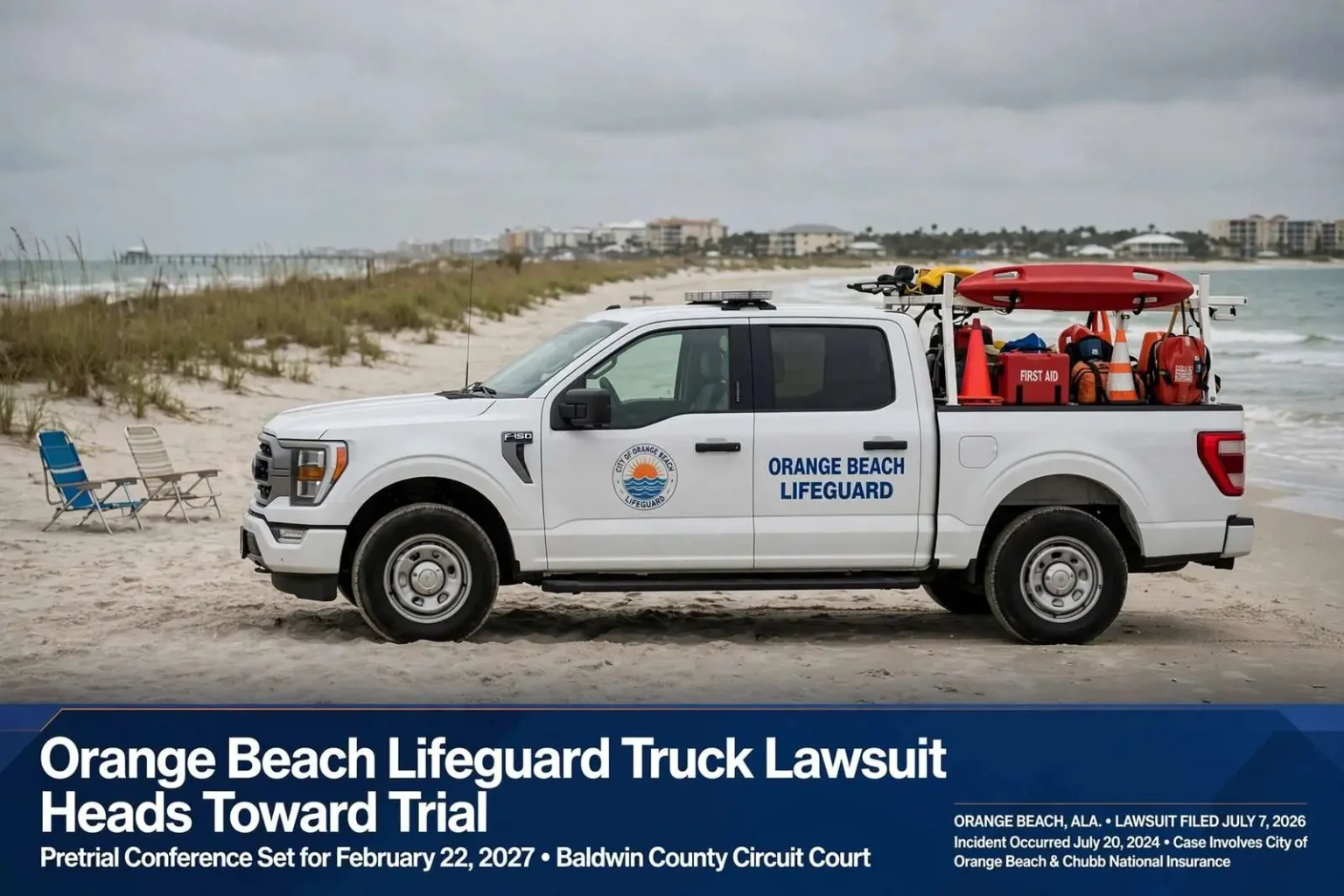
ORANGE BEACH, Ala. — A lawsuit brought by a Georgia man who says he was run over by a city lifeguard’s truck while sitting on the beach is headed toward a trial date, with a pretrial conference set for February 2027.
According to a Sept. 2 order signed by Baldwin County Circuit Judge Ashley Siebert, attorneys representing Mark Kelemen, the City of Orange Beach and a Georgia auto insurance agency must appear in court on Feb. 22, 2027, for a pretrial conference.
Kelemen sued the city in July over a 2024 incident. He also named Chubb National Insurance Company as a defendant, alleging it failed to pay claims related to his injuries.
What the Complaint Alleges
The complaint describes an ordinary afternoon interrupted by a city vehicle.
“Plaintiffs were sitting on beach chairs, conversing with each other, when the City’s employee, Mason, got into his City issued Ford F-150, and without checking his surroundings, turned the truck and ran over Mr. Kelemen as he was sitting on the beach next to his wife,” the complaint reads. “The front of the City’s vehicle hit Kelemen, and the front tire ran over the top of Kelemen’s hips, low back, abdomen, and arm, severely injuring him.”
As of Tuesday, Sept. 8, the city had not filed a response to the complaint. Allegations in a complaint are one side’s account and have not been tested in court.
The Insurance Company’s Answer
Chubb National Insurance denied the allegations against it in a motion filed Aug. 17.
Attorneys for Chubb argued that parts of Kelemen’s complaint violate the U.S. Constitution and that the company was not properly notified.
“The Plaintiffs’ Complaint, and each count thereof, to the extent that it seeks punitive or exemplary damages, violates this Defendant’s rights to protection from ‘excessive fines’ as provided in the Eighth Amendment of the Constitution of the United States and Article I, Section 15 of the Constitution of the State of Alabama, and violates this Defendant’s rights to substantive due process as provided in the Fifth Amendment and Fourteenth Amendment of the United States Constitution and as provided in the Constitution of the State of Alabama, and therefore fails to state a cause of action supporting the punitive or exemplary damages claimed,” the motion reads.
Language of that kind is standard in defense answers and should not be read as a statement about the facts of this particular case. Constitutional objections to punitive damages are routinely pleaded as affirmative defenses in civil answers, largely to preserve the issue for appeal. The substantive dispute with an insurer in a case like this is more often about coverage and notice than about constitutional theory.
Why an Insurer Is a Defendant
The presence of an auto insurance company as a named defendant alongside a municipality suggests an uninsured or underinsured motorist claim, a common structure in Alabama personal injury litigation.
Under such coverage, a policyholder’s own auto insurer may be liable when the at-fault party lacks sufficient coverage to pay a claim. Alabama practice permits an injured party to name their own insurer directly in the action.
The notice argument Chubb raises fits that framework. Uninsured and underinsured motorist policies generally require the policyholder to notify the carrier of a claim and to give the carrier the opportunity to participate in litigation against the at-fault party. Failure to provide required notice can, depending on the policy terms and the prejudice shown, affect coverage.
The Municipal Immunity Question
The most consequential legal issue in the case is one the filings described here do not yet address: the extent to which Alabama law limits recovery against a municipality.
Alabama has a statutory framework governing municipal liability that includes a damages cap in actions against a city for injuries resulting from the negligence of its employees. Cities are also entitled to raise substantive immunity defenses in connection with certain governmental functions.
Whether and how those provisions apply depends on the nature of the activity involved. Beach safety and lifeguard operations occupy contested ground in immunity analysis: courts distinguish between discretionary functions, which typically receive protection, and the negligent operation of a vehicle, which generally does not receive the same treatment.
The description in the complaint — a driver turning a truck without checking his surroundings — frames the claim as ordinary vehicle negligence rather than as a challenge to a discretionary policy decision. That framing is likely deliberate, because it is the framing least likely to be met with an immunity defense.
The city has not yet filed a response, so its position on these questions is not known.
Trucks on the Sand
Beach patrol vehicles are a fixture on the Alabama coast for reasons that are entirely practical. A lifeguard responding to a distress call several hundred yards down the beach cannot cover that distance quickly on foot through soft sand while carrying rescue equipment. Vehicles also transport equipment, move personnel between towers, and serve as platforms for medical response.
The tradeoff is that those vehicles operate in an environment crowded with people who are seated, lying down or otherwise below the driver’s sightline. A person in a low beach chair is difficult to see over the hood of a full-size pickup, particularly at close range and particularly during a turn, when the vehicle sweeps through an area the driver cannot fully observe.
Agencies that operate beach vehicles typically address this through operational protocols: speed restrictions, designated travel lanes near the water rather than through crowded areas, spotters for reverse movements, and requirements to conduct a walk-around before moving a parked vehicle. Whether any such protocols existed here, and whether they were followed, are questions the litigation may develop.
The Push Toward Mediation
Siebert’s order recommends that all parties enter mediation before the Feb. 22 status conference. If a settlement is not reached by then, a trial date will likely be set.
That sequence is standard practice in Alabama civil litigation, and the recommendation is more than a formality. The overwhelming majority of civil cases resolve before trial, and courts actively encourage mediation because it conserves judicial resources and gives parties control over the outcome.
Mediation is non-binding. A neutral mediator facilitates negotiation but cannot impose a result. Either side can decline to settle and proceed to trial.
For a plaintiff, mediation offers certainty and speed against the risk and delay of trial. For a municipality, it offers cost control and avoids the exposure of a jury verdict. For an insurer, it offers a defined resolution to a coverage dispute. Those incentives are why cases in this posture frequently settle.
The Timeline
The incident occurred in 2024. Suit was filed in July 2026. The pretrial conference is set for Feb. 22, 2027, with trial to follow if the case does not resolve.
A gap of roughly three years between injury and trial is unremarkable in civil litigation. Personal injury claims commonly involve a period during which the plaintiff’s medical treatment continues and the full extent of injury becomes clear, followed by pre-suit claim negotiation, and then the ordinary pace of discovery once suit is filed.
South Alabama News will report developments in the case, including any response filed by the City of Orange Beach.
The Filing That Started the Case
The complaint was filed July 7 in Baldwin County Circuit Court, where it was initially assigned to Circuit Judge Byron Brackin, and seeks more than $1 million in damages. Kelemen’s claimed losses include physical and emotional injuries and medical expenses from the July 20, 2024 incident, which the complaint says unfolded at about 3:30 p.m. as he and his wife sat in beach chairs.
The suit also presses claims on behalf of Christine Kelemen, asking the court to award her damages for the shock of witnessing her husband’s injuries, for her own injuries, and for loss of consortium under Alabama law. Against Chubb, the complaint advances an underinsured-motorist theory: because the damages sought exceed the liability coverage available to Mason, plaintiffs argue the insurer “stands in the shoes” of the lifeguard under the uninsured/underinsured provisions of the couple’s own policy.
At the time the filing became public, neither the city nor the insurance company had responded in court and no hearing had been set. City Administrator Ford Handley said then that the city’s attorneys were reviewing the complaint. “Because this is pending litigation, we are unable to comment on the specifics,” Handley said. “We look forward to resolving the matter through the appropriate channels.”