

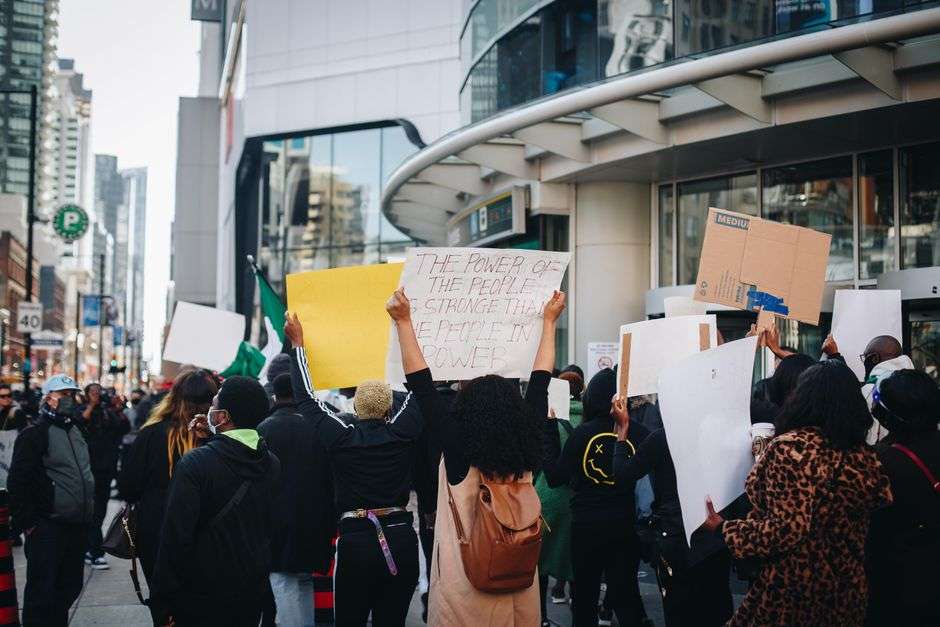
Dozens of Mobile-area residents converged on Bienville Square over the weekend, staging competing demonstrations after the Alabama Legislature passed a sweeping abortion ban that supporters and opponents alike say is designed to reach the U.S. Supreme Court. The gathering drew activists from both sides of the debate, who held signs and listened to speakers before marching through downtown streets.
The event was organized by members of the Mobile County Green Party as an outlet for residents opposed to the new law, while pro-life advocates showed up with their own signs in a counterprotest. Bienville Square, the tree-shaded park at the corner of Dauphin and North Conception streets, has long served as one of downtown Mobile’s traditional gathering places for rallies, vigils and civic observances, and Saturday’s back-to-back demonstrations continued that tradition — even as they underscored how sharply divided the community is over the measure.
The law, passed by the Alabama Senate and signed by Gov. Kay Ivey earlier this month, makes performing an abortion a felony for physicians at virtually any stage of pregnancy, with no exceptions for cases of rape or incest. It is among the most restrictive abortion measures adopted by any state in the country and is widely seen as a direct challenge to Roe v. Wade, the 1973 U.S. Supreme Court ruling that established a constitutional right to abortion.
Under the measure, a doctor who performs an abortion in Alabama could face a felony conviction carrying a sentence that could exceed many violent-crime penalties, while the woman undergoing the procedure would not be held criminally liable. The only remaining exception is for pregnancies judged to pose a serious risk to the mother’s health — language that, as some physicians in Mobile were quick to point out, leaves substantial room for interpretation.
A law built to be challenged
Legislative supporters made little effort to hide the strategy behind the bill. From committee hearings in Montgomery to floor debates in the State House, proponents described the legislation as a deliberate vehicle for forcing the federal courts to revisit — and, they hope, overturn — the constitutional framework established by Roe v. Wade nearly half a century ago. Alabama is hardly alone in that effort: neighboring states including Georgia and Mississippi have advanced their own sharply restrictive abortion laws in recent legislative sessions, and similar measures have been filed across the Deep South, creating what legal observers describe as a pipeline of cases headed toward conservative-leaning federal appellate courts and, ultimately, the Supreme Court itself.
Gov. Kay Ivey, in signing the measure, acknowledged that it may be unenforceable for years to come if courts step in, but framed the bill as a statement of the state’s values and a fitting next step in a decades-long legal campaign by abortion opponents. The law is expected to face swift legal challenges from reproductive rights organizations in the coming months before it can take effect, and advocates on both sides spent the weekend in Bienville Square talking as much about courthouses as about the park around them.
Voices from the pro-choice side of the square
Katherine Brown, who helped organize Saturday’s demonstration, said the rally gave pro-choice Mobile residents a chance to speak out against legislation they view as an overreach into personal medical decisions. “We’re here to push back against this anti-human law,” Brown said. “We feel this law will restrict human rights.”
Brown argued the legislation was crafted specifically to challenge Roe v. Wade and said she does not believe the state senators who voted for the bill, all of whom are men, should have a say over women’s reproductive health decisions. That composition of the Senate — and the absence of women from the final vote on a bill that will shape medical care in Alabama — became a recurring theme among speakers and sign-makers on the pro-choice side of the square, several of whom said the measure reflects a broader pattern of decisions about women’s health being made without women in the room.
For the Green Party members who organized the event, the rally was also intended as a first outlet for a community that had been reacting largely online since the Senate vote. Organizers said they wanted Mobile residents who oppose the law to have a visible, public way to register that opposition — and, in a city where demonstrations of this kind have historically drawn modest crowds, the sight of two competing gatherings occupying the same park drew a steady stream of onlookers throughout the afternoon.
The counterprotest
Not far away, pro-life activists countered with their own message of support for the new law. “I’m encouraged about what has happened,” said Jean Sullivan, one of the pro-life demonstrators. “I’m glad the state is willing to stand up for life.”
Paulette Catherine Bolan, a nurse and pro-life activist from Baldwin County, called the law “a wonderful step” and said she supports removing the rape and incest exemptions altogether. Bolan encouraged women facing unplanned pregnancies to consider adoption, calling it “a viable option.”
Her position reflects a view held by a segment of the anti-abortion movement that had pushed, unsuccessfully, for the bill to be even more absolute than the version that cleared the Legislature. During the legislative debate, some senators argued that exceptions for rape and incest would undercut the state’s legal position by conceding that any abortions are permissible, while others argued that such exceptions were politically necessary. The version signed by Ivey ultimately contained neither.
The counterprotesters’ ranks included residents who said they had traveled from across Mobile County and from Baldwin County to take part, echoing the geographic reach of the anti-abortion advocacy networks that have long been active in South Alabama. Several carried religious signage, and speakers on that side of the square framed the new law as the product of years of grassroots persistence rather than a sudden legislative shift.
A doctor’s warning about the gray zones
Not all of the discussion at Bienville Square broke down neatly along political lines. Dr. Margaret Boozer, a Mobile-area gynecologist and former abortion provider, raised concerns that the law’s broad language could complicate routine reproductive health care that isn’t widely understood as abortion.
Boozer said the law includes an exception tied to the health of the mother, but she worries that exception leaves room for interpretation in situations such as an incomplete miscarriage, where doctors may need to terminate a nonviable pregnancy to protect a patient’s health. “I hope that’s not the case, but you’re entering into a gray zone,” Boozer said, adding that uncertainty over what qualifies as a medical necessity could leave physicians hesitant to act quickly in emergency situations.
Those concerns, she indicated, are not hypothetical. Management of miscarriages and other pregnancy complications can involve the same medical procedures used in abortions, and physicians in states considering similar bans have warned that vague statutory language can create a chilling effect — a delay while a doctor consults counsel or waits for a patient to deteriorate before the legal justification for intervention is clear. In emergency obstetric care, Boozer suggested, that kind of hesitation is precisely the danger.
Boozer said she expects the law to face legal challenges and hopes it will ultimately be struck down. She also pointed to so-called heartbeat bills advancing in neighboring states, which ban abortions once a fetal heartbeat is detected, often as early as six weeks into a pregnancy. “Six weeks is extremely early,” Boozer said. “Many women have no idea they’re pregnant at that point.”
Her warning about early thresholds carried particular weight for the Mobile audience, she noted, because the practical effect of six-week bans in Georgia and elsewhere falls hardest on patients who discover a pregnancy late — often those with the least access to routine care. Because the Alabama law is stricter still, going further than a six-week ban by prohibiting the procedure at any stage of pregnancy, Boozer and others at the rally said the practical questions about enforcement, medical judgment and legal risk will dominate the next phase of the debate regardless of what the courts ultimately decide.
Where Mobile patients will go
The debate comes at a time when Mobile’s only Planned Parenthood clinic is temporarily closed for renovations. Patients seeking services in the meantime are being referred to clinics in New Orleans; Pensacola, Florida; Tuscaloosa; Huntsville; and Montgomery, depending on their location and medical needs, according to Planned Parenthood Southeast.
For patients in southwest Alabama, that referral map illustrates the state’s sparse network of providers. Even before the new law, access in Mobile depended on a single clinic, and the temporary closure has stretched travel distances for everything from routine services to more complex care. New Orleans and Pensacola serve the immediate Gulf Coast corridor, while Tuscaloosa, Huntsville and Montgomery cover patients in central and north Alabama — trips that can mean hours of driving for patients who live far from any of those cities.
If the Alabama law ultimately takes effect, that map would change fundamentally rather than temporarily. Opponents of the measure noted during the rally that the state already has among the fewest clinics per capita in the nation, and that a near-total ban would leave Alabama patients dependent entirely on out-of-state providers. Supporters counter that the law’s purpose is precisely to end the practice in the state, and that the legal fight to come will settle whether that goal can be realized.
What comes next
Alabama’s law is expected to face swift legal challenges from reproductive rights organizations in the coming months before it can take effect. Civil rights groups and abortion providers have signaled they will go to federal court to block enforcement, arguing that the measure conflicts directly with controlling Supreme Court precedent, and similar litigation has already followed restrictive laws in other states — battles that in some cases dragged through the courts for years while the statutes remained unenforceable.
That timeline means the practical effect of the law on Alabama patients will remain unchanged in the near term, even as the legal case moves forward. For Mobile residents on both sides of the issue, however, the legislation has already accomplished something: it has energized activist networks that had been relatively quiet, and it has turned a downtown park into a recurring stage for a national argument playing out at the local level.
For now, both sides say they expect the kind of dueling demonstrations seen in Bienville Square to continue as the law winds its way through the courts.