
State Regulators Move To Fine Baldwin County Sewer Service Over Fort Morgan Treatment Plant
ADEM has proposed a Consent Order and an $18,000 civil penalty against Baldwin County Sewer Service over flow and Biological Oxygen Demand exceedances, unreported sanitary sewer overflows, and years of disputes at its Fort Morgan facility.
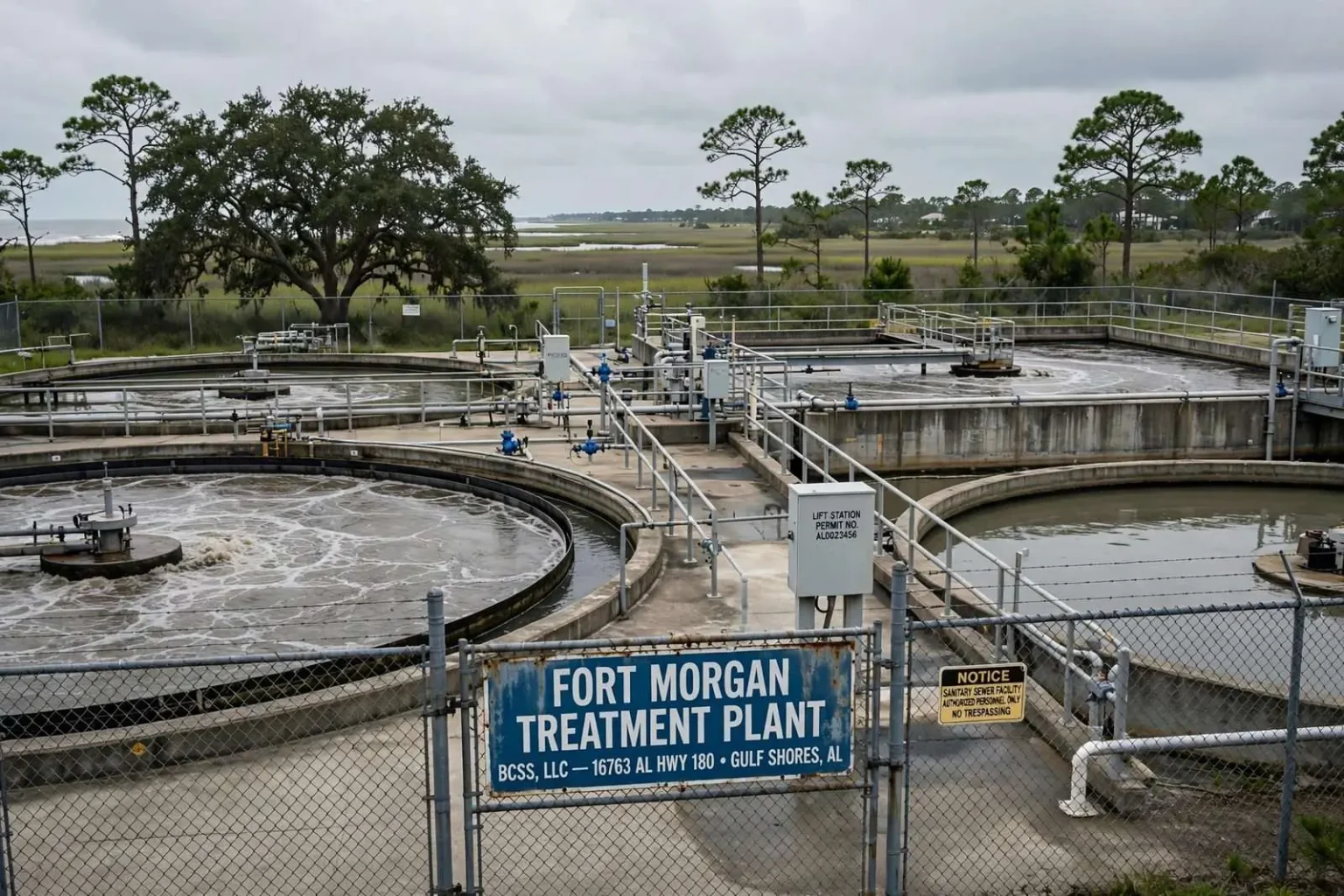
State environmental regulators are moving to penalize Baldwin County Sewer Service over conditions at its Fort Morgan treatment plant, proposing a Consent Order and an $18,000 civil penalty for what they describe as multiple environmental violations at the facility.
The Alabama Department of Environmental Management outlined the proposed action against BCSS, LLC, in a public notice. According to the proposed Consent Order, the violations at the plant — located at 16763 AL Hwy 180 in Gulf Shores — include exceedances of permitted flow volumes and of Biological Oxygen Demand limits. ADEM also cited the utility for unpermitted discharges in the form of Sanitary Sewer Overflows, and for failing to report those overflows to the department within 24 hours of becoming aware of them.
Members of the public have 30 days from publication of the notice to submit written comments on the proposal or to request a hearing. Until that window closes and ADEM acts, the Consent Order remains a proposal rather than a final order.
What the Order Would Require
If issued, the Consent Order would obligate BCSS to do considerably more than write a check. The company would be required to submit a detailed Engineering Report setting out corrective actions, along with a schedule-based Compliance Plan tying those actions to deadlines.
Two additional requirements point beyond the immediate violations toward the plant’s longer-term future. BCSS would have to submit a complete Underground Injection Control permit modification application, and it would have to produce a report examining the feasibility of alternative options for discharging its treated wastewater.
That last item is significant in a case that has centered for years on the question of what the Fort Morgan plant does with what it treats. A feasibility study of alternative discharge options is, in effect, a regulator asking a utility to show its work on whether the current arrangement is the only one available.
What a Consent Order Is
A Consent Order is a negotiated enforcement instrument. Rather than litigating alleged violations, the regulator and the regulated party agree to a document that typically recites the violations, imposes a civil penalty, and — most importantly from a practical standpoint — commits the party to a schedule of corrective work enforceable by the agency.
The advantage of the format is speed and certainty. Contested enforcement can take years, during which the underlying problem may continue. A Consent Order can put a compliance schedule in place in months. The trade-off is that the penalty attached to a negotiated order is usually smaller than what a contested case might ultimately produce, which is one reason such orders draw criticism from residents who have lived with a problem for a long time.
It is also why the compliance obligations in an order often matter more than the dollar figure. An $18,000 penalty is a modest sum for a utility. An enforceable engineering report, a schedule-based compliance plan and a mandatory feasibility study of alternative discharge routes are commitments with a longer reach.
Sanitary Sewer Overflows and the 24-Hour Rule
A Sanitary Sewer Overflow is exactly what the term describes: raw or partially treated sewage escaping from a collection system or treatment facility at a point that is not a permitted outfall. Overflows surface through manholes, through cleanouts, through pump station wet wells, and sometimes through building plumbing. Common causes include blockages from grease and debris, pipe failures, pump or power failures at lift stations, and hydraulic overload during heavy rainfall when groundwater and stormwater infiltrate an aging pipe network.
Because an SSO releases untreated wastewater outside the terms of a permit, it is an unpermitted discharge and a violation in its own right. Discharge permits also impose a separate, independent obligation to notify the regulator promptly — commonly within 24 hours of the operator becoming aware of the event.
That reporting duty exists because the regulator’s response depends on timing. Prompt notice allows the agency to evaluate whether nearby waters, shellfish areas or recreational beaches need to be posted or sampled, and it allows the public to be warned while a warning still has value. A late report cannot recover that window. ADEM’s citation of BCSS for failing to report overflows within 24 hours is therefore a distinct allegation from the overflows themselves.
Reading the Numbers: Flow and Biological Oxygen Demand
The two exceedance categories named in the proposed order describe different kinds of strain on a treatment plant.
Flow volume limits cap how much wastewater a facility is permitted to accept and discharge, typically expressed as a daily or monthly average in millions of gallons per day. The limit is not arbitrary; it reflects the capacity of the treatment units and the assimilative capacity of wherever the effluent ends up. Exceeding permitted flow generally signals that the service area has grown, that infiltration is adding clean water to the system, or both. On a peninsula with heavy seasonal tourism, flows can also swing sharply between the off-season and peak weeks.
Biological Oxygen Demand, usually written as BOD, measures something less intuitive. It is the amount of dissolved oxygen that microorganisms will consume while breaking down the organic material in a water sample over a standard test period, ordinarily five days at a controlled temperature. The result is reported in milligrams per liter and functions as a proxy for how much biodegradable organic pollution the water carries.
BOD matters because oxygen in a natural water body is finite. When effluent with a high oxygen demand reaches a stream, lagoon or bay, the bacteria that consume the organic load draw down dissolved oxygen that fish and other aquatic life depend on. Severe cases produce hypoxic conditions and fish kills. A BOD exceedance in an effluent sample means the treatment process is not removing organic material to the degree the permit requires — the biology inside the plant is not keeping pace with what is coming in.
Underground Injection Control Permits
The Underground Injection Control program is a federal Safe Drinking Water Act program, administered in Alabama by ADEM, that regulates the placement of fluids into the subsurface through wells. Its central purpose is protecting underground sources of drinking water: a UIC permit specifies what may be injected, into which geologic zone, at what rate and pressure, and with what monitoring, well construction and mechanical integrity testing.
Injection is one of the disposal routes available to wastewater utilities in coastal settings where surface discharge is constrained. Where it is used, the UIC permit — not a surface discharge permit — governs the practice, and any change in injection volumes, well configuration or operating conditions requires the permit to be modified rather than simply exceeded.
The proposed Consent Order’s requirement that BCSS submit a complete UIC permit modification application, paired with the requirement to study alternative discharge options, suggests regulators want both the existing arrangement properly authorized and the alternatives properly examined.
A Plant Older Than Its Neighbors
The proposed penalty is the latest chapter in a long and contentious history. The Fort Morgan plant was originally constructed in 1986, in what was then an unzoned, unincorporated part of Baldwin County. Over the decades that followed, the Alabama coast changed around it. Residential neighborhoods grew up directly against a facility that had been sited when there was little nearby to object.
BCSS officials have leaned on that chronology in defending the plant, arguing that “the residential development has come to the facility,” which was operating long before the surrounding homes existed.
The argument is not without force as a matter of sequence, and it describes a pattern familiar across the Gulf Coast, where treatment plants, industrial sites and airports built on the edge of settlement have been overtaken by the growth they helped make possible. It has proved considerably less persuasive to the people who now live beside the plant.
The Sludge Pond and the Cease-and-Desist Order
Local residents and watchdog groups — notably the Little Lagoon Preservation Society — have raised sustained environmental and quality-of-life objections to the facility’s operations.
Tensions escalated sharply in late 2021, when BCSS constructed a 1-million-gallon sludge processing pond on the property without obtaining a permit from the City of Gulf Shores. The pond was built less than 100 feet from a subdivision. Residents of the neighboring Little Lagoon Mobile Home Park were subjected to severe odors and swarms of insects.
Sludge is the solid residue that wastewater treatment concentrates and removes, and processing it is an inherently odorous business. Distance and enclosure are the usual mitigations. Fewer than 100 feet of separation from homes offers little of either.
The City of Gulf Shores responded in May 2022 with a cease-and-desist order halting use of the sludge pond. The city classified the pond as an illegal expansion of a nonconforming use in a residential zone — a determination upheld by the city’s Zoning Board of Adjustment.
That phrase carries specific meaning in zoning law. A nonconforming use is a use that lawfully predates current zoning and is permitted to continue in its existing form, but generally may not be enlarged or intensified. Under that framework the plant’s 1986 origins protect what it was, not what it later became. Adding a million-gallon sludge pond was treated as an expansion the exemption did not cover — an answer, in effect, to the argument that the neighborhoods came second.
How the Comment Period Works
Before a proposed Consent Order becomes final, ADEM must publish notice of it and accept public comment for 30 days. Anyone may submit written comments during that period, and anyone may request a hearing.
Comment periods on enforcement documents are narrower in scope than many people expect. The question before the agency is whether the proposed order — its findings, its penalty and its corrective requirements — is appropriate, not whether the facility should exist. Comments that engage with specifics tend to carry the most weight: documented odor or overflow events with dates, observations about receiving waters, or arguments that a compliance schedule is too slow or a required study too narrow.
The agency is obligated to consider timely comments before finalizing the order, and it may modify the order in response. It may also proceed as proposed. Residents who wish to comment or request a hearing should follow the instructions in ADEM’s published notice, which specifies where submissions must be sent and the exact date the 30-day window closes.
What Comes Next
For now the Fort Morgan plant remains in the position it has occupied for years: a facility older than the neighborhoods around it, operating under scrutiny from a state regulator, a municipal government and organized residents at the same time.
If the Consent Order is issued as proposed, the documents that follow — the Engineering Report, the Compliance Plan, the UIC permit modification application and the alternative discharge feasibility report — will offer the clearest public picture yet of what BCSS intends to do with the plant and how quickly. Whether those filings satisfy the people living nearest to it is a separate question, and one that a 30-day comment period is unlikely to settle.