

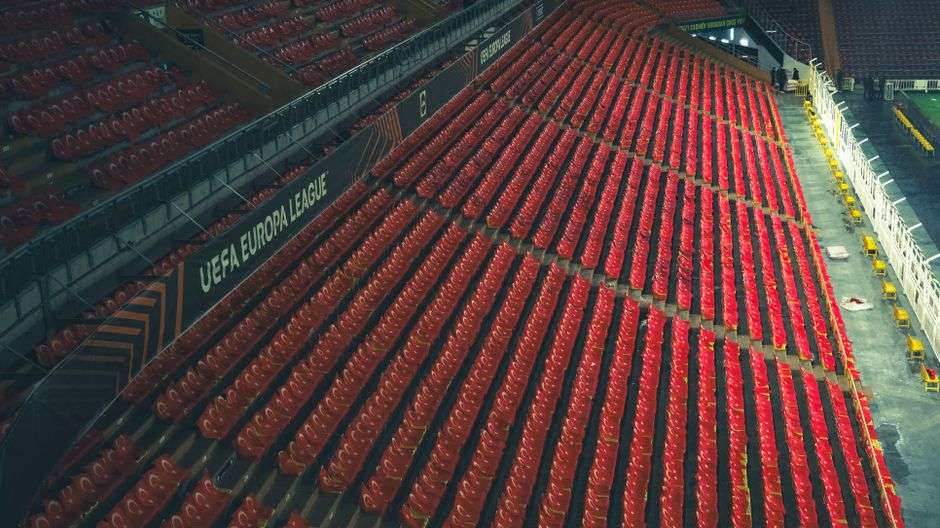
The University of South Alabama’s new on-campus football stadium, Hancock Whitney Stadium, was built to hold more than 25,000 fans. But as the university finalizes its plans for the 2020 football season, athletic officials say fewer than 10,000 spectators may be allowed inside for home games because of pandemic-related restrictions.
South Alabama Athletic Director Joel Erdmann said the department is preparing for the possibility that stadium capacity will be limited to as little as 25 percent of normal seating this fall, a reduction that could cost the athletic program roughly $2 million in revenue for the season.
“The ticket revenue, the walk-up sales revenue, and the parking revenue really start to decrease,” Erdmann said of the financial impact a reduced-capacity season would have on the department’s budget.
A debut like no other
The Jaguars are scheduled to christen the new stadium’s playing surface on September 26 against the University of Alabama at Birmingham, a matchup that will take place under significantly altered circumstances compared to what university officials had originally envisioned for the long-awaited venue’s debut.
Several of the season’s marquee matchups have either been canceled outright or will now be played in front of sharply limited crowds because of the coronavirus pandemic.
Erdmann pointed to a trio of games that had been expected to draw sellout crowds to the new facility. “The game against Grambling would have been a sellout. The game against UAB would have been a sellout. The same against Troy would have been a sellout,” he said.
What the stadium means to the program
The campus stadium was designed to be the permanent home of a football program that is, by college standards, still young. South Alabama fielded its first team barely more than a decade ago, playing its early games in front of remarkable crowds at Ladd-Peebles Stadium while the program climbed from club-level beginnings into Division I competition and, eventually, the Sun Belt Conference. Moving onto campus was always about more than bricks: it was meant to fold football into the everyday life of the university, putting students within walking distance of the game and giving the program a home that belongs to the school rather than a facility shared with the city.
That ambition makes the pandemic constraints doubly frustrating. A first season in a new stadium is a once-only event — the opener, the sellouts, the sense of occasion that never repeats. Instead, the Jaguars’ christening will unfold before a fraction of the crowd it was built for, with seats roped off, tailgating curtailed and the usual pageantry trimmed to whatever health guidance allows.
The financial arithmetic compounds the disappointment. College athletic departments are unusual enterprises: football revenue does not merely sustain football, it helps carry the non-revenue sports, the academic support services and the operational costs that ticket sales quietly subsidize. Remove $2 million from a department of South Alabama’s size and the effects ripple well past the football offices — into budgets that fund travel for Olympic sports, staffing and the maintenance of facilities across the program.
The ripple effect beyond campus
The financial strain extends well beyond the university’s own books. Restaurants and hotels near the South Alabama campus had been counting on the new stadium to draw larger crowds, visiting fans and weekend travelers into their businesses this fall. With tailgating scaled back and out-of-town crowds unlikely to materialize in normal numbers, many of those nearby businesses are bracing for a slower season as well.
“It’s going to limit exposure. It’s going to limit pedestrian and vehicle traffic,” Erdmann said, acknowledging the ripple effect the reduced attendance is expected to have on the surrounding area.
Game days are among the most reliable economic events on any college town’s calendar. A home football Saturday concentrates thousands of people — many of them visiting fans with money to spend on meals, lodging and fuel — into a neighborhood for an afternoon and evening. The new stadium was expected to amplify that effect for the businesses along the corridors near campus, which had watched the construction progress with the interest of stakeholders. A season played before one fan in four converts that expected windfall into a fraction of itself, and for restaurants and hotels already weathering a difficult year, the loss of six or seven robust Saturdays is not a rounding error.
Still unfolding
University officials have not yet finalized exact attendance figures for the season, and any plan will likely depend on guidance from local and state health officials as the pandemic evolves.
That uncertainty has been the defining condition of college athletics in 2020. Conferences across the country spent the summer revising schedules, canceling non-conference games and drafting attendance policies that could change from week to week. For South Alabama, the opener against UAB — a regional rivalry with natural draw on both sides — was supposed to be the loudest afternoon the new stadium had ever heard. Planning for it has instead meant preparing for the quietest version of the same event, with every scenario from socially distanced general admission to empty stands on the table.
Despite the setback, Erdmann struck an optimistic tone about the stadium’s future once public health conditions allow for a return to normal capacity. “The end of that tunnel, we will get to the other side of this. When we do get to the other side of this, then the capabilities of Hancock Whitney Stadium will be on full display to everyone,” he said.
How departments are adapting
South Alabama’s athletic department, like those at colleges and universities across the country, has had to weigh public health guidance against the financial realities of operating a major athletics program without the ticket and concession revenue that full stadiums typically generate.
The adjustments are both immediate and structural. In the short term, departments facing reduced gate revenue have leaned on reserves, spending discipline and whatever television and conference distributions remain stable. In the longer term, seasons like 2020 are teaching athletic administrators to build budgets less dependent on a single revenue stream — spreading risk across donations, media rights and sponsorships so that one empty fall does not destabilize everything else the department does.
There are smaller adaptations as well. Reduced-capacity seating changes how tickets are sold: season-ticket holders may be relocated to spread fans apart, single-game walk-up sales may be limited or eliminated entirely, and mobile ticketing replaces cash at the gate to minimize contact. Parking lots that once filled with elaborate tailgate setups may operate at reduced capacity or with different rules entirely. Each of those changes has a customer-relations dimension as well as a financial one, since fans asked to accept new rules in a new stadium are forming their first impressions of the venue under unusual conditions.
What fans can expect at the gate
While final attendance policies remain in flux, the direction is clear. Expect ticket sales to run through accounts rather than cash windows, expect sections to be sold in blocks that keep parties together and apart from their neighbors, and expect concourse amenities to be trimmed to the essentials. Face coverings, entry screening and sealed or staff-served concessions are the standard playbook at stadiums operating under health restrictions, and South Alabama will be applying its own version of those measures under whatever guidance local and state officials set for Mobile County in September.
Season-ticket holders — many of whom bought in specifically to be part of the stadium’s first season — face the strangest trade-off of all: the right to be present for history, in a venue that history will barely notice them filling. How the university communicates those seating changes, and how generously it credits accounts for seats it cannot sell, will shape goodwill toward the stadium long after the pandemic fades.
The longer view
The stadium itself, a long-anticipated project for the university and the surrounding Mobile community, represents a significant investment in South Alabama’s athletic infrastructure. Its opening season was expected to be a showcase moment for the program and a boost for local businesses that serve game-day crowds. Instead, the 2020 season will serve as a test of how college athletics departments adapt financially to operating under public health restrictions.
If there is a consolation in the timing, it is that the stadium’s story does not hinge on any single season. Buildings outlast disruptions. The 25,000-plus seats will still be there when crowds return, and the rivalries — Grambling, UAB, Troy — will come around again with sellout demand behind them. What 2020 will leave instead is a stranger kind of memory: the year the Jaguars finally came home, played well beneath a half-empty bowl of a stadium, and proved the program and its supporters could carry an unfinished celebration until the crowds were allowed back to finish it.