$1.25 Billion Youth Football Lawsuit Against Gulf Shores Quietly Settled
A $1.25 billion lawsuit stemming from a 2016 sideline dispute at a Gulf Shores youth football game has reportedly been settled just before it was set to go to trial.
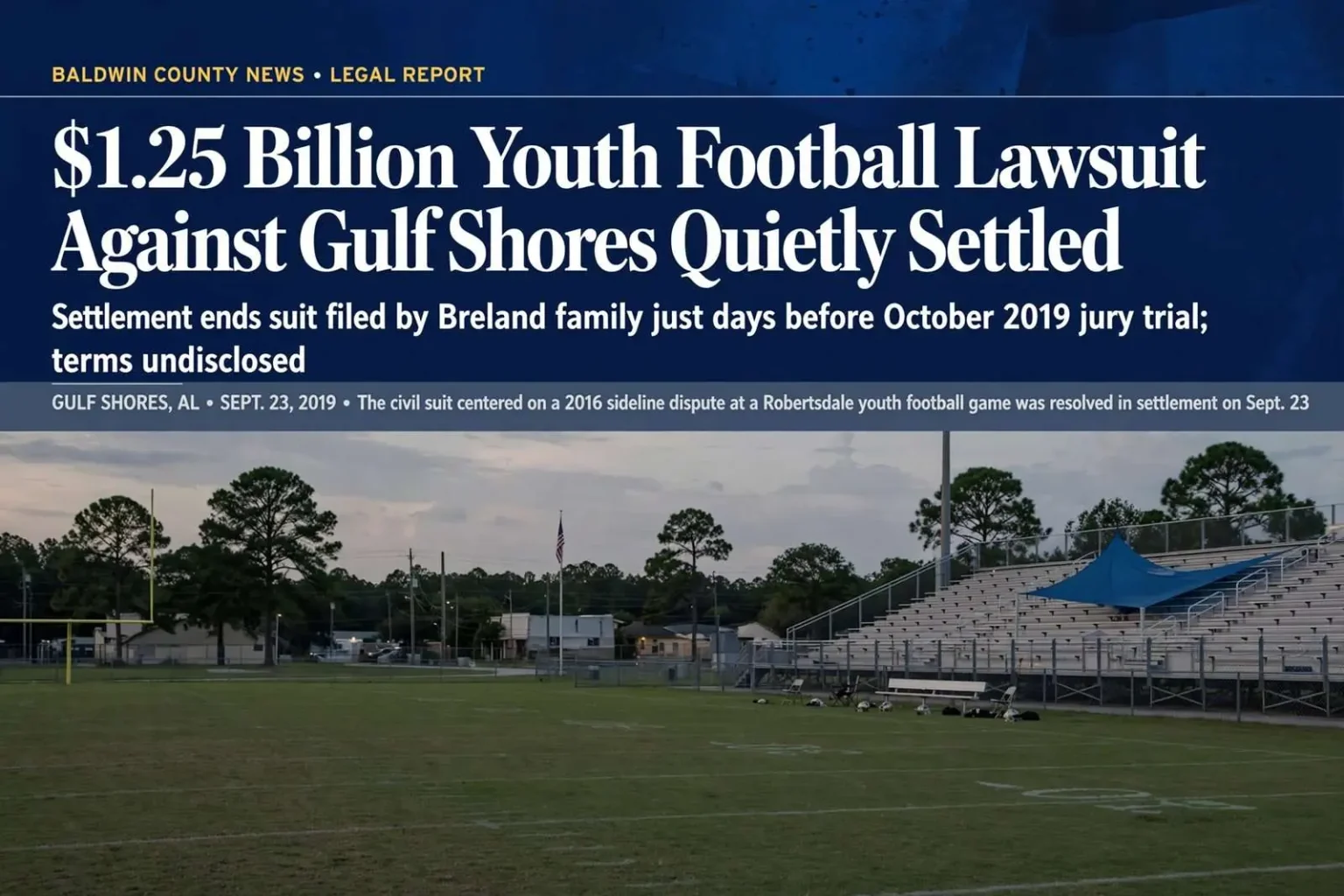
A civil lawsuit that sought an eye-popping $1.25 billion over a sideline dispute at a Baldwin County youth football game has reportedly ended in a settlement, closing out a case that had been headed for a jury trial in Baldwin County Circuit Court. The suit, filed by Jessica and Robert Breland on behalf of their minor son, named the city of Gulf Shores, two Gulf Shores recreation league football coaches and another parent as defendants.
A jury trial had been scheduled to begin Oct. 7, 2019, but Circuit Judge J. Clark Stankoski signed an order on Sept. 23, 2019, indicating the parties had reached a settlement.
Terms of the agreement were not disclosed, and none of the parties or their attorneys responded to requests for comment. Chris Callaghan represented the Brelands, while the city and its employees were represented by Andrew Rutens of the Galloway, Wettermark & Rutens law firm.
Despite the astronomical dollar figure attached to the original filing, the underlying dispute traced back to a single evening at a youth football game in Robertsdale in September 2016. According to the lawsuit, Jessica Breland had set up a sunshade in the stands intending it for a pregnant spectator and elderly family members who were expected to arrive.
When children belonging to another parent, Rebecca Walker, sat under the shade first, Breland told them they would need to move once the intended guests arrived. The complaint alleges that confrontation escalated quickly.
“In the middle of the football game, Walker came over to Mrs. Breland and verbally assaulted her by getting within inches of Mrs. Breland’s face and calling her a ‘f*****g b***h,’ and telling her, ‘You wanna go G*****n ghetto, we’ll go G*****n ghetto,’” the lawsuit states. “Ms. Walker’s unwarranted and iniquitous reason for attacking Mrs. Breland was because Mrs. Breland asked Ms. Walker’s daughters to give up the seats where they were sitting under Mrs. Breland’s canopy so that a pregnant woman and some elderly spectators could sit under the canopy.”
Game officials reportedly had to intervene, threatening to eject the entire Gulf Shores youth team from the stadium unless the situation was defused. According to the complaint, Gulf Shores coach Jason Byrd initially hesitated to confront Walker because she is married to assistant coach Dequinton Clark, a co-defendant in the case.
“It was not until the referees threatened to end the game and eject the entire Gulf Shores little league football team from the stadium that Coach Byrd finally went over to Walker and told her to ‘shut up,’” the suit states. The Brelands claimed that confrontation was not an isolated incident, alleging a broader pattern of behavior by Walker that city recreation staff failed to address.
The lawsuit describes a follow-up incident on Oct. 3, 2016, in which Walker allegedly walked onto the practice field and, in front of coaches, players and parents, said, “I’ve got to get the f**k out of here before I blow my G*****n stack… I’m so sick of this b***h.” The family said repeated complaints to Gulf Shores Athletics Coordinator Mark Perkins and his supervisor, Ralph Pereda, went unheeded.
The dispute culminated, according to the suit, when the Brelands’ son was removed from the team. The family says they were not told directly and instead learned of the decision when they arrived for a game in Fairhope.
There, recreation department employee David Dryer allegedly informed them their son was banned from further games and practices and demanded he surrender his equipment on the spot. “Dryer refused and demanded [their son’s] pads and uniform, publicly humiliating him,” the complaint states, adding that the boy was made to strip down to his underwear in front of teammates and ride home that way.
The Brelands’ complaint included a claim for outrage, seeking $250 million from all defendants and arguing the conduct “was so outrageous in character and extreme in degree as to go beyond all possible bounds of decency, and are to be regarded as atrocious and utterly intolerable in a civilized society.” Additional claims — harassment against Walker, slander against Byrd and Dryer, libel against Perkins over a letter sent to supervisors, and wantonness against all defendants — each sought another $250 million, bringing the total demand to $1.25 billion. The suit also included non-monetary negligence claims against the city related to hiring, training and supervision of its recreation employees.
In a November 2017 motion to dismiss, the defendants denied the Brelands’ account, contending the dispute actually stemmed from Jessica Breland being passed over for a “team mom” appointment. They maintained the boy was not kicked off the team outright but was barred from participating in the season’s final two games.
Attorneys for the city argued that under Alabama law, “shocking conduct is often deemed… insufficient to create a jury question,” and that even if the allegations were accurate, the conduct did not rise to the level required to sustain a claim of outrage. The city also argued the disputed statements to supervisors were privileged internal communications rather than public defamation, and that coaches Byrd and Clark, as volunteers, were immune from liability.
With the settlement reached just before trial, the substantive legal questions raised in the case — including how far volunteer-coach immunity extends and what obligations cities have to supervise recreation department employees — were resolved privately rather than decided by a jury.
Alabama’s tort of outrage
The largest single claim in the suit was for “outrage,” Alabama’s name for the tort of intentional infliction of emotional distress. The Alabama Supreme Court first recognized the claim in 1980 in American Road Service Co. v. Inmon, and it has since described outrage as an extremely limited cause of action, one it has upheld mainly in a narrow set of circumstances such as wrongful conduct involving family burials, coercive insurance settlement tactics and egregious sexual harassment. That high bar is what the city’s attorneys were invoking when they argued the alleged conduct was not enough to put the claim before a jury.