AltaPointe Doctors Push Back as Mobile Council Weighs $200,000 Funding Shift
AltaPointe Health System physicians packed a Mobile City Council meeting to oppose a proposed $200,000 cut to the nonprofit's city funding, which would be redirected to Veterans Recovery Resources under a councilman's budget amendment.
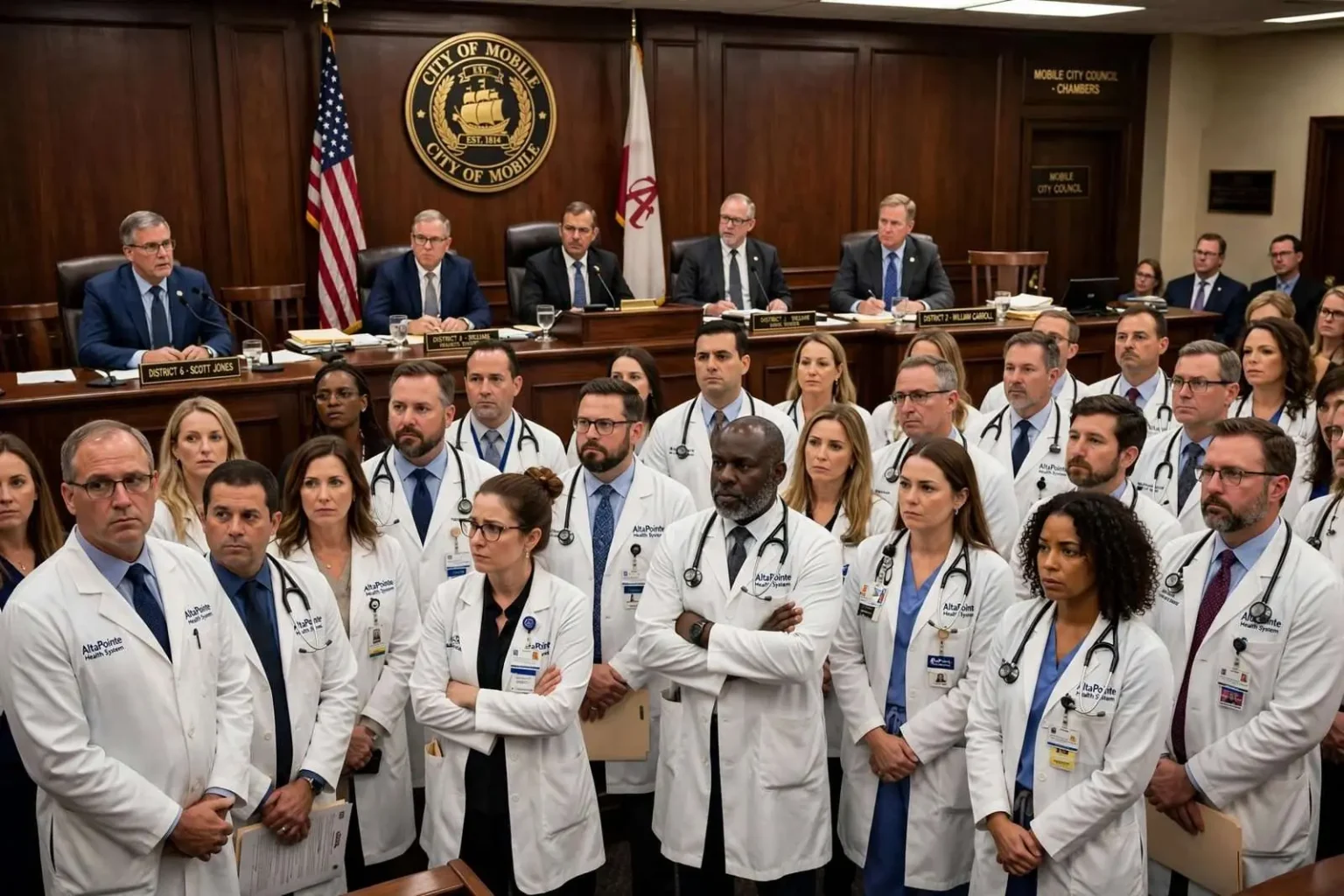
A group of roughly 30 physicians in white coats filled a Mobile City Council meeting this week as leaders of AltaPointe Health System defended the nonprofit’s mental health work amid a proposal that would shift $200,000 of its city funding to a separate veterans’ recovery program. The turnout was deliberate and unmistakable: a room full of clinicians, in the uniforms of their profession, standing behind a budget line. Few budget amendments have drawn that kind of visible professional backing to the council chambers, and the sight made the stakes plain before anyone spoke.
What the money does
AltaPointe has for several years received a $600,000 performance contract from the city of Mobile to support operations at its EastPointe Hospital in Daphne, which treats indigent patients referred by the Mobile County Probate Court. The arrangement links two ends of the mental health system that rarely share a room: the Probate Court, which under Alabama law handles involuntary commitment hearings for people in crisis, and the psychiatric hospital that receives them when a judge signs the order. Mobile residents committed by the court end up at EastPointe regardless of their ability to pay, and the city contract exists to keep that bed space available.
A proposed amendment to the city’s fiscal year 2023 budget, introduced by District 6 Councilman Scott Jones, would cut that contract to $400,000 and redirect the remaining $200,000 to Veterans Recovery Resources, a Mobile-based facility that provides addiction recovery and mental health services to veterans, first responders and their families, along with indigent patients. The amendment set up a classic municipal collision: two nonprofits serving overlapping populations, each with a claim on a finite pot of city money, and a council that must choose between them or find a third path.
Parker: ‘Let us keep our money’
AltaPointe Chief Medical Officer Dr. Sandra Parker told council members the proposed cut would hurt the hospital’s ability to treat patients who cannot pay for care. She said a majority of patients at EastPointe Hospital are uninsured, and that caring for those indigent patients already costs the hospital about $4 million a year in lost revenue.
“We find it discouraging that now, with the rate of depression skyrocketing in our community, that anyone would consider reducing our budget,” Parker told the council. “We don’t mind anyone else getting money, but what we don’t want is to have our money reduced. Let us keep our money to serve our patients.”
District 2 Councilman William Carroll pressed Parker on what specifically would be lost if the funding reduction is approved. Parker said the cut would directly limit the hospital’s capacity to admit patients and could ultimately require staff reductions at a facility already operating with tight margins. The answer, in practical terms, meant fewer beds for Probate Court referrals — which is to say, people ordered into treatment by a judge waiting longer for placement, or being held elsewhere while they wait.
The scale of the system
AltaPointe CEO Tuerk Schlesinger, responding to questions from Jones, said the organization receives about $75 million a year in combined federal and state grant funding and serves as the primary depository of state mental health dollars for Mobile, Baldwin and Washington counties. The figure put the $600,000 city contract in perspective: a rounding error beside the state and federal totals, but the kind of flexible local money that grant funding rarely provides.
Despite that scale, Schlesinger said AltaPointe operates on thin margins, netting roughly $450,000 in profit annually while still struggling to fund employee raises and fill about 200 vacant staff positions. “Two hundred thousand dollars would pay for 12 or 13 nursing assistants,” Schlesinger said, framing the proposed cut in terms of direct patient-facing staff. In a labor market where hospitals across the Gulf Coast have been competing for the same clinical workers, the arithmetic was meant to translate a budget line into faces around a ward.
Schlesinger acknowledged under questioning that AltaPointe had, within the previous two weeks, possibly turned away patients because of limited bed space. He maintained that the organization is meeting the terms of its performance contract with the city by continuing to serve patients referred through the Mobile County Probate Court, even as the arrangement runs at a loss. He put the hospital’s total losses tied to those services at roughly $9 million.
“Seventy-one percent of our patients are uninsured,” Schlesinger said. “We have to piece together revenue to make that hospital work.” The phrase captured the financial model of a public-serving psychiatric hospital in the American safety net: bill whoever can be billed, draw down grant dollars wherever they exist, and absorb the rest as a loss subsidized by a patchwork of contracts from governments that use the beds.
The council members’ questions tracked the two ways a cut of this kind can be defended or attacked. One view holds that an organization pulling down $75 million in outside funding should be able to absorb a reduction, particularly when a smaller nonprofit with a distinct mission stands ready to use the money. The other holds that the contract is not charity but payment for a specific service — court-ordered psychiatric beds for Mobile residents — that cannot simply be shifted to another provider without consequences somewhere in the system.
The case for Veterans Recovery Resources
Supporters of shifting funding toward Veterans Recovery Resources argued the smaller nonprofit fills a distinct need. John Kilpatrick, the organization’s founder and owner, told the council his program has grown from a single employee in 2019 to 29 staff members today, and that about 80 percent of the patients it serves are unable to pay for treatment.
Kilpatrick said his organization is well positioned to help address the region’s mental health needs, particularly among veterans and first responders. The population is not a small one in Mobile: the Gulf Coast is home to a large veteran community, and police officers, firefighters and paramedics absorb the kind of repeated trauma that mental health clinicians have come to treat as an occupational hazard rather than a private failing. Programs built specifically for that population — where patients sit in groups with others who share the experience — have argued for years that mainstream clinics, however capable, are not the same fit.
“VRR is part of the solution,” Kilpatrick said. “We ask you to approve the amendment to the budget and allow funding to VRR.” The request framed the amendment as an addition to the city’s mental health capacity rather than a raid on one provider for the benefit of another — a framing AltaPointe’s leadership did not accept, since every dollar redirected came out of a contract already funding services the city court system relies on.
A broader tension
The debate reflects a broader tension facing the council as it finalizes the city’s annual spending plan: balancing support for an established provider that already receives substantial state and federal money against a newer organization built specifically to serve veterans and first responders, a population advocates say is often underserved by larger systems. Every growing city confronts versions of this question as its nonprofit sector expands — whether to concentrate funding where the systems are strongest, or to seed new institutions aimed at gaps the big systems leave open.
Following the regular meeting, the council held a second finance committee session to continue discussing the budget amendment. The spending plan is scheduled to return to the full council’s agenda at its meeting on Tuesday, Sept. 27, when members are expected to take up the funding question again before finalizing the fiscal year 2023 budget. Between now and then, the two organizations will be counting votes in the chamber — one with a roomful of white coats behind it, the other with a growth story and a mission tailored to the city’s veterans and first responders.
The white-coat turnout also carried a message about who ultimately absorbs a cut. The physicians in the chamber were AltaPointe employees lending their presence to an argument about dollars, but the residents of Mobile who use the mental health system rarely appear at budget hearings at all: people in psychiatric crisis, families navigating a Probate Court commitment, veterans who stopped asking for help years ago. Budget decisions of this size are made about them without them, which is why the providers who serve them show up in person.
How the council resolves the question will set a precedent for future budget cycles as well. If the city is willing to reduce an existing performance contract midstream to fund a newer organization, other nonprofits will read that as a signal about the durability of city commitments; if it preserves the contract and finds separate money for veterans’ services, the council will have affirmed that established obligations are honored even as new needs are addressed. Either path costs money, and the Sept. 27 meeting is where the council will say which one it is taking.