AltaPointe, Mobile County Probate Court Still at Odds Over Doctor Testimony Rules
A brief agreement between AltaPointe Health System and Mobile County Probate Judge Don Davis over whether psychiatrists must testify at involuntary commitment hearings has unraveled, with attorneys for both sides still negotiating over who can appear in doctors' place.
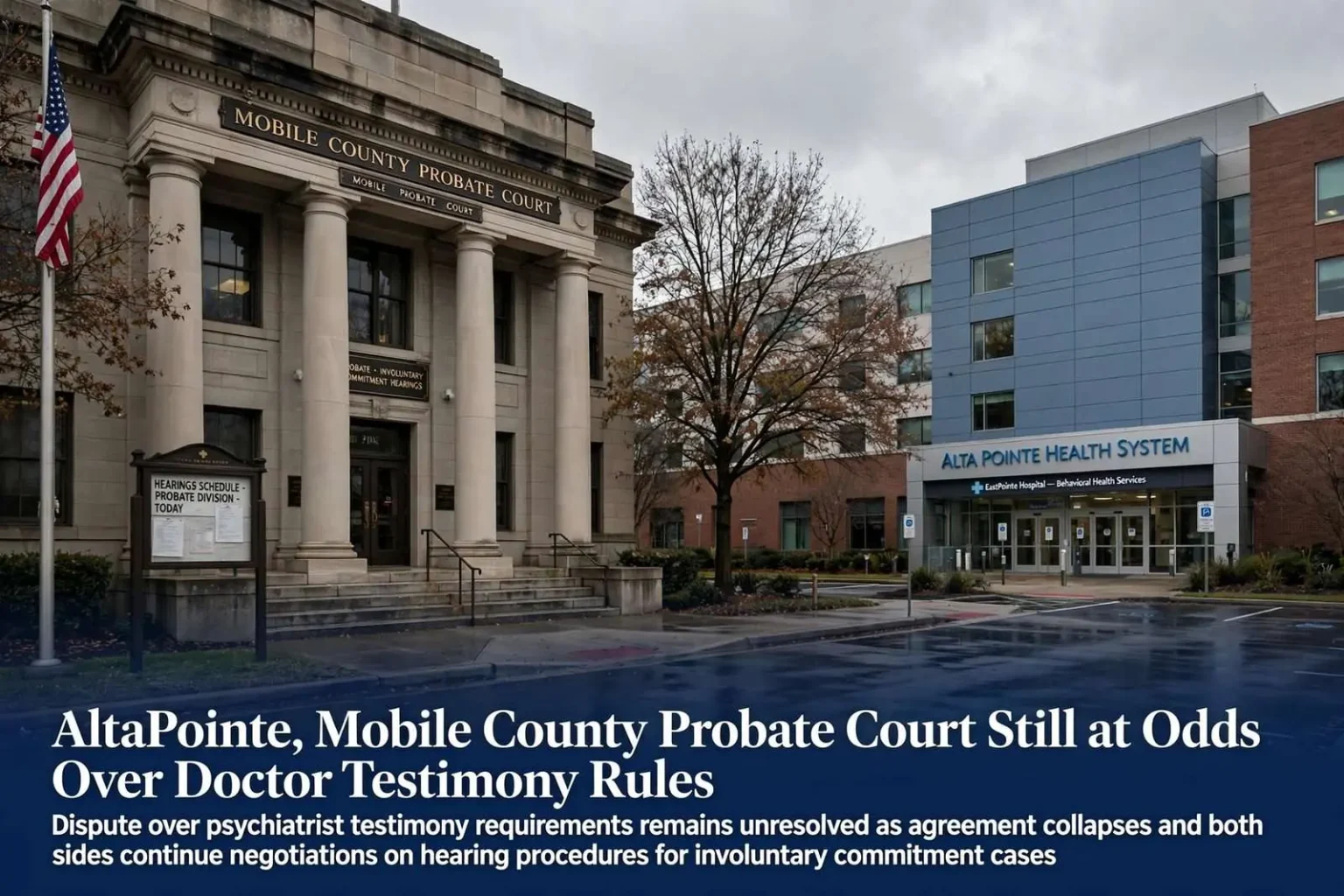
A dispute between AltaPointe Health System and Mobile County Probate Judge Don Davis over courtroom procedures in involuntary commitment cases remains unsettled, after an agreement that appeared to resolve the disagreement last week fell apart within days.
The disagreement centers on a requirement, imposed by Davis for nearly three years, that AltaPointe psychiatrists personally testify at merit hearings held to determine whether a person involuntarily committed for psychiatric observation needs continued treatment. Davis has said the rule grew out of concerns over inconsistencies in the medical record keeping at AltaPointe’s EastPointe Hospital in Daphne, where many of the patients at issue are evaluated and treated.
AltaPointe Chief Executive Officer Tuerk Schlesinger has pushed back on the requirement, arguing that pulling psychiatrists away from their clinical duties to sit through hearings takes time away from patient care. Schlesinger has asked the court to allow master’s-level clinicians to appear at the hearings in doctors’ place, a request that appeared close to being granted last week before the two sides’ interpretations of a proposed compromise diverged.
AltaPointe spokeswoman Carol Mann said Monday that attorneys representing the health system and the court were meeting privately in an attempt to iron out a new agreement on hearing procedures. Under the proposal being discussed, AltaPointe doctors would not be required to testify at every merit hearing, but could be called to appear if attorneys or the court determined it was necessary. Davis has also said attorneys would be permitted to interview doctors directly at the Daphne hospital when needed.
The unresolved sticking point is who, exactly, is qualified to testify in a doctor’s absence. Mann said Davis had agreed to allow master’s-level clinicians to testify, which is what AltaPointe had requested from the outset. But Probate Court General Counsel J. Michael Druhan said the judge’s position requires a Ph.D.-level psychologist to testify under the proposed guidelines, not a master’s-level clinician. Druhan added that AltaPointe doctors have agreed to submit letters to the court during the hearing process, and said an attorney representing a patient could still subpoena a treating doctor to testify in person if circumstances warranted it.
Attorneys who regularly represent patients at the hearings offered mixed reactions to the standoff. Desi Tobias, a partner in the Midtown law firm of Tobias, McCormick and Comer who represented six patients at merit hearings last week, said he supports Davis’ approach and was disappointed to see the agreement falter.
“The agreement was reasonable and professional,” Tobias said.
Fellow firm partner Bryan Comer, who has a client scheduled for a hearing this week, said he was glad the framework still allows attorneys to call a treating doctor to the stand when needed. In the case he is currently handling, Comer said he has subpoenaed the attending physician because of discrepancies between the patient’s medical records and the doctor’s clinical opinion.
“It’s part of the vetting process to bring the doctor in to testify,” Comer said. “Medical records can be inconsistent, and you want the psychiatrist there to clear up that inconsistency.”
Comer said that in five of the six cases he observed last week, testimony from a clinician working off the medical records, paired with a doctor’s written recommendation, would likely have been sufficient. He said the value of the compromise framework is that it allows hearings to be handled on a case-by-case basis rather than under a blanket rule.
The dispute has also touched on how AltaPointe doctors and hospital staff have characterized their treatment in court. In earlier public comments, AltaPointe physicians complained that the time commitment required by the hearings disrupted their schedules, and raised concerns about how they were treated by attorneys and judges during proceedings. Comer disputed that characterization, saying doctors are cross-examined as part of the normal legal process but that hearings are consistently “polite and professional,” and typically last about 10 minutes.
During a transcript taken from last week’s merit hearings, Davis addressed what he described as a public relations effort by AltaPointe, calling on the health system’s leadership to apologize for what he characterized as a “media blitz” in recent weeks.
“I am calling publicly for an apology from AltaPointe’s board of directors to the respondents, their families, the lawyers involved in this case and the Mobile community for what has occurred,” Davis said, according to the hearing transcript. “Everyone needs to remember, AltaPointe is not a private corporation. This conduct that occurred is not acceptable in my view of any entity private, or public, but it’s even more reprehensible in my view because AltaPointe is owned by the citizens of Mobile and Washington counties.”
AltaPointe Health System serves as the primary community mental health provider for Mobile, Baldwin and Washington counties, operating outpatient clinics and inpatient psychiatric care, including at EastPointe Hospital in Daphne. Involuntary commitment hearings, sometimes called merit hearings, are held before the probate court to determine whether a person who has been involuntarily hospitalized for psychiatric evaluation should remain under care or be released.
Attorneys for both AltaPointe and the probate court said discussions over the final wording of the hearing procedures were ongoing, and it was not immediately clear when a resolution might be reached.
How Commitment Hearings Work
Alabama’s commitment law sets deadlines for these hearings. When a probate judge orders someone detained or temporarily treated while a commitment petition is pending, the judge must hold a probable cause hearing within seven days. The final hearing on the merits must take place within 30 days of the date the person was served with the petition.
At that final hearing, the probate judge can order inpatient commitment only if clear and convincing evidence shows that the person has a mental illness and, because of it, poses a real and present threat of substantial harm to themselves or others, among other findings the law requires. That standard is why testimony about a patient’s condition carries so much weight in these proceedings.