Baldwin County Commission Earns National Recognition for Budget Presentation
The Baldwin County Commission has been awarded the Government Finance Officers Association's Distinguished Budget Presentation Award, one of the top honors in municipal finance.
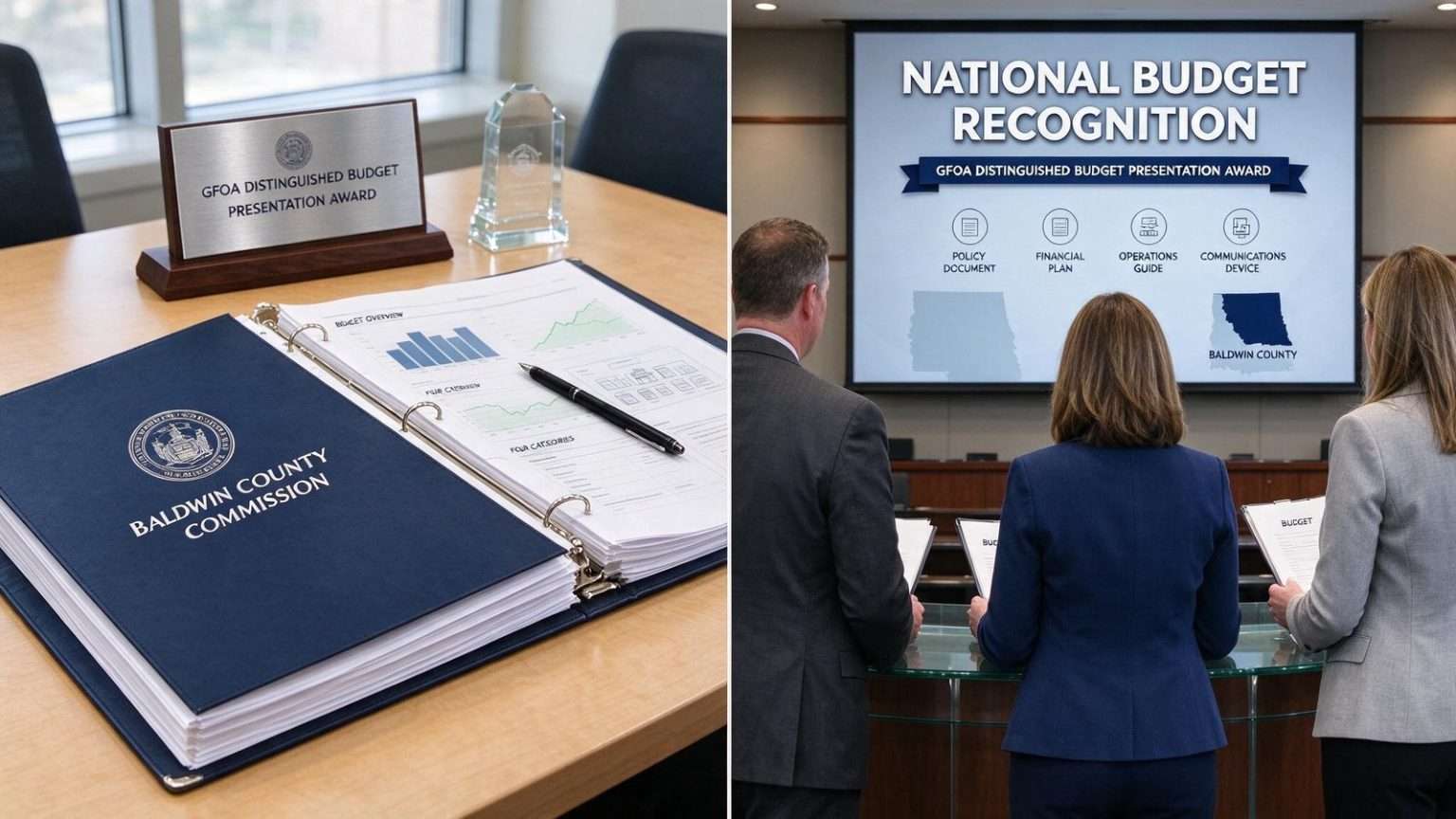
The Baldwin County Commission has been awarded the Government Finance Officers Association’s Distinguished Budget Presentation Award, one of the top national honors in municipal budgeting. The recognition underscores the commitment of the commission and its staff to the highest principles of governmental budgeting, according to a statement from the commission. For a county that has spent recent decades among the fastest-growing in Alabama, the award signals that its financial house is being kept in order that meets a national standard rather than merely a state one.
To earn the award, Baldwin County’s budget had to satisfy nationally recognized guidelines for effective budget presentation, judged on how well it serves as a policy document, a financial plan, an operations guide and a communications device. Budget documents must be rated “proficient” across all four of those categories, as well as 14 mandatory criteria within them, to qualify for the award. The four-part test gets at something residents rarely think about until they need it: a county budget is not just a ledger of revenue and spending, but the clearest public statement a commission makes about its priorities, and the quality of the document determines how well anyone outside the finance office can follow along.
More than 1,900 government entities participate in the Budget Awards Program across North America each year. The GFOA works to advance excellence in government finance by providing best practices, professional development opportunities, resources and practical research to more than 25,000 members and the communities they serve. Earning the distinction places Baldwin County in the company of governments across the continent that have volunteered their budget documents for outside review — a submission process in which trained reviewers judge the material against criteria designed to be demanding rather than symbolic.
What the Award Actually Measures
The GFOA’s four judging categories each capture a different function a good budget serves. As a policy document, the budget must clearly communicate the governing body’s goals and explain how appropriated dollars connect to those goals, so that residents can see not just what the county spends but why. As a financial plan, it must present a coherent picture of revenues, reserves, debt obligations and multi-year trends, giving readers confidence that the numbers were assembled through a disciplined process rather than assembled to fit a narrative.
The operations-guide standard asks whether the document helps county employees and department heads understand what they are funded to do and how performance will be measured — turning the budget from a static financial table into a working management tool. The communications-device standard, finally, judges whether the budget is usable by its widest audience: whether a resident with no finance background can find the information that matters, whether charts and summaries genuinely clarify, and whether the document explains the county’s decisions rather than merely recording them. The 14 mandatory criteria within those categories drill down into specifics such as organization charts, financial policies, goals and objectives, and long-range planning.
Because reviewers rate the document rather than the underlying financial condition of the government, the award is best understood as a transparency and craftsmanship honor. It says that Baldwin County publishes a budget that is complete, honest about its assumptions and genuinely readable — qualities that cost staff time and effort to achieve, and that many governments of similar size do not consistently deliver. Voluntary submission also matters: participation means inviting outside scrutiny of a public document, a posture that itself reflects well on the commission’s approach to its duties.
Baldwin County’s Fiscal Context
The award arrives in a county whose financial picture is unusually dynamic for Alabama. Baldwin County has been among the state’s fastest-growing counties for years, drawing new residents from across the Gulf Coast with its schools, beaches and quality of life along the eastern shore of Mobile Bay. Growth of that kind is a fiscal blessing and a fiscal challenge at once: property and sales tax revenues rise, but so do demands for roads, schools, public safety, sewer capacity and storm recovery — all of which a county commission must plan for in a budget document that anticipates several years of change rather than one.
The county’s geography adds another layer to its financial planning. Baldwin County is Alabama’s largest county by land area, stretching from Mobile Bay across to the Florida line, and encompassing the resort economies of Gulf Shores and Orange Beach, the agricultural middle of the county, and fast-growing suburban communities like Daphne, Fairhope and Spanish Fort that now anchor the eastern side of the Mobile metropolitan area. Commission districts that cover such different economies must share a single budget, and the document that wins a national award for presentation is the same one that has to make the case for infrastructure on the bay side and beach nourishment on the coast.
Storm exposure gives the budget process added seriousness. Baldwin County sits squarely in hurricane country, and its budgets have historically had to account for emergency response, debris removal and the long tail of recovery spending that follows Gulf storms. A budget document judged as a sound financial plan must therefore show how the county balances day-to-day services against reserve requirements and contingency planning — a discipline that matters most in the years residents hope never come.
The GFOA and National Standards
The Government Finance Officers Association, the body behind the award, is the professional association of public-sector finance officials in the United States and Canada, with roots going back to 1906. Its members include finance directors, treasurers, comptrollers and budget officers from governments of every size, and the association’s best-practice publications function as the de facto national standards for how local governments should present their finances. When the organization evaluates a budget for the Distinguished Budget Presentation Award, it is applying the accumulated expertise of that professional community — reviewers who have seen how the best governments in North America document their spending.
For county staff, preparing an award-caliber document is a months-long effort running alongside their regular duties. The budget must be drafted, reviewed with the commission, revised for clarity, illustrated and organized so that its structure mirrors the criteria reviewers are looking for. Achieving “proficient” ratings across every category and all 14 mandatory criteria on a submission of that complexity is the product of a finance office that treats public communication as part of its job description, not an afterthought.
What It Means for Residents
The practical takeaway for Baldwin County residents is that their county’s spending decisions are documented in a form designed to be found and understood. Anyone who wants to know how much the county spends on roads versus parks, how its reserves stand, or what its long-term debt looks like can open a document that has been certified as clear enough to meet a national communications standard. In an era when public trust in institutions often turns on transparency, an outside organization independently confirming the quality of that transparency is worth the county’s displaying with pride.
The award also carries a quieter competitive significance. Businesses considering relocating to Baldwin County, and bond-rating analysts who follow its finances, tend to read the same budget documents residents do; a nationally recognized presentation contributes to the county’s reputation for professional management. For a commission courting growth, that reputation is an asset in its own right — one earned not with a single big project, but with the patient, annual work of producing a budget document good enough to be called one of the best presentations in North American government finance.
A Standard Set by the Profession
The criteria behind the award are worth understanding because they describe what good government budgeting looks like everywhere, not just in Baldwin County. Reviewers expect a document that opens with a readable summary, explains its basis of accounting, lays out financial policies on reserves and debt, and presents each major fund with both numbers and narrative. Organization charts, position counts and performance measures connect appropriations to the people and services they fund, and a long-term financial outlook shows readers whether the county’s plans are sustainable beyond a single fiscal year. A document missing any of the mandatory criteria cannot receive the award at all, no matter how polished its other sections are.
That structure is why the GFOA program has functioned for decades as the profession’s quality benchmark. Governments that participate tend to improve year over year, because reviewer feedback identifies exactly where a document falls short, and the next year’s budget becomes a revised edition rather than a new project from scratch. Counties and cities that maintain the award across multiple years are, in effect, maintaining a permanent internal standard — one that outlasts individual finance directors and commissions because it is written into the document itself.
Baldwin County’s participation in that system connects it to a professional conversation happening far beyond southwest Alabama. The best practices the association publishes — on fund balance, on revenue forecasting, on capital planning — are developed from the experience of thousands of member governments, and a county that adopts them is importing lessons learned from every hurricane, recession and growth boom that its peers have navigated. For a county managing the growth pressures Baldwin faces, having that accumulated expertise built into the budget process is a practical advantage, and the award is simply the visible evidence of it.