Three-Quarters of a Mile to Get Into Buc-ee’s: Labor Day Departure Day in Baldwin County
Highway 59 and the Baldwin Beach Express carried the weight of Labor Day departure traffic Monday, and the Buc-ee's at Loxley became its own bottleneck. Travelers headed to Tennessee, Atlanta and Birmingham said the stop was non-negotiable.
LOXLEY, Ala. — Baldwin County’s highways carried the annual weight of a holiday ending Monday, as beachgoers who had spent Labor Day weekend on the Alabama Gulf Coast pointed their cars north and inland.
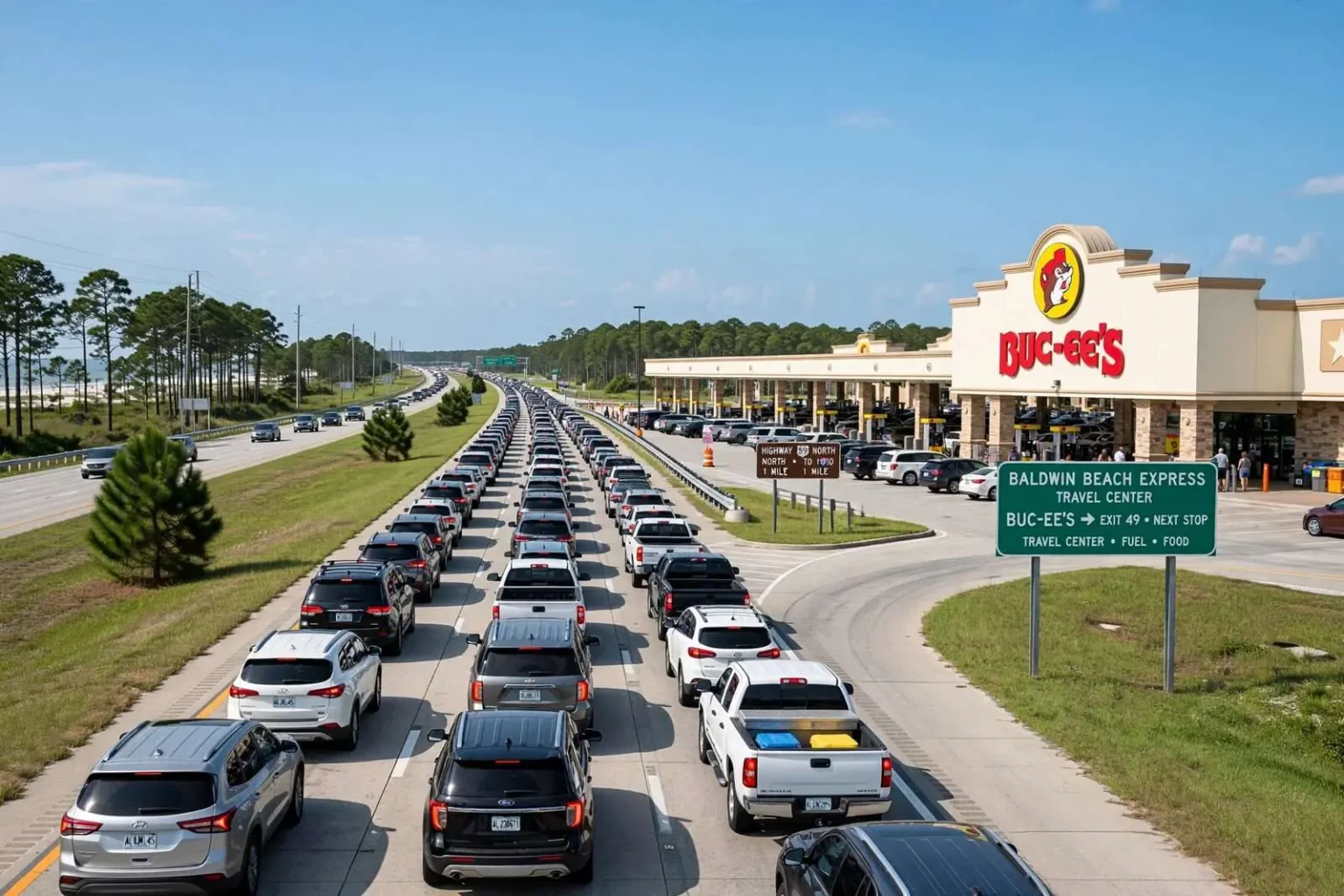
Alabama 59 and the Baldwin Beach Express handled most of it. Before 11 a.m., traffic was already backing up on Highway 59 North near Interstate 10. A few miles east, the Baldwin Beach Express was busier still — and the Buc-ee’s Beach Express Travel Center had lines of cars waiting to get both into and out of its parking lot.
Several travelers described the stop as mandatory.
‘Everybody Loves Buc-ee’s’
Chris Dalton, headed to Tennessee, put the morning simply.
“It has been crazy, especially up through here,” Dalton said. “It has just been bumper to bumper. Everybody loves Buc-ee’s.”
Chris Vazquez was more expansive.
“This place is just like it’s an American monument,” Vazquez said. “It’s fantastic. You come here just to see the craziness.”
Ben Cheatham said the stop was on the itinerary before the trip began.
“Coming to Buc-ee’s, we planned a stop just for this because it’s one of those things when we come down here,” Cheatham said.
The store’s pull is an odd but real piece of the region’s travel infrastructure. A travel center of that scale — a hundred-plus fuel positions, a store the size of a supermarket, restrooms that the chain has built an entire brand identity around — functions less like a gas station and more like a destination that happens to sell fuel. On a departure morning, that produces a paradox: a facility designed to move enormous volumes of traffic efficiently becomes a bottleneck because so many people choose to stop at once.
One traveler, identified only as Derek, measured the wait in distance rather than time.
“Coming out of Gulf Shores, traffic was… it was okay,” he said. “They just need to make all the green lights green. But then, waiting to get into Buc-ee’s was another, I don’t know, a quarter mile. No, three quarters of a mile.”
Gas Is Up, and It Did Not Seem to Matter
Gas prices are running 60 cents per gallon above the national average compared with this time last year, according to AAA.
It did not appear to deter anyone. Most travelers said the drive had gone reasonably well, and the parking lots along the corridor said the same thing more loudly.
That tracks with what the travel industry generally observes about holiday driving demand: it is relatively insensitive to fuel price at the margins. A family that has already paid for four nights of lodging on the coast is not going to cancel over an additional $20 in the tank. Fuel cost shapes decisions made months in advance far more than it shapes decisions made in the car.
Getting Out of the Beach Towns
Craig Watson, headed to Atlanta, described the standard departure-day pattern — heavy congestion leaving the beach, easing once drivers reach the interstate.
“We caught a lot of traffic coming out of Orange Beach because you know, everybody was leaving at the same time but then once we get on 10 it will be pretty good, we get on the highway up 85 it should be alright,” Watson said.
That bottleneck is structural. Gulf Shores and Orange Beach are served by a small number of roads, and the geography — a narrow barrier island strip with water on both sides — means there is no alternate route to discover. Everyone leaving on the same morning uses the same handful of intersections. Signal timing, as Derek noted, becomes the whole ballgame.
Toya Connor, headed to Birmingham, said drivers had mostly kept their composure.
“Yeah. A few mishaps but for the pretty much, yeah everybody’s just trying to get back home safely,” Connor said.
The Tunnels, Again
Westbound interstate traffic stayed busy throughout the day, producing long backups approaching both tunnels heading into Mobile.
This is the region’s most familiar and least surprising traffic story. Interstate 10 narrows as it approaches the Wallace Tunnel under the Mobile River, and the geometry of the approach — a sharp curve into a confined bore, with lane reductions — produces a chokepoint that no amount of holiday planning routes around. On heavy travel days the backup extends across the Bayway and, on the worst of them, out to Spanish Fort. The Causeway, the traditional alternative, absorbs its own share of overflow and slows accordingly.
That bottleneck is the entire justification for the $3.2 billion Interstate 10 Mobile River Bridge and Bayway project, which state officials expect to reach a construction start before the end of the year. The design — a six-lane cable-stayed bridge over the river feeding a widened Bayway carrying three lanes in each direction — is aimed squarely at eliminating the tunnel approach as a constraint.
Until it is built, Labor Day in Baldwin County looks the way it looked Monday.
What to Expect Next Time
For anyone planning around the next holiday departure, a few patterns held true again this weekend:
- The window is narrow. Congestion on Highway 59 North had built before 11 a.m. Leaving substantially earlier or substantially later than mid-morning is the single most effective adjustment available.
- The Express is faster, but not immune. The Baldwin Beach Express is the better route for most northbound departures, but its Buc-ee’s interchange generates its own delay independent of through traffic.
- Fuel before the crowd, not with it. The travel center is at its worst precisely when everyone is leaving.
- The tunnel is the last obstacle, not the first. Drivers who clear Baldwin County smoothly still have the Wallace Tunnel approach ahead of them.
Traffic was expected to ease through the evening as the last of the weekend’s visitors cleared the corridor. It will be back the next time a Monday is attached to a Sunday.
How Big the Beach Economy Actually Is
The traffic on Highway 59 and the Baldwin Beach Express on Monday morning was, in economic terms, a very large amount of money leaving.
Alabama’s Gulf Coast beaches draw millions of visitors annually, and lodging revenue in Gulf Shores and Orange Beach runs into the hundreds of millions of dollars a year — this newsroom reported earlier this month that the state’s beaches had reached $739 million in lodging revenue through July, according to the region’s tourism leadership. Labor Day weekend is one of the final high-volume weekends of the summer season before the calendar shifts to fall events, snowbird season and the shoulder months.
That concentration is what produces the departure-day pattern. A destination that fills and empties on a weekly rhythm during peak season produces enormous directional traffic surges at checkout time, and a holiday compresses the effect further by aligning nearly every departure to the same morning.
The Buc-ee’s Effect
The travel center at the Baldwin Beach Express interchange has become a destination in its own right, which is the plainest explanation for why traffic backed up three-quarters of a mile to enter a gas station.
The format is deliberately built for it: an enormous fuel canopy, a store with the footprint of a supermarket, prepared food counters, a merchandise operation, and restrooms the chain has made central to its marketing. The result is a facility that converts a fuel stop into a 30-to-45-minute visit, which is excellent for the business and difficult for the road in front of it.
Travelers described it in terms usually reserved for landmarks.
“This place is just like it’s an American monument,” Chris Vazquez said. “It’s fantastic. You come here just to see the craziness.”
The traffic engineering consequence is straightforward. A conventional highway interchange is designed around vehicles passing through it. When a destination at the interchange generates its own trip demand — people stopping because of the store rather than because they need fuel — the interchange has to absorb queuing it was never sized for.
Fuel Prices in Context
AAA data showing prices 60 cents per gallon above the national average compared with a year ago is a meaningful gap, and it did not appear to change anyone’s plans.
That is consistent with how fuel prices affect leisure travel generally. Research on travel demand finds that gasoline price elasticity is low in the short run: a price increase produces relatively little immediate change in miles driven, because most trips are either necessary or already committed. Effects show up over longer horizons, in vehicle purchase decisions and in trip planning made months out — not in whether a family already at the beach drives home.
For a coastal tourism economy dependent on drive-market visitors from Tennessee, Georgia, Mississippi and north Alabama, that inelasticity is good news in a high-price year.
Planning the Next One
The next major departure-day surges on this corridor will come with the fall holiday calendar and again at the start of the next beach season. The mitigation strategies available to an individual driver have not changed: leave before mid-morning or well after it, fuel up before reaching the crowd rather than with it, and account for the Wallace Tunnel approach as a separate obstacle after Baldwin County clears.