Two Days in Mid-September Decide Whether the I-10 Bridge Gets Built: ‘It’s About to Get Real’
ALDOT expects to close TIFIA loans and sell revenue bonds Sept. 16-17, locking down financing for the $3.2 billion I-10 Mobile River Bridge and Bayway project. Eastern Shore MPO chairman Jack Burrell says a groundbreaking this year is very likely.
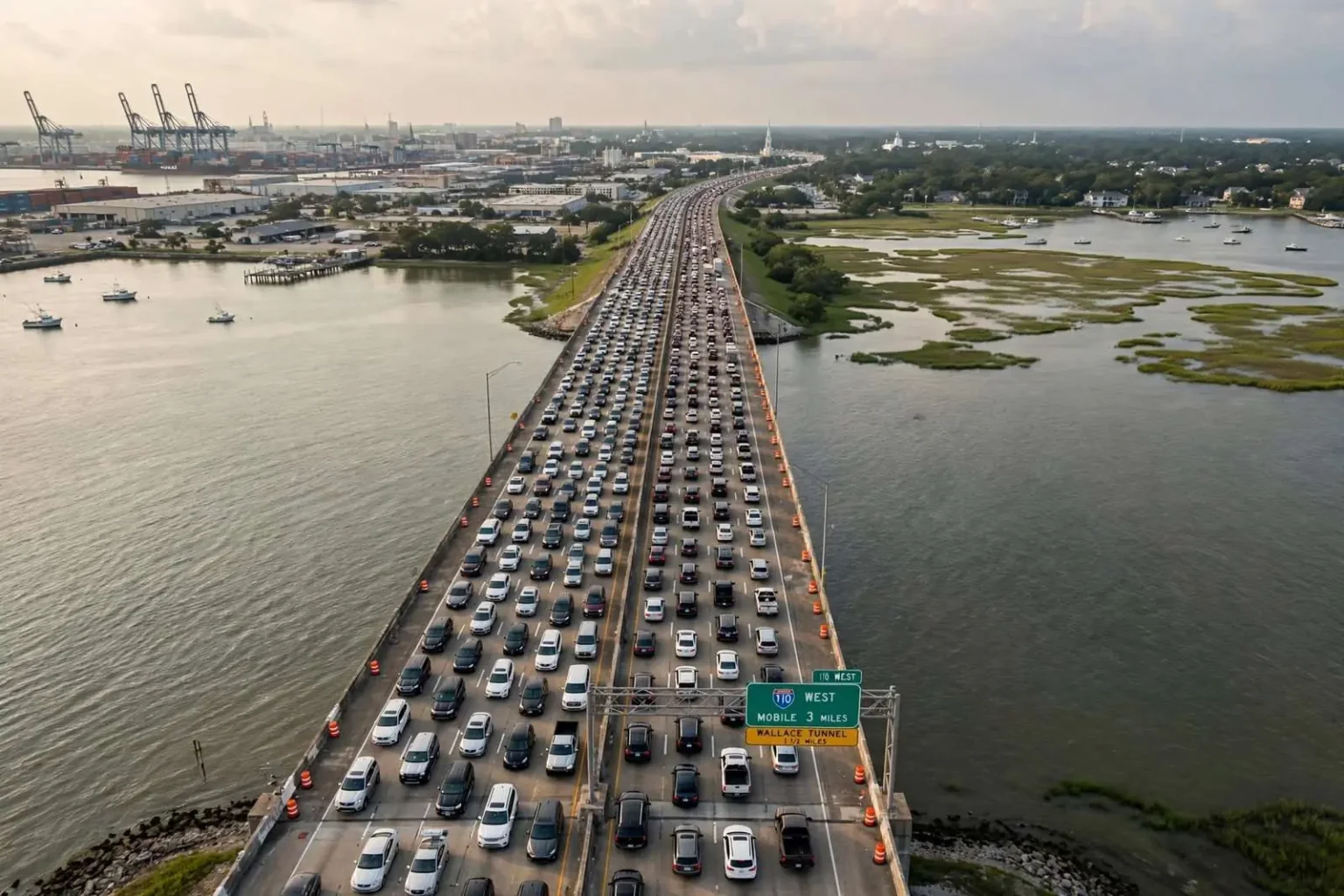
MOBILE, Ala. — Westbound traffic slowed to a crawl across the Bayway for most of Monday. Even the Causeway backed up.
The Labor Day jam followed the pattern every summer holiday follows here: travelers heading home hit the bottleneck at the Wallace Tunnel and stop. What made this particular version of an old story notable is what happens in nine days.
Alabama officials are preparing to take what may be the decisive step toward the project meant to end those jams. By the end of next week, the Alabama Department of Transportation expects to lock down the financing for the $3.2 billion Interstate 10 Mobile River Bridge and Bayway project.
“It’s about to get real,” said Jack Burrell, chairman of the Eastern Shore Metropolitan Planning Organization. “I do think we’re going to stick a shovel in the ground this year. I’m very, very confident in that. Everything is moving in the right direction right now.”
What Happens Sept. 16-17
A two-day process on Sept. 16 and 17 is intended to give Alabama the cash to begin construction of a six-lane cable-stayed bridge carrying drivers from Mobile onto a newly restriped Bayway that will accommodate three lanes of traffic in each direction.
The sequence has two parts.
First, the TIFIA loans. The state plans to finalize low-interest federal borrowing through the Transportation Infrastructure Finance and Innovation Act, which can cover up to nearly half the project’s cost.
Second, the bond sale. The state then plans to sell revenue bonds to private investors to cover the portion not paid for by the TIFIA loan and direct government spending.
Burrell does not expect trouble finding buyers.
“They’re state-backed, so they should sell quickly,” he said.
Why TIFIA Matters So Much
TIFIA is a federal credit program rather than a grant program, and the distinction is the whole reason a project this size can pencil out.
The program lends at rates tied to Treasury borrowing costs, well below what a project would pay in the ordinary municipal market. It permits long repayment terms and, critically, allows repayment to be deferred until several years after construction is substantially complete — which matters enormously for a toll-financed project, because a toll facility generates no revenue at all while it is being built and takes years to reach steady-state traffic.
TIFIA debt can also be structured to sit behind other debt in the repayment order, which improves the credit profile of the senior bonds being sold to private investors. That is the practical mechanism by which a federal loan makes a private bond sale work: the federal government takes the riskier position so the market will take the safer one at a better price.
None of this is a subsidy in the conventional sense. It is borrowed money that has to be repaid.
Which Brings Us to Tolls
ALDOT has already spent significant money on the project, including $125 million from the federal Nationally Significant Multimodal Freight and Highway Projects program — known as INFRA — and most of the $250 million ALDOT itself committed.
Burrell said the pursuit of grant money is not finished.
“We are going to continue, as we’ve said over and over — we’re gonna continue to go after more grant money,” Burrell said. “Just because we’ve received the INFRA grant and we received the bridge investment program grant doesn’t mean that we’re gonna stop there and not go after more grant money.”
The reason that pursuit matters is straightforward: if no further grants materialize, the full borrowing cost is repaid by drivers through tolls. The lowest rate starts at $3 per crossing and includes use of the Bayway.
Every additional grant dollar is a dollar that does not have to be collected from a windshield. That is why officials keep applying even after financing closes — grant proceeds received later can retire debt early or, in some structures, restrain future toll escalation.
Tolling is also the issue that killed earlier versions of this project. A previous proposal collapsed under public opposition to the toll structure attached to it, and the current $3 minimum reflects years of negotiation over that history.
What Gets Built
The project has two halves that are frequently discussed as one.
The bridge is a six-lane cable-stayed span across the Mobile River with sufficient clearance for the shipping traffic serving the Port of Mobile — a requirement that drove much of the design. Cable-stayed construction is the standard solution for a crossing of this length and clearance: towers carry the deck on cables running directly to them, which spans long distances without the anchorage requirements of a suspension bridge.
The Bayway is the elevated stretch of I-10 across the northern end of Mobile Bay between Mobile and Spanish Fort. The current structure carries two lanes each way and sits low enough that storm surge has closed it. The project restripes and reconfigures it to three lanes in each direction.
Together they eliminate the Wallace Tunnel as the mandatory route for through traffic on I-10.
The Merge Question
Burrell acknowledged that heavy volumes could still slow at the merge point on the Bayway — a natural consequence of traffic transitioning between the bridge and the widened elevated roadway. He did not think it compared to the current situation.
“I think that there’s maybe a natural tendency to slow down there, but it’s certainly not gonna be like a 90-degree turn going into a tunnel like we have to deal with now in only four lanes,” he said. “So I definitely think it will alleviate the traffic.”
He is describing the actual mechanism of the current bottleneck. The Wallace Tunnel problem is not simply capacity; it is geometry. Drivers approach a sharp curve, descend into a confined bore with no shoulder and low overhead clearance, and instinctively slow down. That instinct propagates backward through following traffic as a shock wave, which is why the Bayway backs up for miles behind a tunnel that is not actually blocked.
What Monday Looked Like
The current conditions were fully on display over the holiday.
Paul and Jenny Wilson, heading home to Mississippi after a trip to the Eastern Shore, said they had never seen it so bad.
“It was bumper to bumper, and we thought they had an accident,” said Paul Wilson, who lives in Madison, Mississippi. “Actually, getting out of the Hampton Inn, when we got out, you couldn’t even pull out onto that traffic going south.”
“I was surprised,” Jenny Wilson added. “We’ve never been in so much traffic down here. We thought maybe there was a wreck or something.”
The Wilsons were not familiar with the bridge plan but said it sounded like a good idea.
Brandi Birchett of Meridian, Mississippi, caught in the same backup after a holiday weekend at the beach, said the Causeway was not much of an alternative.
“It was slow coming in, for sure. … It’s backed up all the way to Spanish Fort,” she said.
That the delay was caused by nothing at all — no wreck, no closure, just volume meeting geometry — is the most telling detail in the whole account.
What Would Have to Go Wrong
Financing closings of this kind are heavily prepared in advance, and the parties do not schedule a two-day process without a high degree of confidence. The realistic risks are market conditions moving sharply between now and the sale, or a documentation issue delaying the TIFIA closing.
Assuming the mid-September process goes as planned, the remaining sequence runs through final contract execution to a construction start. Burrell said he expects a shovel in the ground this year.
Actual completion of a project of this scale is measured in years after that. Drivers sitting on the Bayway next Labor Day should not expect a different experience. The one after that is a fair question.
Why This Project Took So Long
Burrell’s “it’s about to get real” carries the weight it does because residents of this region have heard versions of this announcement before.
A new Mobile River crossing has been studied, designed, redesigned and shelved across more than a decade of planning. The engineering was never the obstacle. The obstacles were money and politics, and they were connected: a project of this magnitude in a state with limited transportation funding requires tolls, and tolls require public acceptance that has been difficult to secure.
An earlier iteration collapsed under exactly that pressure. Proposed toll rates drew organized opposition from commuters on both sides of the bay who use the crossing daily and who saw a significant recurring cost imposed on a route they had no alternative to. The plan was withdrawn.
What has changed since is a combination of things: a restructured toll schedule with a lower entry rate, substantial federal grant awards that reduced the amount requiring toll-backed debt, and a financing structure leaning on TIFIA to lower the cost of borrowing. None of those individually solved the problem. Together they produced a package that could be financed.
What a $3 Toll Means in Practice
The lowest advertised rate is $3 per crossing and includes use of the Bayway. For an occasional traveler that is trivial. For a daily commuter between Baldwin County and Mobile it is not.
Two crossings a day, five days a week, is $30 a week before any account discounts or frequency programs. Over a working year that is a meaningful household expense, and it falls disproportionately on the people who cross most often — which in this corridor means Eastern Shore residents working in Mobile.
That distributional question is why toll structures for facilities like this typically include frequent-user provisions, and why local officials continue chasing grants after financing closes. Every grant dollar received later is debt that does not have to be serviced from toll revenue.
What Happens After the Financing Closes
Assuming the mid-September process proceeds, the remaining sequence to construction is procedural rather than uncertain: final contract execution with the selected developer, mobilization, and the early site work that constitutes a groundbreaking.
The construction period itself will be long, and it will not be invisible. A project of this scale on an active interstate corridor produces years of lane shifts, temporary closures, detours and periodic full-weekend restrictions. Residents who have been waiting for relief should understand that the first several years of the project make traffic worse before they make it better.
Marine construction adds its own constraints, since the Mobile River is an active shipping channel serving the Port of Mobile and construction cannot obstruct it. Barge-mounted equipment, channel closures coordinated with the Coast Guard and pile driving on a working waterway all shape the schedule.
The Bayway’s Other Problem
Congestion is the reason the Bayway gets discussed, but it is not the only reason it needs replacing.
The existing structure sits low over the northern end of Mobile Bay, and it has been overtopped and closed by storm surge. A route that fails during a hurricane is a route that fails precisely when evacuation capacity matters most. Raising the elevation of the crossing is a resilience investment as much as a capacity one, and it is a consideration that does not show up in a Labor Day traffic report but that emergency managers weigh heavily.