Free Digital Literacy Workshop in Lillian to Focus on Spotting Phishing and Romance Scams
A free workshop at Lillian Recreation Park on July 28 will teach residents how to spot phishing emails and romance scams before they cause financial harm.
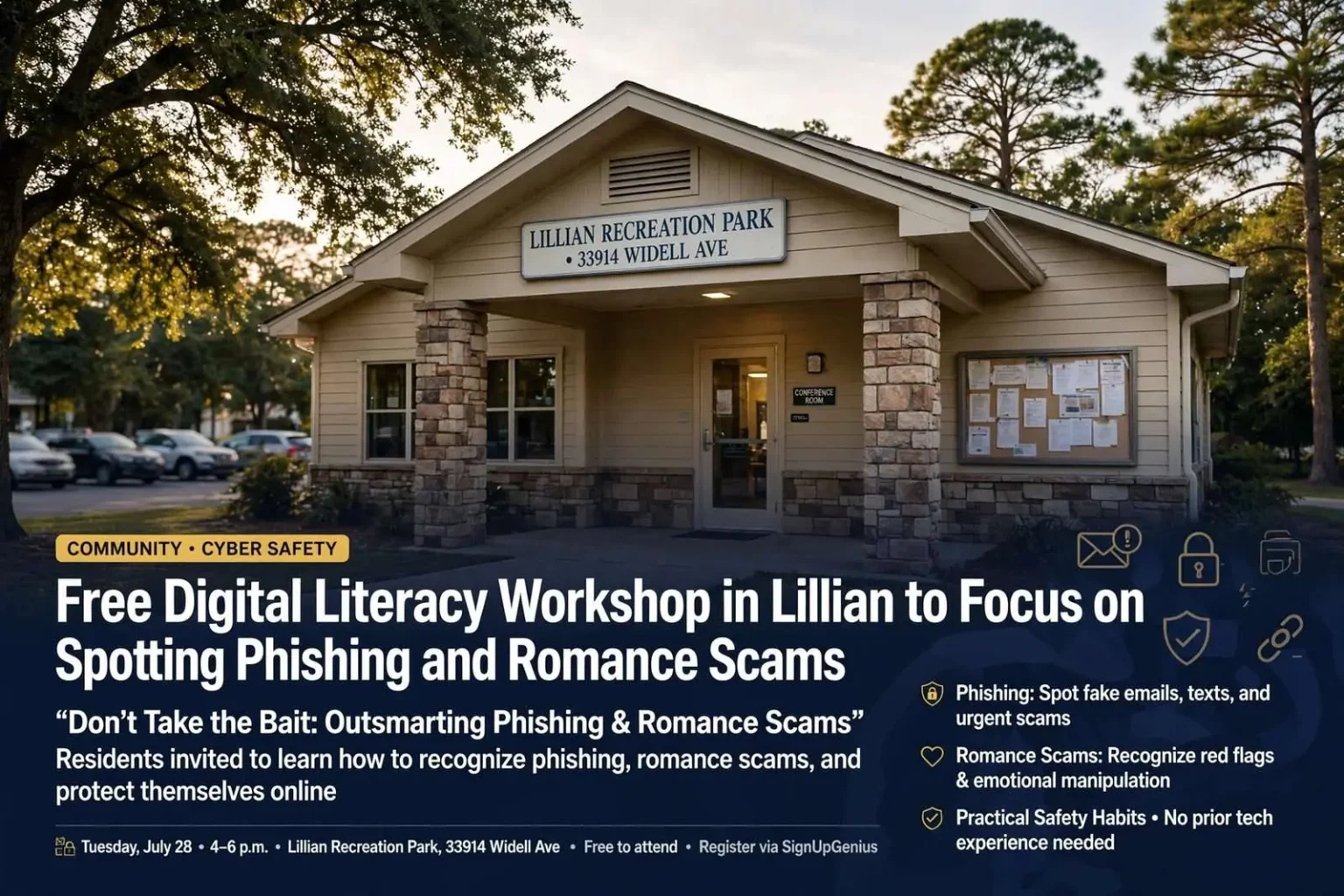
Residents looking to sharpen their online safety skills can attend a free digital literacy workshop later this month in Lillian focused on recognizing phishing attempts and romance scams. The workshop, titled “Don’t Take the Bait: Outsmarting Phishing & Romance Scams,” will be held Tuesday, July 28, from 4 to 6 p.m. in the conference room at Lillian Recreation Park, located at 33914 Widell Ave. Organizers say the session is designed for everyday internet users — no technical background required — and aims to leave attendees better equipped to spot fraud before it reaches their wallet.
The timing reflects a reality that law enforcement and consumer advocates across Alabama have emphasized for years: scams are no longer clumsy, easy-to-spot schemes. Organizers note that scammers have grown increasingly sophisticated, targeting victims through both email inboxes and personal relationships. A fraudulent message today can mimic a bank’s branding down to the logo, and a romance scammer can spend weeks or months cultivating trust before asking for money. The workshop’s two-hour format gives attendees time to look at real examples, ask questions about messages they have received, and practice recognizing the warning signs in a low-pressure setting.
What the workshop covers
The first portion of the session focuses on phishing — the broad category of fraudulent messages designed to trick recipients into revealing passwords, financial information, or personal details. Attendees will learn to recognize the common warning signs: urgent language demanding immediate action, unfamiliar senders, links that do not match the organizations they claim to represent, requests for account numbers or passwords, and offers that seem too good to be true. Because phishing now arrives by text message and phone call as well as email, the discussion extends beyond the inbox to the full range of channels scammers use.
The second portion turns to romance scams, a category that consumer protection agencies consistently rank among the costliest forms of fraud. These schemes begin with a message or friend request from a stranger who seems attentive and trustworthy. Over time the scammer builds an emotional connection — often claiming to work far away, in the military, on an offshore rig, or in another profession that explains why they can never meet in person. Eventually comes the crisis: an emergency, an investment opportunity, or a travel problem that can only be solved with money. By the time the request arrives, the victim may have been communicating with the scammer daily for months, which makes the request feel like an act of trust rather than a red flag.
The workshop’s goal is practical rather than technical: attendees should leave knowing the steps to protect themselves and their finances. That includes habits such as verifying senders before clicking links, never sharing passwords or one-time verification codes, slowing down when a message pressures immediate action, and talking with family members before sending money to anyone met online.
Why Lillian and why now
Lillian sits in southeastern Baldwin County along the Perdido River, at the Alabama-Florida line — a growing community that blends long-time residents with retirees drawn to the Gulf Coast, plus newcomers commuting to jobs in Pensacola and along the Baldwin County beach corridor. That mix matters for a workshop like this one, because older adults are heavily targeted by both phishing and romance scams, and smaller communities often lack convenient access to the consumer-protection seminars that larger cities host. Holding the session at Lillian Recreation Park, the community’s central public recreation site on Widell Avenue, keeps it within easy reach of residents throughout the area.
The session is free to attend, but interested residents are asked to register in advance through SignUpGenius so organizers can plan seating and materials in the conference room. Attendees are encouraged to bring questions about real messages they have received — a suspicious text, a strange email, a worrying online relationship a family member has mentioned — since those examples make the warning signs concrete. Bring a spouse, a parent, or a neighbor; the people most at risk are often the least likely to attend on their own, and a two-hour evening in July is a small investment against the financial and emotional damage these scams can do.
Recognizing the warning signs
Across both halves of the workshop, the same core habits keep coming up, and they apply to nearly every kind of online fraud. The first is urgency: scammers manufacture pressure — an account about to be closed, a warrant out for your arrest, a romantic partner stranded abroad — because victims who feel rushed stop thinking critically. The second is secrecy: fraudsters discourage victims from telling family members or friends, knowing that an outside perspective often unravels the scheme. The third is the unusual payment request: gift cards, wire transfers, cryptocurrency, or cash sent by mail are hallmarks of scams precisely because they are difficult or impossible to reverse once sent.
Phishing messages add their own tells. A bank you do not use asking to verify your account, a delivery notice for a package you never ordered, a password reset you did not request — the mismatch between the message and your actual life is often the clearest signal. Links can be checked by hovering over them before clicking, and when in doubt, the safest move is to contact the organization directly using a phone number you already have rather than the one in the message.
Romance scams follow a recognizable arc that attendees will learn to identify: quick declarations of affection, elaborate excuses for never meeting in person or video chatting, increasingly serious stories of hardship, and finally the financial request. Consumer protection guidance is unanimous on the response: never send money or financial information to someone you have never met in person, no matter how long you have corresponded or how convincing their story sounds. A reverse image search on a profile photo can reveal whether the picture belongs to someone else entirely.
What to do if you have been targeted
Part of protecting yourself is knowing the steps to take after a suspicious contact or a completed fraud. Reporting matters at every level: local law enforcement should be notified in cases involving losses, and federal resources — including the Federal Trade Commission’s fraud reporting channels and the FBI’s Internet Crime Complaint Center — track these crimes nationally and sometimes recover funds. Banks and credit card companies should be contacted immediately when an account is involved; in some cases, quick action can stop a transfer before it clears. Freezing credit files and monitoring financial statements are standard follow-up steps when personal information has been exposed.
Just as important is removing the shame that keeps victims silent. Scammers are professionals who run scripts refined over thousands of targets; falling for one says nothing about a person’s intelligence. Family members who respond to a scam disclosure with support rather than blame are far more likely to hear about the next suspicious message in time to intervene. That cultural piece — talking openly about fraud attempts within families — is among the most effective defenses a community can build, and it is the kind of habit a workshop like this one is designed to encourage.
How to attend
“Don’t Take the Bait: Outsmarting Phishing & Romance Scams” runs Tuesday, July 28, from 4 to 6 p.m. in the conference room at Lillian Recreation Park, 33914 Widell Ave. There is no charge to attend, but advance registration through SignUpGenius is requested so organizers can accommodate everyone. Residents from across southeastern Baldwin County and nearby Pensacola-area communities are welcome. Two hours of practical instruction could be the difference between recognizing the next scam email — and paying it.
The scale of the problem on the Gulf Coast
Scam awareness sessions have become a fixture of community education across Baldwin County and the wider Gulf Coast for good reason. The region’s demographics — a large and growing retiree population, seasonal residents splitting time between states, and newcomers unfamiliar with local institutions — create conditions that professional fraudsters actively exploit. Consumer protection agencies have reported for years that fraud losses nationwide run into the billions of dollars annually, with older adults losing the largest amounts per incident, and romance scams and imposter scams repeatedly appearing at or near the top of the loss rankings. No specific figures are attached to this workshop, but the pattern behind it is well established: these schemes work, they extract life savings as often as small amounts, and education remains one of the few reliable countermeasures.
Local context adds another layer. Residents of communities like Lillian often bank with regional institutions and conduct much of their lives by phone and internet, with the nearest branch potentially a drive away. Scammers know that a victim cannot easily walk into a bank lobby and ask a human whether a message is legitimate, which is why so much fraud now arrives by text, email, and phone rather than in person. Teaching residents to verify independently — calling the number on the back of a card, visiting the official website by typing it directly — is the practical antidote the workshop will emphasize.
Bringing the lessons home
Organizers of events like this generally encourage attendees to treat the session as a starting point rather than a one-time inoculation. Scam tactics evolve constantly — the same fraudsters who ran fake tech-support calls a few years ago now deploy AI-generated voices and cloned websites — so the durable skill is not memorizing a list of specific scams but internalizing the habits that generalize: verify independently, resist urgency, refuse unusual payment methods, and talk to someone you trust before money leaves your hands.
Families can extend the workshop’s value at home. A brief conversation after the session — sharing the warning signs with siblings, adult children, and grandchildren — multiplies the reach of two hours of instruction. Adult children of older Baldwin County residents may find the session especially useful, since they are often the first to notice a parent’s suspicious new “online friend” or unusual bank activity. Knowing the arc of a romance scam makes those observations far easier to raise, and far more likely to be heard.
The bottom line for residents of Lillian and the surrounding communities: the workshop is free, close to home, and squarely aimed at two of the most damaging fraud schemes currently circulating. Registration through SignUpGenius secures a seat in the conference room at Lillian Recreation Park on Tuesday, July 28, from 4 to 6 p.m. The scammers targeting the Gulf Coast are professionals; the best defense is a community that knows exactly how they operate.