Mobile County Voters to Decide Fate of $66 Million Road and Bridge Overhaul in November
Mobile County commissioners approved a $66 million engineering report for 40 road and bridge projects, sending the 2014 Pay-As-You-Go Program to voters for final approval on Nov. 4.
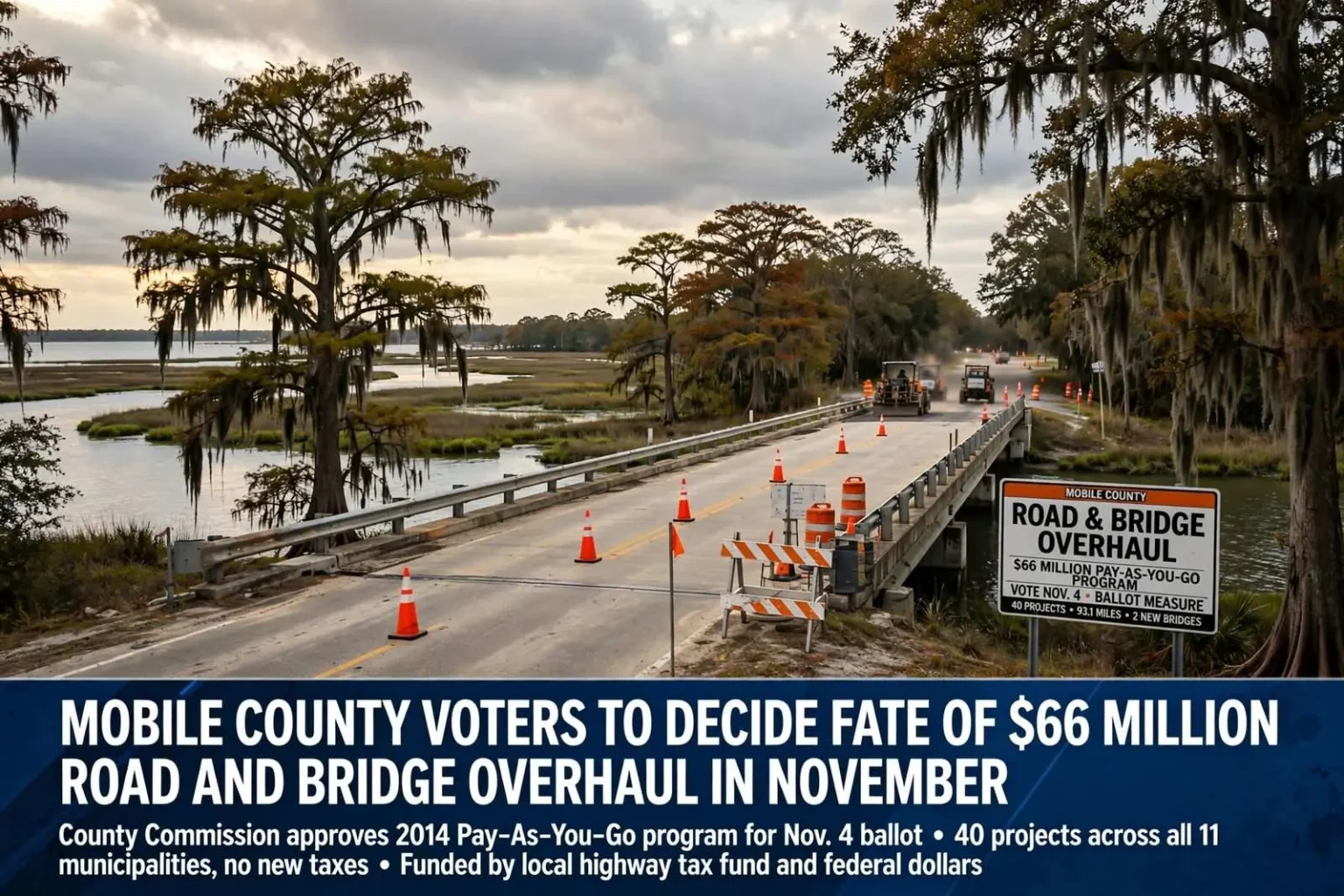
Mobile County voters will have the final say this November on a sweeping $66 million package of road and bridge upgrades after the Mobile County Commission gave its approval this week to launch the 2014 Pay-As-You-Go Program. The vote scheduled for Nov. 4 will ask residents to authorize the largest single investment the county has made in its road network under the financing model it has used for more than three decades, and the projects it funds will reach every corner of a county that stretches from the Mississippi line to Mobile Bay.
The program, unique to Mobile County among Alabama’s counties, is a financing method that lets the county fund road and bridge improvements without raising taxes or taking on new debt. Instead, the county sells and buys back bonds on the same day, a maneuver that frees up money already collected through a decades-old property tax fund without saddling taxpayers with interest payments. The mechanics sound arcane, but the effect is straightforward: the county converts money it already collects into money it can spend on pavement and bridges, without a bond underwriter, without a repayment schedule and without the interest costs that make conventional borrowing expensive.
That special fund traces back nearly 90 years, to when the Alabama Legislature set aside 6.5 mills of ad valorem, or property, taxes for counties to use through a dedicated Highway Tax Fund. The millage was established in an era when county roads were mostly dirt and the automobile was still transforming rural life, and it has remained a fixture of county finance ever since. According to Assistant County Engineer Bryan Kegley, the county uses that revenue to purchase and immediately buy back bonds, a same-day transaction that shifts the money into a Pay-As-You-Go account where it becomes available for road work.
“It essentially takes money out of the highway tax fund and puts it into a Pay-As-You-Go account. Then we can spend it,” Kegley said. “But you can only approve funding on what the citizens approve by vote, which has to be in the engineering report that defines the projects.”
That last constraint is the heart of the system. The county cannot simply spend the fund as it pleases; every dollar of Pay-As-You-Go money must be tied to a voter-approved engineering report that itemizes the projects. The requirement gives the ballot measure its purpose: when Mobile County residents vote on a Pay-As-You-Go program, they are not approving a blank check but a specific list of roads and bridges, costed and mapped before the election ever happens.
What the $66 million buys
That engineering report, totaling $66 million, is what commissioners signed off on this week. It lays out 40 separate projects covering 93.1 miles of road construction, paving and repaving, along with the construction of two new bridges and a range of other infrastructure work across the county. Of the total cost, the county’s Highway Tax Fund will cover roughly $55 million, with an additional $12 million coming from federal funding sources to round out the package.
The federal share reflects the way most substantial road work is financed everywhere: local money that demonstrates a commitment, paired with federal dollars that multiply it. The 93.1 miles of paving and repaving represents the bulk of the program’s mileage, and that is by design — resurfacing is the least glamorous work a county does and the most constant. Asphalt has a lifespan, Gulf Coast summers and heavy truck traffic shorten it, and a county that skips its repaving cycle for a few years finds itself paying for rebuilding instead.
If approved by voters on Nov. 4, the 2014 program will mark the 15th Pay-As-You-Go initiative since Mobile County first adopted the funding model in 1977. Every one of the previous 14 programs has cleared the ballot box, according to county officials. That unbroken record is rare in American ballot politics, where road taxes and bond issues routinely fail, and it says something about how the program is structured: voters are asked to approve a defined list of projects, the work gets done where people can see it, and no one is asked to approve a tax increase to pay for it. A program that delivers visible pavement without a new tax has an easy argument to make every few years.
All 11 municipalities in Mobile County stand to benefit from the proposed work, with roadway upgrades planned in each one. The city of Mobile, the county’s largest municipality, would see the most extensive benefit, with improvements planned across 33 miles of roadway under the 2014 program. But the inclusion of every municipality — from the city to the county’s smaller towns — is deliberate, and it is one reason the program has passed fourteen consecutive times. Every commissioner’s district and every city hall can point to projects in the report, which means every delegation to the county has a reason to support it and no municipality is left telling its residents the ballot measure had nothing in it for them.
Why the model stretches the money
Kegley said the Pay-As-You-Go structure roughly doubles the amount of money the county can put toward road projects compared with a conventional bond sale.
“In a regular bond program, you sell bonds and then you take the proceeds from those bonds, you start the design process, right of way acquisition, utility relocation and you bid it, but the whole time you’re paying interest on those bonds,” he said. “In the Pay-As-You-Go Program, the money is already in that special tax fund. So not only are you not paying interest, the money is in a checking and savings account that’s actually accruing interest.”
The comparison illustrates why the model matters. In conventional financing, a county borrows the full cost of a project up front, then spends years — sometimes decades — repaying principal and interest on work whose design phase has not even begun. Interest accrues on every dollar from the day it is borrowed, including the dollars that sit idle while engineers design the road and crews relocate utilities. Under the Pay-As-You-Go approach, the county spends the money as it goes, so interest is never owed on funds that have not yet been used, and the unspent balance continues earning interest for the county rather than for a bondholder. Over the life of a $66 million program, that difference compounds into real pavement.
Two bridges, and the costliest projects
Among the highlights of the plan are two new bridges: one on Padget Switch Road over Carl’s Creek in Bayou La Batre, and another on Wilmer-Georgetown Road over Big Creek. Those two structures are the costliest single projects in the program, priced at roughly $4 million and $3.7 million respectively.
Bridge work carries a price that resurfacing never approaches, and both locations matter to the communities they serve. Padget Switch Road carries traffic in and around Bayou La Batre, the small seafood-processing city on the county’s southern shore where the road network is the economic lifeline for the working waterfront. Wilmer-Georgetown Road serves the fast-growing communities in the county’s northwestern corner, near the Mississippi line, where residential growth has steadily added traffic to rural routes built for a different era. A failed bridge on either road means a detour measured in miles for school buses, log trucks and commuters alike, which is why new structures anchor the project list.
“Two of the county’s largest responsibilities to taxpayers is public safety, and providing adequate and safe roads for our constituents,” said Mobile County Commissioner Jerry Carl. “I am excited to see these road improvements as they provide a better quality of life for our constituents, as well as bring in much needed economic development to Mobile County.”
County officials say the full engineering report, including maps and detailed descriptions of all 40 projects, is available for public review online through the county’s website ahead of the November vote. Residents who want to know whether their road is on the list can look it up by name before they vote — a transparency that most bond measures never offer and that county officials point to as a habit worth keeping.
If history is any guide, the program’s long, unbroken track record of voter approval since 1977 suggests strong odds that Mobile County’s road and bridge network will soon see its largest infusion of Pay-As-You-Go funding to date. Fourteen straight approvals have made the program a fixture of county government, and the 15th edition — 40 projects, 93.1 miles and two new bridges — would be its largest test yet.
What it means for the November ballot
For voters, the practical questions are the ones the engineering report answers. Which roads get repaved, which bridges get replaced, and what each project costs are all laid out in the document commissioners approved, and the county has made a point of publishing it rather than summarizing it. That matters because Pay-As-You-Go measures succeed or fail on specifics. A ballot question that merely authorizes “road improvements” invites skepticism; one backed by a 40-project list with maps, mileage and prices gives voters something concrete to support or reject.
The program also arrives at a moment when infrastructure costs across the Gulf Coast continue to climb. Paving prices ride on the cost of asphalt, which tracks petroleum markets, and bridge construction carries the expense of engineered materials, environmental permitting and the specialized contractors who do the work. A $66 million program will not stretch as far in today’s market as the same figure would have a generation ago, which is part of why the county pairs its local fund with federal money: the $12 million federal share offsets costs that the highway fund alone would struggle to absorb while still covering routine work.
For the municipalities, the promise of work in all 11 cities and towns is a reminder of how much of Mobile County’s daily transportation happens on county roads rather than state highways. The state’s trunk lines — the interstates and U.S. highways — get the attention and the separate funding streams, but the roads people actually use to reach schools, churches, stores and jobs are largely county and municipal streets. Resurfacing a residential corridor does not make the news the way a new interchange does, but it is the difference between a smooth commute and a car alignment, and for the 93.1 miles on this list, it is the whole point.
The Nov. 4 vote will be the fifteenth time Mobile County residents are asked to approve the model, and the county’s engineers have already done the paperwork that makes the question answerable. What remains is the part the 1977 framers of the program built into it from the start: the citizens’ approval, project by project, every time the fund is tapped. As Kegley put it, the money can only be spent on what the people have approved — and this November, the people get the chance to approve it again.