Critics Question Whether a County Commissioner’s Road Promises and a School Board President’s Finances Hold Up to Scrutiny
Mobile County Commissioner Mike Dean and School Board President Fleet Belle have each faced public criticism, Dean over unfulfilled promises on private road repairs and Belle over federal tax liens tied to himself and his church.
Two of Mobile County’s elected officials have drawn pointed public criticism in recent weeks over how they have handled their responsibilities to taxpayers, in the kind of scrutiny that local commentators argue is simply part of the job for anyone entrusted with public money.
Hope as road policy
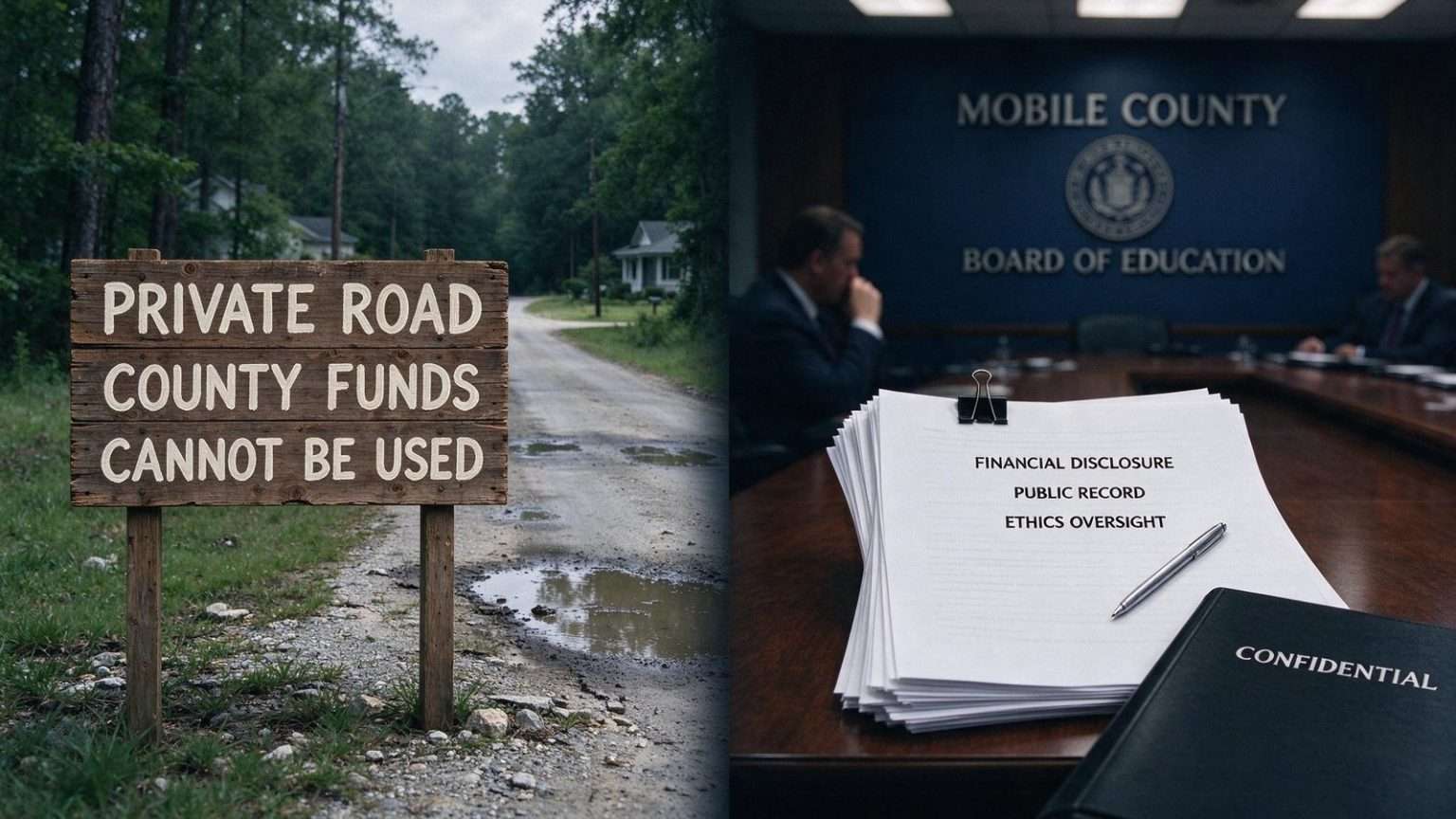
Mobile County Commissioner Mike Dean has come under fire for what critics describe as a pattern of raising residents’ hopes about fixing muddy, potholed private roads using public funds, despite knowing that county money generally cannot be used to pave or repair privately owned roads.
According to critics tracking his public remarks, Dean has been recorded making the suggestion on at least two occasions. In an interview with a news reporter, Dean reportedly acknowledged that he tells residents this because he does not want to simply tell them no.
For homeowners living on unpaved or poorly maintained private roads, a stretch of pavement funded by the county would be a welcome fix, but the practice of implying that help might be on the way, without a real mechanism to deliver it, has drawn criticism as more about managing constituents’ expectations than solving their problems.
Why public money can’t just fix any road
The distinction between public and private roads matters because Alabama counties are generally limited in how they can spend public road funds. Public roads are maintained using tax dollars and gas tax revenue precisely because they are open to and used by the general public; private roads, by contrast, are typically the responsibility of the property owners who use them, absent a formal process to have them accepted into the public road system.
The rules are not bureaucratic hair-splitting. County road departments are financed by gasoline taxes, tag fees and other dedicated revenue that is legally restricted to the public road network. Spending that money on a private lane — no matter how deep its potholes — invites audit findings, legal challenge and the obvious problem of fairness: the county cannot buy pavement for one group of private landowners without owing the same to every other group with a muddy drive.
There is a lawful path for residents who want their road maintained at public expense: petition to have the road dedicated to the county and accepted into the public system, which brings the right-of-way, engineering standards and maintenance obligations with it. Many subdivisions built decades ago with private roads never took that step, and their residents have lived with the consequences ever since.
Commissioners fielding complaints about deteriorating private roads are in a genuinely difficult spot, caught between residents who want help and legal limits on what county government can actually do. Critics argue that difficulty is exactly why elected officials should be straightforward about those limits rather than letting residents believe a fix is coming.
The costs of saying “maybe”
Dean’s defense — that he does not want to simply tell constituents no — captures a real tension in local representation. A commissioner whose district includes miles of rural and subdivision roads hears the same story repeatedly: a private lane that washes out every rain, a handful of families sharing the repair bill, no clear path to county help. “No” is the legally accurate answer most of the time, but it is also the answer that sends voters to the next election looking for someone else.
The trouble, critics say, is what “maybe” costs. Residents who believe the county is coming postpone their own repairs. Neighborhood associations debate waiting versus acting. And when the promised help never arrives, the disappointment lands on the same office that raised the hope. A recorded pattern of suggestions the commissioner knew could not be fulfilled, critics argue, converts a political habit into a governance problem.
It also obscures the genuine solutions available. Resident-funded paving, road dedication petitions, special districts and coordination with developers are all real mechanisms for improving private roads in Mobile County — none of them as satisfying as a commissioner’s promise, but all of them achievable.
Questions about the school board president’s finances
Separately, scrutiny has fallen on the president of the county’s school board over questions about personal finances and the handling of money — the kind of scrutiny that attaches quickly to anyone who presides over a budget as large as a county school system’s.
A school board’s credibility rests on the stewardship of public education funds, and its president is the public face of that stewardship. When questions arise about an officer’s own financial affairs — obligations, disclosures or business dealings — the concern is less about any single transaction than about the standard the board sets for itself. Alabama’s ethics framework requires public officials to file statements of economic interests and bars the use of public office for personal gain, and boards of education are expected to hold themselves to at least the disclosure standard they demand of vendors and contractors.
For a district of Mobile County’s size — tens of thousands of students and a budget in the hundreds of millions of dollars — the president’s personal financial conduct functions as a referendum on the board’s overall seriousness. Commentators following both stories made the same point: whatever the eventual findings, an official who invites the question has already paid part of the cost.
Scrutiny as part of the job
The thread connecting the two stories is the expectation that elected officials tell the public the truth about what government can and cannot do — with roads, with money, with their own affairs.
Mobile County’s county commission and its school board are the two largest spenders in county government outside the municipalities, and both operate under disclosure regimes meant to keep their decisions visible. The commission’s road funds come with statutory limits; the school board’s budget comes with state oversight and public meetings. Neither body can function well when its members blur the lines — promising what the law forbids, or leaving the public to guess about finances that disclosure rules were written to keep in the open.
Local commentators’ argument in both cases was the same: this is the job. Anyone who accepts authority over public money accepts the auditing that comes with it — from critics, from reporters, from opponents at election time. The officials who resent that scrutiny most, the argument runs, are usually the ones who most need to hear it.
What residents can do
For homeowners on private roads, the practical takeaway from the controversy is to pursue the lawful paths rather than wait on a commissioner’s hope. A road dedication petition, a shared repair agreement among the owners who use the road, or a conversation with the county engineer’s office about what acceptance into the county system would require will accomplish more than a reassuring word at a town meeting.
For taxpayers following the school board questions, the tools are disclosure and the ballot. Statements of economic interests are public records, board meetings are open, and board presidents answer to voters in district elections. The scrutiny now directed at the office is, in the end, the system working as designed — slowly, loudly and sometimes uncomfortably, but in public.
Both stories remain examples of the same civic lesson: in county government, the distance between a promise and a legal authority to keep it is the whole game. Officials who respect that distance earn the public’s trust the hard way. Officials who don’t get headlines like these — and deserve them.
How Alabama counties handle private roads
The road dispute sits on ground that county commissions across Alabama know well. State law defines what county governing bodies may do with their road and bridge funds, and the answer turns on the road’s status. Roads accepted into the county system — dedicated rights-of-way, built to county standards, maintained by county crews — are public and eligible for every dollar of maintenance the commission can direct. Roads that were never accepted remain private property concerns, however many county residents drive them.
The difference shows up on the ground in subdivisions across the county. Neighborhoods platted decades ago with private lanes, rural property reached by shared drives, and newer developments whose roads were never deeded to the county all present the same problem: dozens or hundreds of homeowners whose only road is one the county cannot legally grade, gravel or pave.
County commissioners in rapidly growing districts inherit these disputes constantly. The genuine remedies all involve work: an engineer’s review of whether the road could meet county standards, a petition process that must win support from the owners along it, and often cost-sharing that no one wants to fund. Against that landscape, a quick assurance that “the county will take care of it” is not a plan — it is the beginning of a misunderstanding, which is the core of the criticism directed at Dean.
What the criticism asks for
Nothing in the criticism of either official questions the office itself — the county commission’s authority over roads or the school board’s authority over its budget. The argument is about candor: that an official’s words carry the weight of public authority and should track what the law actually allows.
That standard is easy to state and hard to keep. Constituent service rewards optimism; the law rewards precision. An officeholder who explains to a muddy-road resident exactly why the county cannot pave the lane, and then walks them through the dedication petition instead, spends more time and wins less applause — but leaves the resident with a real option rather than a false hope.
The same logic governs financial questions. A board president whose finances are fully disclosed has answered every legitimate question before it is asked; one whose disclosures lag behind the questions invites the suspicion that follows any public official who treats transparency as optional.
Both controversies, in the end, are arguments for the unglamorous version of representation: telling constituents the truth about the limits of the office, documenting what the office controls, and letting the public judge the record rather than the promise.