

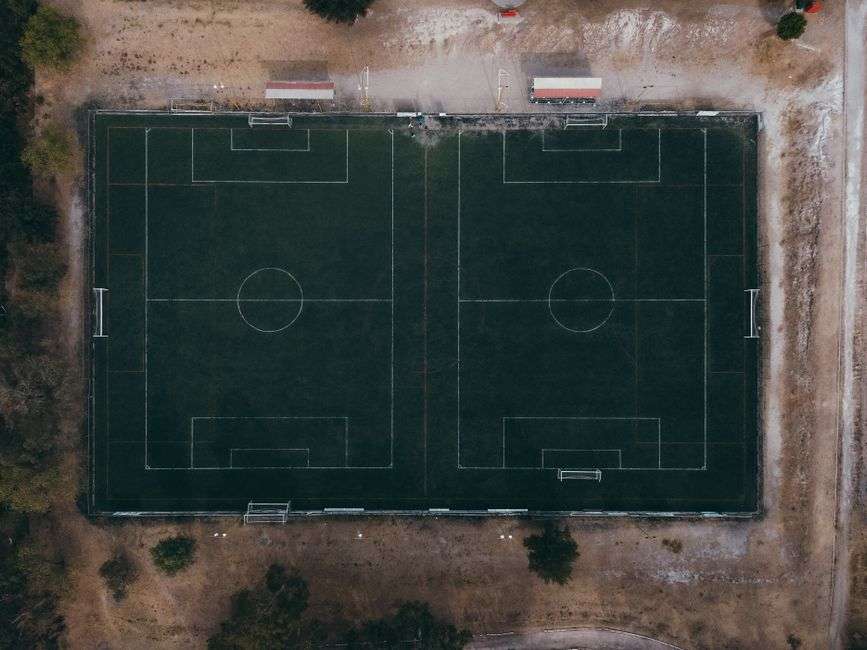
The Mobile County Commission is set to decide Tuesday whether to spend $10,000 to lock up a purchase option on 116 acres near the interchange of Interstates 10 and 65, land that could become the site of a long-discussed multi-field soccer complex.
The property, at the northwest corner of the I-65/I-10 interchange, is owned by the real estate firms White-Spunner Realty and Berg and Company. If the county later decides to move forward with a full purchase, the price tag would be $2.96 million.
County Attorney Jay Ross told commissioners during a conference meeting that the county would have nine months from the date of the option to make that decision. Under the terms being discussed, the $10,000 option fee would be refunded in full if the county ultimately chooses not to buy the land.
The structure is a standard real estate instrument adapted to public deliberation. An option converts an open-ended debate into a bounded one: for a fixed fee, the county would control the land’s fate for nine months while engineering, environmental and financial questions were answered, without risking a competing buyer or a price increase. Whether a public body should pay even a refundable fee to buy time was the argument commissioners were set to have.
Commission President Connie Hudson described the arrangement as a low-risk way to keep the project moving forward. “It’s a no-lose situation,” Hudson said.
As part of the deal, the sellers would also include an additional 80 acres of mostly wetlands at no extra cost. Hudson has said in the past that she would like to see that additional acreage developed into a nature trail, adding a recreational amenity beyond the soccer fields themselves.
The wetlands acreage shapes the site’s logic. Land at an interstate interchange that cannot be built on is usually a liability in a sale, but as parkland it becomes a buffer — separating the playing fields from highway traffic, absorbing stormwater, and giving the complex a green edge that pure ballfield developments lack. Nature trails through bottomland wetlands are also among the cheapest recreational amenities a government can build, which made the throw-in worth more than its nominal price.
Two visions for the county’s soccer money
Hudson has been the leading advocate on the commission for building an 11-field, tournament-style soccer complex at the I-10/I-65 site, arguing that the interstate access would make it an attractive draw for regional and out-of-town tournaments.
Commissioner Jerry Carl has pushed back on that plan, favoring instead a complex built on a separate piece of property off McDonald Road in Irvington.
The disagreement is really about economic development strategy. A tournament complex at a major interstate interchange is designed to import spending: teams and families from across the Gulf South filling hotels, restaurants and gas stations on weekends, in the model that has turned suburban sports complexes across the Southeast into economic engines. A local complex in Irvington, in the county’s southern end, is designed to serve the neighborhoods that already play there — and to concentrate investment in a district whose commissioner has long argued it gets less than its share.
The interchange site’s appeal rests on more than visibility. Sitting between I-10, the Gulf Coast’s east-west artery, and I-65, which runs north toward Montgomery and the interior Southeast, the corner puts the county’s population and much of the region’s within an hour’s drive. Tournament organizers weigh drive times and hotel inventories first; a site with both, next to a growing hotel corridor, changes the math.
The option agreement includes some added flexibility, and some added cost, if the commission needs more time. Beyond the initial nine-month window, the county could request up to two additional 90-day extensions, but each extension would cost another $10,000, and unlike the original option fee, those payments would not be refundable.
Carl has questioned why the county needs to spend money at all to secure an option on property he said has been sitting on the market for 12 to 15 years without a buyer. He said he remains unconvinced that additional county funds should go toward the project until there is a clearer picture of the complex’s total cost.
“This is typical politics,” Carl said. “We’re getting pushed into a kennel chute, and soon we’ll be so far in that we won’t be able to turn around.”
His point about the land’s history was the sharpest available argument against the option. Property that has failed to sell for more than a decade is, by one reading, unlikely to attract another buyer in nine months, and the county’s money buys protection from a threat that does not exist. The counter-reading is that a large-scale, motivated buyer — the county itself, with an announced plan — is exactly what the parcel has been waiting for, and that the option is what turns a decade of drift into a deal.
The commission recently approved roughly $70,000 to prepare the property for a potential sale, including environmental assessments of the site. Hudson defended that spending, saying it would have been premature, and ultimately wasteful, to commission engineering and environmental work without first securing an option to buy the land.
“If you’re going to spend money, you want to make sure the property is secured,” Hudson said. “It’s a process.”
Environmental diligence is not optional at a site like this. Bottomland near two interstate interchanges carries a history of drainage questions, and any wetlands on the property trigger federal permitting that can reshape which acreage is buildable at all. Spending the assessment money before an option would risk buying analysis of land the county never controlled; spending it after a purchase would risk buying land the analysis disqualifies. The option window exists precisely to hold both risks apart.
Carl, who withdrew his own proposed project from consideration for county funding last month in favor of pursuing private financing, said he has lined up two significant financial commitments for his alternative plan, though he declined to discuss the details publicly.
He said he is working to assemble a board to oversee what could ultimately become as many as three separate soccer-related developments around the Mobile area. In addition to the Irvington site, which he estimated would cost about $5 million to build out, Carl said he has held discussions with Mobile city officials about a potential site near downtown and with athletic officials about an indoor facility near the USS Alabama Battleship Memorial Park.
“We’re worried about spending $20 million on one spot when we can spend that in three other places,” Carl said.
The three-site plan distributes what the county site would concentrate. Irvington would serve the growing southern tier of the county; a downtown-adjacent field site would put soccer within reach of the city’s urban core; an indoor facility near the battleship park — where tourists already converge — would add a weather-proof venue that outdoor complexes in the Gulf Coast’s storm season cannot offer. Whether private money can actually be assembled for all three, at a scale that satisfies tournament organizers, was the question his plan had to answer.
Cost estimates for the I-10/I-65 project, informally referred to by some as the Halls Mill Road complex, have varied widely depending on who is asked. Carl has put the price at around $20 million, a figure Hudson disputes. She has previously estimated the project’s cost at closer to $12 million.
The gap between the two figures is more than an accounting dispute; it frames the whole vote. At $12 million, the complex is a large but conventional county parks project. At $20 million, it enters the range where the three-site alternative becomes genuinely competitive, and every dollar of option fees and assessments looks like a down payment on a decision that has not really been made.
The commission is expected to take up the option agreement at its Tuesday meeting.
What Tuesday’s vote would actually decide was narrower than the slogans around it. A yes would commit $10,000 — refundable — and nine months of diligence on one site, without approving the purchase, the complex or its price. A no would end the county’s control of the interchange parcel and leave Hudson’s plan without a site while Carl’s private-financing alternative stood alone on the field. Either way, the argument over how Mobile County builds its soccer future was only moving to its next quarter.
For families who actually use the county’s fields, the debate arrives after years of shortage. Youth soccer associations across Mobile County have long queued for practice slots on a handful of municipal parks, and tournament-grade facilities in the region are concentrated in other cities, sending traveling teams — and their weekend spending — out of the county. Whoever wins the argument, the demand the plans respond to is not in dispute.