Mobile Hits Arc Terminals, Trading Partner With Maximum Daily Fines Over Illegal Acid Storage
The City of Mobile is fining Arc Terminals and its business partner $298 a day for storing sulfuric acid on the waterfront without proper approval, and is seeking a court order to force its removal.
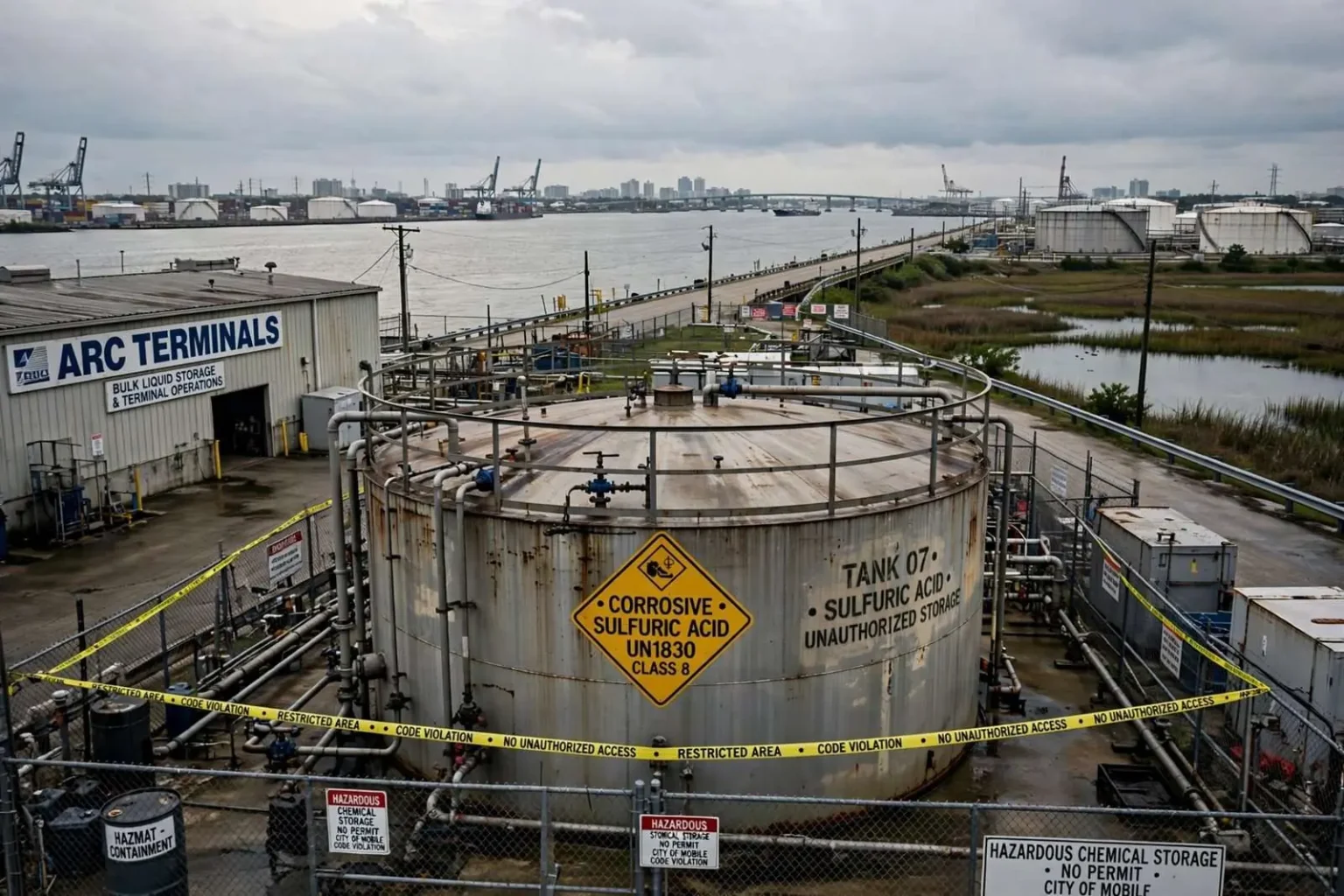
Mobile city officials have levied the maximum daily fine allowed under municipal code against Arc Terminals and its business partner, Sulfuric Acid Trading Company, for storing sulfuric acid in an above-ground tank on the city’s waterfront without the required approval.
A spokesman for Mayor Sandy Stimpson announced the penalty this week, saying the companies will be charged $298 for every day they have been out of compliance, a figure that stretches back to the initial delivery of the chemical and continues to accrue until the acid is removed from the property.
“The city today notified the companies that they will be fined the maximum amount allowed for every day they have been in violation, dating back to the initial delivery,” city spokesman George Talbot said in a statement. “They also will be fined every day going forward until the sulfuric acid is removed from the site.”
How the timeline came to light
The fines follow a City Council meeting earlier in the week during which Arc officials acknowledged that sulfuric acid had been sitting in a tank at the company’s terminal on Cochrane Causeway since February, months before the Mobile Planning Commission approved the storage in June. Council members were weighing an appeal of that Planning Commission approval when the timeline came to light. After hearing the admission, the council voted unanimously to reverse the approval altogether.
Clayton Curtis, Arc’s vice president of regulatory affairs, told reporters after the meeting that the company had not realized it needed separate approval to store sulfuric acid in a tank that had originally been permitted for petroleum storage. Curtis said Arc only became aware of the oversight after Sulfuric Acid Trading Company, its client, attempted to obtain a business license from the city. He said the company subsequently disclosed the issue to Planning Commission staff.
Doug Anderson, the attorney who represents the Planning Commission, disputed any suggestion that the commission had known about the early storage before granting its approval. He said the council meeting marked the first time Arc had publicly disclosed that the acid had been on site since February.
“It was never told to the Planning Commission in my presence,” Anderson said, adding that if commissioners had known about the storage beforehand, inspectors would have been sent to the site.
The company’s response
Arc issued its own statement a day after the city announced the fines, saying that once it recognized approval was needed, the company sought and received sign-off from the Planning Commission.
“Arc greatly values our long-term relationship with the City of Mobile, and we regret the breakdown in communication during the subsequent appeals process, which has led to this issue,” the company said, adding that it was “taking prompt action to ensure full compliance with the permit in question.”
City officials pushed back sharply on that characterization. Talbot confirmed the fines will apply retroactively from February, when the acid was first delivered, through June, when the Planning Commission initially approved its storage, and will resume for the period following the council’s reversal. He said the total amount owed will ultimately be determined in court.
“Neither Arc Terminals nor its business partners have approval to store or transport sulfuric acid in the City of Mobile,” Talbot said. “By their own admission, the companies have been operating in violation of city law since February.”
Why a separate approval was required
Although Arc’s terminal sits on property zoned for heavy industry, city rules required a separate Planning Commission sign-off once the material stored in the tank changed from petroleum to sulfuric acid, a hazardous chemical that requires additional safety and handling review.
Talbot said the city is also pursuing a temporary restraining order against Arc and its partner in an effort to force what he called “the immediate and safe removal of this hazardous chemical” from the site.
“We are disappointed by the irresponsible and reckless behavior displayed by Arc and its partners,” he said. “Their disrespect for due process and the safety of our citizens is unacceptable and incongruent with the many responsible businesses operating in and around the Port of Mobile.”
Sulfuric Acid Trading Company could not be reached for comment, and Planning Commission Chairman Jay Watkins had not returned a call seeking comment as of this report.
The dispute adds to what has already been a contentious few weeks over industrial chemical storage along Mobile’s working waterfront, as residents and city leaders alike press for clearer answers on how the arrangement went unapproved for so long.
The setting on the Causeway
The terminal sits on Cochrane Causeway, the causeway corridor that runs across the northern edge of Mobile Bay and links the city’s industrial districts to the areas west of the river. Lined for generations with terminals, tank farms, shipyard support operations and rail spurs feeding the Port of Mobile, the corridor is among the most intensively industrial landscapes in south Alabama — and among the closest to neighborhoods that edge toward it. That proximity is precisely why the city’s zoning code treats a change in stored material as a new planning question rather than a formality.
Sulfuric acid is one of the most widely shipped industrial chemicals in the United States, used in fertilizer manufacturing, metal processing and countless other applications, and it moves routinely through major ports. But it is also a substance whose handling carries well-understood hazards: it is highly corrosive, reacts violently with water in some circumstances, and demands compatible tank materials, secondary containment and emergency planning appropriate to the site. None of those requirements makes storage impossible — tank farms across the country store it safely — but they are the reason municipalities separate petroleum permissions from chemical ones and review the change through a public process.
The city’s framework gives the Planning Commission, an appointed citizen body, the job of weighing exactly those questions, with the ability to attach conditions, require inspections or reject a use outright. The commission’s June approval had followed that normal course; what transformed the dispute was the disclosure that the substance had already been inside the tank for months before anyone reviewed it. The council’s unanimous reversal reflected how quickly that timeline changed the politics of what had begun as a routine appeal.
For Mobile’s waterfront, the episode has become a test of enforcement credibility. The port anchors thousands of jobs and has been the engine of the city’s recent industrial growth, and city officials were careful in their statements to draw a line between the many operators they described as responsible partners and the conduct of Arc and its client. The accumulating fines — and the court fight over them — will now establish what that line costs to cross.
The competing accounts of what the Planning Commission knew will likely shape how the dispute is resolved. Anderson’s insistence that inspectors would have been sent had the commission been told frames the case as a straightforward failure of disclosure by the operator: the approval process exists to bring review and inspection before a hazard is in place, and an operator that fills the tank first and seeks the paper afterward has, from the city’s view, inverted that protection. Arc’s account — that it acted promptly once it learned a permit was required, and blamed the escalation on the appeals process — treats the episode as a documentation lapse rather than a safety failure. The court where the fine total is ultimately determined will have to sort which framing the facts support.
The arithmetic of the fine shows why the city chose the maximum it did. At $298 per day, a violation stretching from February’s delivery well into the summer reaches into the tens of thousands of dollars and keeps growing until the chemical leaves the site, giving the companies a daily financial reason to speed removal rather than litigate at leisure. Backing the accrual with a temporary restraining order adds the possibility of a judicial deadline, the faster and more decisive instrument the city has for getting the acid off the waterfront.
The episode also illustrates how the chemistry of the port’s growth collides with the geography of the city around it. Mobile’s working waterfront sits close to downtown and to residential districts along the bay, and every increase in bulk chemical traffic raises the stakes of the permitting review. A tank approved for petroleum products does not become a sulfuric acid tank by changing its contents: the storage compatibility questions, the spill response assumptions and the emergency planning that the city and its first responders rely on all change with the material. That is the substance of the “separate approval” rule the companies say they overlooked, and the reason city officials treated the bypass as more than paperwork.
For residents following the dispute, the open questions are practical ones: where the acid will be moved, how it will be transported once removed, and whether the city will add safeguards — tighter disclosure requirements, earlier inspections, clearer penalties — so that the next change of substance in a waterfront tank happens through the front door. Those answers will arrive through the same institutions already on display: the Planning Commission that reviews uses, the council that hears appeals, and a court that will now put a number on the violation.
Until the acid is gone, the fines accrue and the restraining order is pending, the dispute stands as a reminder of how much of the port’s promise depends on the unglamorous machinery of local permits — and how quickly that machinery matters when the substance in a tank is not what the city was told it would be.