Arc Logistics Admits It Was Already Storing Sulfuric Acid in Mobile Before Permit Vote
An Arc Logistics executive admitted the company was already storing sulfuric acid on Mobile's waterfront before council members voted on its permit.
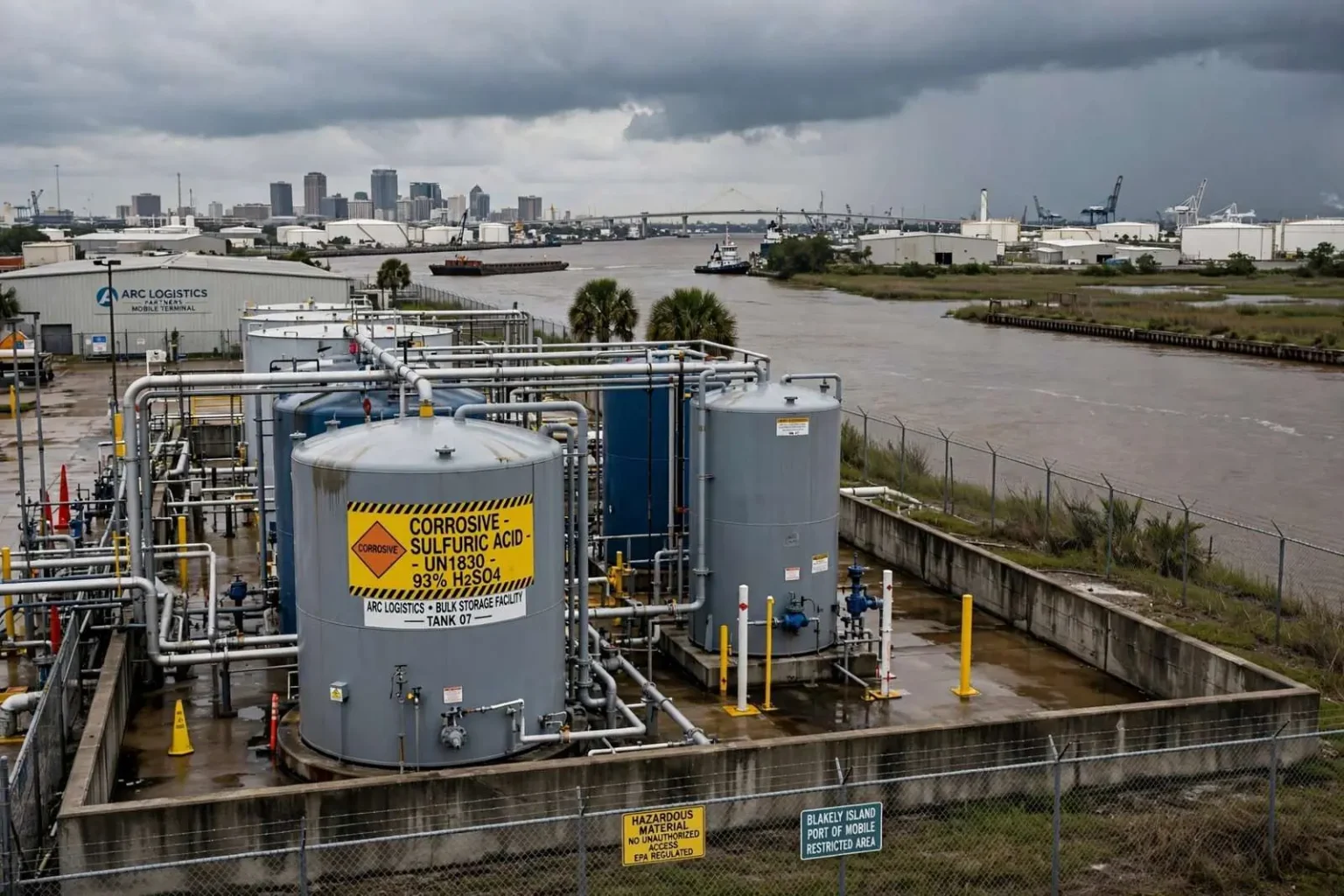
A routine permit vote at Mobile’s City Council took an unexpected turn this week when an Arc Logistics Partners executive admitted the company was already storing sulfuric acid on the city’s waterfront, months before council members ever cast a ballot on whether to allow it. The admission came after weeks of heated debate and heavy criticism from community members over Arc’s request to store the chemical at its bulk storage facility.
As the council prepared to vote, Councilwoman Gina Gregory asked point-blank whether the company was already using sulfuric acid storage tanks on the waterfront. The answer stunned people in the room. Arc Vice President Clayton Curtis replied simply, “correct.”
Councilman Levon Manzie said he was taken aback by the admission, noting that the entire purpose of the vote was to determine whether the chemical storage should be permitted in the first place. In response, Curtis said the company had not realized it needed permission until after the tanks were already in place, telling the council he had assumed people were aware of the arrangement.
In the end, the council allowed Arc to continue storing asphalt at the site but rejected the request tied to sulfuric acid storage. City officials did not immediately say what would happen to the sulfuric acid already sitting in tanks on the property, leaving an open question about enforcement and next steps.
A Contentious Fight Over the Waterfront
The revelation adds a new layer to an already contentious fight over industrial storage along Mobile’s waterfront, where residents near Blakely Island have spent weeks pressing officials over the safety of storing hazardous chemicals so close to the Mobile River. Neighbors have raised concerns about emergency planning in the event of flooding or a hurricane, as well as the long-term direction of Arc’s operations in the city.
Blakely Island sits in the heart of Mobile’s working port district, where bulk terminals, tank farms and barge facilities line the river channels. The neighborhood debate has drawn residents to city hall in growing numbers, and the discovery that the chemical was already on site transformed a zoning-style permit question into a question of regulatory oversight: how storage of a hazardous material began without the city’s blessing in the first place.
The concern about storms is not abstract along the central Gulf Coast. Mobile’s waterfront has absorbed hurricanes and tropical storms that pushed surge up the Mobile River and flooded low-lying industrial ground, and residents argue that tanks holding corrosive chemicals near the water deserve the strictest possible review, not a retroactive one.
What the Council Decided
The split decision — allowing the asphalt storage to continue while rejecting the sulfuric acid request — leaves Arc in a complicated position. The company can keep its established bulk asphalt operation at the facility, but the chemical storage that prompted the evening’s most dramatic moment now lacks the permit the council was asked to grant, and the material already in the tanks exists in something of a legal limbo until officials say otherwise.
Bulk liquid storage is a defining feature of Mobile’s economy. The city’s port complex is among the largest on the Gulf of Mexico, and companies ranging from petroleum handlers to chemical distributors maintain tank capacity along the river. That industrial footprint brings jobs and tax revenue, but it also places hazardous materials within reach of neighborhoods, schools and downtown, which is why storage requests routinely draw public scrutiny at city hall.
Sulfuric acid itself is one of the most widely produced industrial chemicals in the world, used in fertilizer manufacturing, metal processing, water treatment and battery production. It is corrosive and dangerous in concentrated form, requiring tanks, piping and spill containment designed to industrial standards. Transportation and storage of such chemicals fall under federal and state rules, but the city’s permit process is the layer that determines whether a particular waterfront site may host that activity at all.
Curtis’s explanation that the company assumed the arrangement was understood — and only learned it needed permission after the tanks were in place — did little to calm critics, who asked how a major industrial operator could misunderstand which approvals its operations required. The episode has become a case study for permit opponents, who argue that if a company of Arc’s scale could store a regulated chemical first and ask questions later, smaller operators face even less scrutiny.
Questions of Enforcement and Oversight
City leaders now face pressure to explain how a company came to store a hazardous chemical on city-regulated waterfront property without the required permit, and what oversight mechanisms exist to catch similar gaps before they happen. Possible avenues include enforcement action through the city’s permitting authorities, coordination with state environmental regulators, or a negotiated timeline for removing the material — but no official had outlined any of those steps by the end of the meeting.
The council’s rejection of the sulfuric acid request also raises practical questions about the tanks themselves. Storage that is permitted at one moment and denied at another leaves regulators to sort out what happens to product already on hand, and the council did not set a deadline for the company to address it.
For the residents who filled the chamber over recent weeks, the vote was a partial victory. They succeeded in blocking new authorization for chemical storage, but the admission that the storage already existed undercut the assumption that the permit process stood between the neighborhood and the material. Community groups have signaled they will keep pressing for answers about emergency planning, evacuation routes and notification procedures in the event of a spill, particularly during hurricane season.
A Larger Debate About the Working Waterfront
The episode is likely to fuel further scrutiny of industrial permitting along Mobile’s working waterfront as the city weighs future storage and expansion proposals from companies operating there. Mobile’s port economy continues to grow, and every expansion proposal that comes before the council now arrives with a more skeptical audience and a recent example of the system failing to catch an unpermitted use.
Council members did not set a timeline for resolving the status of the sulfuric acid already on site, but the admission is expected to remain a point of contention as the debate over waterfront industrial use continues. What began as a routine agenda item has instead become a test case for how Mobile balances its identity as a working port city against the expectations of the residents who live beside it, and the next steps — enforcement, removal or renewed negotiation — will signal how strictly the city intends to police its own permit process going forward.
The tension at the council meeting reflected a broader shift in how Mobile residents engage with port-adjacent development. For decades, decisions about tank farms and bulk terminals were largely the province of industrial regulators and business leaders, with limited neighborhood participation. Recent years have brought larger crowds to public hearings, organized community groups focused on waterfront land use, and a council more accustomed to answering questions about what is stored where along the river.
Mobile’s geography sharpens those concerns. The city sits at the head of Mobile Bay, where the Mobile River and Three Mile Creek converge, and storm surge from Gulf hurricanes routinely pushes water into low-lying districts near the port. Flood maps place much of the industrial waterfront in areas vulnerable to inundation, and residents argue that emergency planning for a chemical facility must account for a hurricane scenario in which responders might be stretched thin across the county at the exact moment a tank wall is tested.
How the Permit System Is Supposed to Work
Under Mobile’s permitting framework, industrial uses on waterfront property are subject to city review before operations begin, with the council or its designated boards weighing factors such as safety, compatibility with surrounding land use and the site’s infrastructure. The stated purpose is straightforward: elected officials and residents should know what hazardous materials are coming to a neighborhood before they arrive, not after. That is precisely the sequence the Arc episode inverted.
Council members’ questions about how the gap went unnoticed point toward a possible review of internal procedures, including whether permit enforcement for port-area properties is proactive or complaint-driven. A complaint-driven system depends on residents noticing unusual activity, while a proactive one involves periodic inspection of regulated sites. The difference matters in an industrial district where many facilities operate behind fences, away from public view.
The asphalt portion of Arc’s operation, which the council allowed to continue, is the facility’s established business and was not the subject of the same level of opposition. The distinction the council drew — continuity for a longstanding use, rejection for the newly requested chemical storage — gives the company a path forward while affirming that new hazardous-material uses must clear the permit bar before, not after, tanks are filled.
As the city sorts out the fate of the acid already on site, the case has become a reference point on both sides of the waterfront debate. Supporters of port growth see a company that made an administrative misstep and was still able to conduct most of its business; opponents see proof that the city must tighten enforcement before the next tank goes up. The council’s handling of the open enforcement question will likely determine which reading prevails.