Mobile Tows First Vehicles Under New Junk Car Ordinance
The city of Mobile towed its first two vehicles under a new ordinance targeting inoperable cars left in public view, part of an effort to address hundreds of junk car complaints.
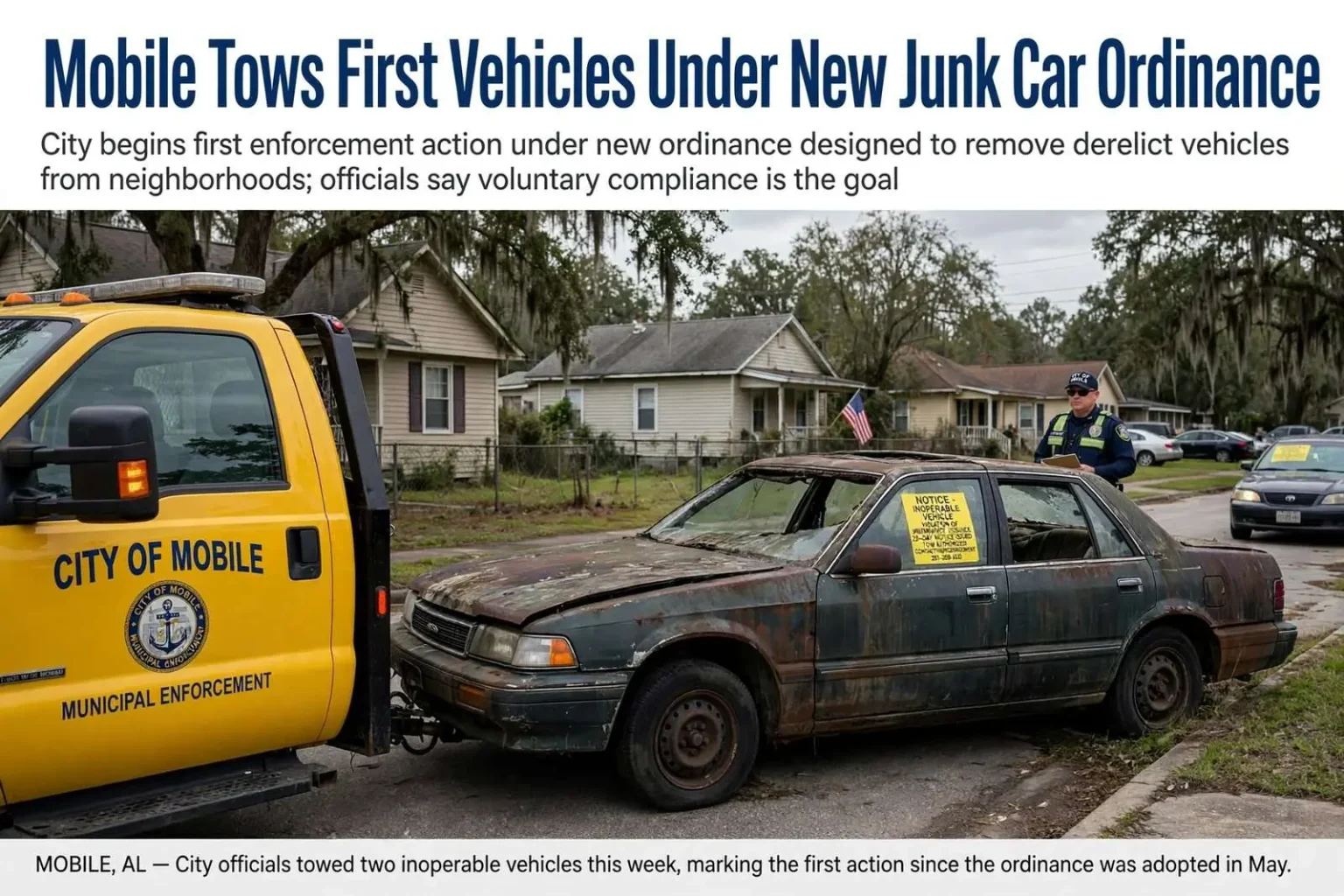
The city of Mobile towed away its first two inoperable vehicles under a new municipal ordinance, marking the initial enforcement action since the rule was adopted earlier this year to make it easier to remove derelict cars from private property. City officials framed the towings as the beginning of a new phase in Mobile’s fight against neighborhood blight, one that replaces a slow, court-dependent process with an administrative one built for speed and accountability.
Passed in May, the ordinance allows the city to ticket, and eventually remove, vehicles that are found to be inoperable if they sit in public view for an extended period. Under the rule, a vehicle parked in the same spot for 30 days triggers a ticket, with both the property owner and vehicle owner notified. If the vehicle still hasn’t been moved after another 30 days, the city dispatches a wrecker service from its rotating list to tow it to an impound lot. A lien is then placed on the vehicle, and after 60 days in impound, it goes up for auction. Any proceeds beyond the cost of impoundment are returned to the vehicle’s listed owner.
The tiered timeline was written to balance two goals that often pull against each other: giving owners ample notice and a fair chance to comply, and delivering relief to neighbors who have watched a rusting hulk deteriorate in plain sight for months. The rotating wrecker list, a standard feature of municipal towing programs, spreads the paid work among local towing companies rather than funneling it to a single contractor.
How enforcement got rolling
David Daughenbaugh, deputy director of municipal enforcement, said city officials have been preparing for enforcement since the ordinance passed. He said the first warning notices, yellow stickers created by the mayor’s Innovation Team, went out over the summer, and the two vehicles towed were originally noticed back in September. The months-long gap between first notice and first tow reflected the ordinance’s own waiting periods and the city’s deliberate effort to get the process right before removing anyone’s property.
Daughenbaugh said several other flagged vehicles have already been moved voluntarily by their owners, an outcome he described as the program working as intended. In code enforcement, officials generally measure success less by the number of cars towed than by the number of problems resolved without a tow, since removal is the costliest and most confrontational step for everyone involved.
Before the new ordinance, the city could only address inoperable vehicles through its litter ordinance, a process that required cases to move through the court system. Daughenbaugh said that approach sometimes produced a conviction without actually resolving the underlying problem, leaving residents to continue living next to a junk car. A judge could levy a fine, but nothing in that process guaranteed that the vehicle itself ever left the property, and repeat complaints would send the same case back through municipal court again.
The new ordinance is designed to give residents faster relief when an inoperable vehicle is left in public view, he said, adding that “public view” includes vehicles parked in backyards that remain visible to the public or to neighbors. That definition matters in Mobile’s older neighborhoods, where shallow lots, alleys and fencing mean a car hidden from the street may still dominate the view from half a dozen homes around it.
Compliance first, towing second
James Barber, executive director of public safety for the city, said the priority is “voluntary compliance,” meaning the goal is for owners to move cited vehicles before towing becomes necessary. If a vehicle does end up at the city’s impound lot, Barber said, the owner faces at least $125 in fees plus additional storage costs. The fee structure, officials noted, is designed to make the choice clear: moving a car on one’s own costs nothing, while letting it ride through the enforcement timeline ends in fees, a lien and the loss of the vehicle altogether.
Mayor Sandy Stimpson called the first towing a milestone for the city and said the ordinance would help address the roughly 800 complaints Mobile received about junk cars in 2017. That volume of complaints—more than two per day on average—made derelict vehicles one of the most common quality-of-life issues reported to City Hall, alongside potholes, streetlight outages and trash collection problems.
Daughenbaugh told Stimpson the city expects to issue citations on somewhere between 100 and 200 vehicles during the ordinance’s first year. The projection suggests enforcement will focus on the most visible and most complained-about cases rather than a sweeping sweep of every property in the city, an approach consistent with the complaint-driven way municipal enforcement generally operates.
“I know a lot of citizens are happy to see these dilapidated cars out of their neighborhoods,” Stimpson said at a press conference announcing the towing. “It’s a big day.” The mayor has made neighborhood revitalization a recurring theme of his administration, arguing that the condition of streets, parks and private property shapes both public safety and the city’s ability to attract new residents and investment.
State legislation behind the local rule
State Rep. Adline Clarke, who helped pass the local legislation enabling Mobile to adopt the ordinance, told Stimpson she was glad to see it move forward, noting that junk cars can create a “health and safety issue” for surrounding neighborhoods. Alabama cities generally need enabling authority from the Legislature to regulate activity on private property beyond what state law provides, which is why a municipal towing ordinance of this kind traces back to a bill carried through the Statehouse by the city’s delegation.
The health and safety dimension Clarke described is more than rhetorical. Inoperable vehicles collect standing water that can breed mosquitoes, leak oil, gasoline and other fluids into the ground, attract vermin, and in some cases serve as cover for break-ins and other crime. Blighted vehicles also drag down property values on the blocks where they sit, penalizing homeowners who maintain their own houses and yards.
City officials said the first removals will be watched closely as the ordinance matures. If complaints continue at the pace of recent years, the yellow warning stickers that the Innovation Team designed are likely to become a familiar sight on Mobile streets—a signal to owners that the window for voluntary compliance is open, but that it closes.
The ordinance’s journey from idea to first tow traced the path that many of Mobile’s recent quality-of-life reforms have followed: a resident complaint pattern documented at City Hall, a policy response drafted by the Stimpson administration’s staff, enabling legislation secured from the city’s delegation in Montgomery, and finally the unglamorous work of building an enforcement routine inside the municipal bureaucracy. Officials said the Innovation Team—the mayor’s in-house group focused on redesigning how city services are delivered—played a central role by developing the bright yellow warning notices that start every case, printing them in a form that clearly states the deadlines, the consequences and the phone number an owner can call to resolve the matter.
For the enforcement officers who write the citations, the new law changed the daily mechanics of the job substantially. Under the litter ordinance, building a junk car case meant documenting the vehicle, filing in municipal court and waiting on a docket, with each stage susceptible to delay and each conviction offering no guarantee of removal. The administrative process now runs on a calendar rather than a court schedule, and the outcome is an actual tow rather than a fine. Officers can spend less time shepherding cases through court and more time responding to the next complaint on the list.
The ordinance also brought Mobile in line with practices common in peer cities across Alabama and the Southeast, many of which adopted administrative junk vehicle programs years earlier after watching similar court-based approaches stall. Municipal codes in communities from Huntsville to Pensacola typically define an inoperable vehicle by a combination of factors—expired registration, missing or disabled components, a vehicle that cannot move under its own power—and Mobile’s rule follows that pattern, pairing the definition with the notice-and-waiting-period process before any removal occurs.
Neighborhood associations across the city, which have long listed derelict vehicles among their most frequent complaints, welcomed the first enforcement action as validation of a years-long push. Residents in areas like Toulminville, Crichton, Spring Hill and the communities around Government Street reported the same frustration: a car abandoned on a corner lot or along a fence line, untouched for seasons, serving as a de facto dumping ground and a magnet for vandalism. Under the old system, the association could file a complaint and follow the case into court, only to see the car still sitting there after the matter was adjudicated.
What happens next will depend on how the caseload develops. If the 100-to-200-citation projection for the first year holds, the city will average only a handful of cases each week—a pace that lets enforcement officers walk owners through the process carefully in these early, precedent-setting months. Officials said the goal is a program that compounds: every vehicle moved voluntarily, every auction completed and every complaint resolved makes the case to the next owner that complying quickly is the cheaper and easier path.