Mobile Workers Have Clawed Back Most of the Paychecks Lost to COVID-19, Local Economist Finds
A monthly tracking of local wages and employment shows Mobile-area workers have regained nearly 60 percent of the paycheck income lost during COVID-19 shutdowns, though total worker income as of November 2020 still lagged pre-pandemic levels.
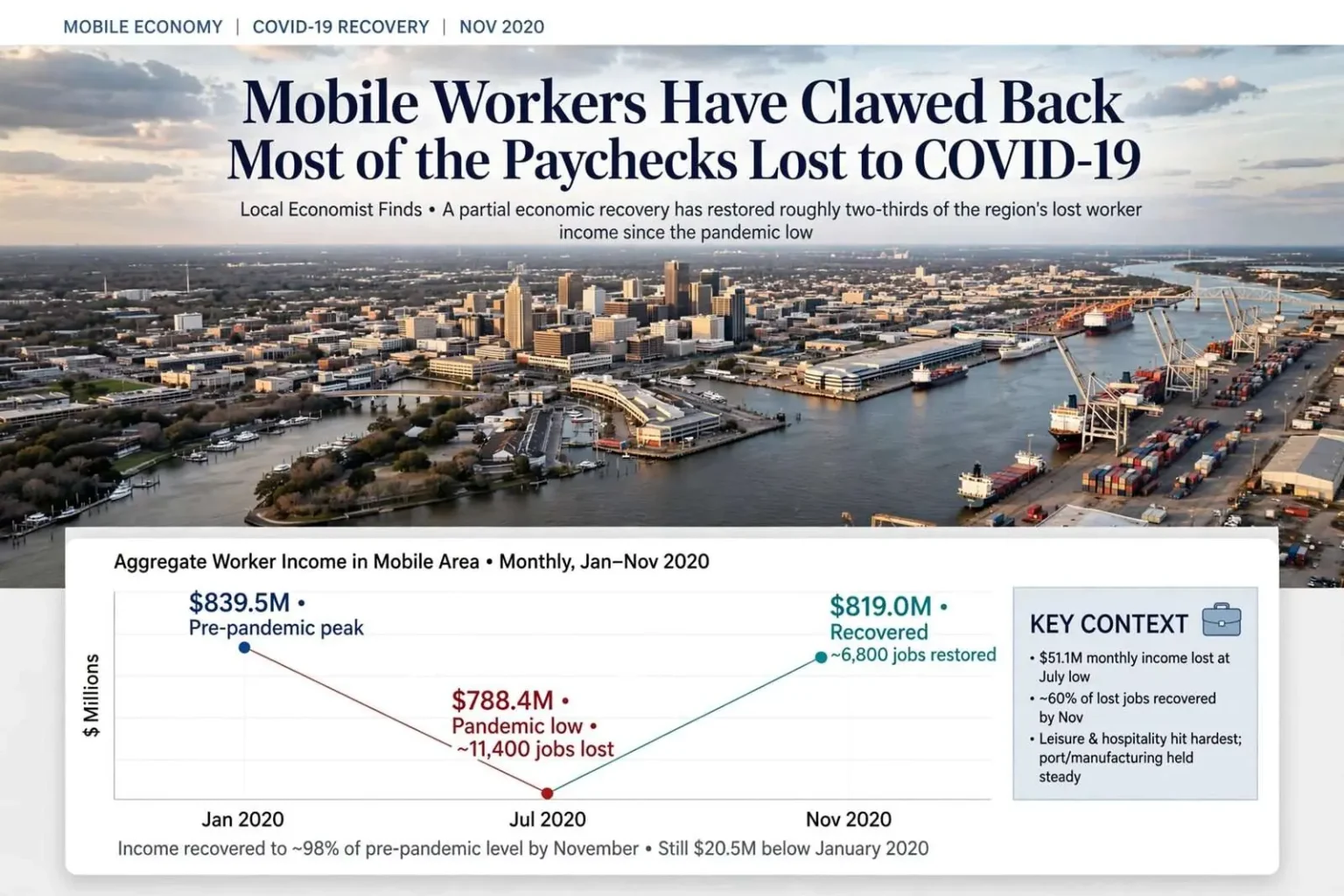
A year into the coronavirus pandemic, one of the clearest signs of how hard the Mobile-area economy has been hit — and how much of it has come back — is showing up in a simple but telling number: the total paycheck available to local workers each month. The measure is called aggregate worker income, and its path over the past year traces both the collapse and the partial recovery of the region’s economic life in a single line.
That figure, sometimes called aggregate worker income, is calculated by multiplying the number of people employed in each major industry by the average wages those workers earn. Tracked monthly using employment data from the U.S. Bureau of Labor Statistics, it offers a running gauge of how much money is actually flowing into local households to be spent on rent, groceries, and everything else that keeps the regional economy moving.
In January 2020, before the virus reached Mobile, the local workforce had an estimated $839.5 million available to spend. By July, as shutdowns and reduced hours took their toll, that figure had fallen to $788.4 million, the lowest point of the year. By November 2020, the most recent month for which full data has been published, worker income had climbed back to $819.0 million — a recovery measured in tens of millions of dollars a month, but one that still left the region short of where it began.
A Decade Erased, Then Partly Restored
The scale of that swing becomes clearer in historical context. The July low was roughly equivalent to worker income levels last seen in Mobile before 2010, effectively erasing close to a decade of wage growth in a matter of months. Put differently, the pandemic stripped out the cumulative gains of the long expansion that followed the Great Recession — the slow, steady accumulation of jobs and hours that had lifted the region’s monthly paycheck to its pre-pandemic high.
The November rebound put the local economy back in the neighborhood of where it stood in 2016 and 2017 — a meaningful recovery, even if it still falls short of pre-pandemic levels. Recovering four years of lost ground in four months is its own kind of achievement, but the gap that remained in late 2020 represented real money not reaching real households: roughly $20 million a month less than the same workers would have collected a year earlier.
Because wage rates for most industries have stayed fairly steady over the past several years, the swings in total worker income are driven mainly by how many people are employed rather than by pay cuts. The pandemic’s damage was not that Mobile’s workers earned less per hour — it was that tens of thousands of them were not working at all, or were working shortened hours in industries that had shed shifts.
Counting the Lost and Recovered Jobs
Between January and July, Mobile-area employers shed roughly 11,400 jobs across the ten major industry sectors tracked by the Bureau of Labor Statistics. By November, about 6,800 of those positions had been refilled, meaning local businesses had rehired nearly 60 percent of the workers they had lost during the worst of the shutdown period.
The pattern of those losses followed the shape of the pandemic itself. The industries hit hardest were the ones built on public gathering — restaurants, hotels, entertainment and retail — where shutdown orders and consumer caution emptied rooms and storefronts almost overnight. Industries tied to the port, manufacturing, logistics and professional services saw shallower dips, and some continued hiring through the downturn. That unevenness is why aggregate numbers can recover steadily while entire sectors remain in crisis, and why the region’s restaurant and hospitality workers have experienced a very different year than its shipyard workers.
The remaining gap — the roughly 4,600 jobs still missing in November — represents the hard core of the recovery, the positions that do not return simply because businesses have been allowed to reopen. Some vanished with businesses that closed permanently; others wait on consumer confidence, on events and travel returning, or on the reorganization of industries that the pandemic accelerated.
What the Numbers Mean for Mobile Households
Aggregate worker income is a statistic, but what it measures is household reality. Each month’s figure represents the pool of wages available for rent in Midtown, groceries in Tillman’s Corner, tuition payments, car notes and church offerings across the metro area. When it fell by more than $50 million a month, that decline showed up as deferred maintenance, skipped purchases and strained family budgets; when it recovered, the money returned to the same cash registers and landlords, flowing back into the local economy at street level.
The measure also explains why the pandemic recession felt different from previous downturns. The 2008 financial crisis built slowly and cut deeply across industries, while the pandemic downturn arrived in weeks and concentrated its damage on specific sectors. Aggregate worker income in Mobile, which had taken years to climb from its pre-2010 levels to its January 2020 peak, lost a decade’s progress in the spring and then won back roughly two-thirds of it by fall — a speed of both loss and recovery with no recent precedent.
The composition of the recovery matters as much as its size. Rehiring concentrated where the losses began, in leisure, hospitality and retail, as restaurants reopened patios and stores restaffed. But the months between November 2020 and full recovery promise to be slower, because the easy restorations — reopening a business that survived — are already done. What remains is rebuilding, in the industries where the pandemic changed consumer behavior permanently.
The Road Back to January 2020
Economists watching the region look for the moment aggregate worker income crosses its pre-pandemic peak, the marker that the recovery has become an expansion again. On the November trajectory — recovering roughly $30 million of a $51 million loss over four months — the remaining gap suggested more months of steady repair, dependent on the pace of vaccination, the return of travel and events, and the health of the national economy that pulls so much of Mobile’s trade through the Port of Mobile.
The port and its related industries give the region a recovery engine that tourist-dependent Gulf Coast economies lack. Cargo volumes through the State Docks held comparatively steady through the pandemic, and manufacturing employment — anchored by the shipyards on the Mobile River — provided a floor under the local economy while consumer-facing industries cratered. That diversity is why Mobile’s aggregate income fell less than it might have, and why the region’s full recovery does not depend on any single industry’s rebound.
A year after the virus arrived, the numbers tell a story of damage and repair in nearly equal measure. Mobile’s workers had recovered most of what they lost — nearly 60 percent of the jobs, roughly two-thirds of the income gap — but the last portion of the distance back to January 2020 would be the hardest, and the data of the following year would show whether the region’s comeback continued at the same pace or stalled short of the peak.
Behind the aggregate figures sit the details that local employers and workforce agencies have been tracking all year. The Bureau of Labor Statistics divides the economy into ten major industry sectors — from construction and manufacturing to leisure and hospitality — and the pandemic treated them wildly differently. Aggregate worker income blends those experiences into one number, which is why economists supplement it with sector data when explaining what is actually happening on the ground.
Sector by Sector, One Region’s Story
The leisure and hospitality sector absorbed the deepest initial shock anywhere in the country, and Mobile was no exception. Restaurants, bars, hotels and event venues shed workers at a pace no previous recession had produced, and while rehiring began as soon as restrictions eased, the sector’s payroll remained well below its pre-pandemic level through the fall. Every shift cut in a hotel restaurant ripples outward — to suppliers, to tip-dependent workers, to the downtown streets that depend on foot traffic.
Retail, another high-loss sector, faced a different dynamic: stores reopened, but the pandemic accelerated the shift toward online ordering, raising questions about how many retail positions will ever return in their previous form. Manufacturing, construction and trade-transportation-utilities — the sectors that anchor Mobile’s port economy — fared comparatively well, with shipbuilding and cargo operations continuing through the pandemic under safety protocols.
Government, healthcare and education — the stable, salary-driven employers that make up much of any metro economy — saw shallower swings, which cushioned the aggregate numbers. That mix of stable and volatile sectors is why Mobile’s total income decline, while severe, was less catastrophic than the experience of regions dependent on a single industry; the region’s shipyards and port facilities functioned as economic ballast while its restaurants and hotels rode out the storm.
Reading the Months Ahead
The monthly release of the employment data has become a quiet ritual for the region’s economists and planners, each figure answering the same question: is the recovery holding its pace? The most recent month’s data always arrives revised, and the picture it paints is retrospective — a description of where the economy was, not where it is heading. For policymakers at Mobile City Hall and the county’s economic development agencies, the aggregate income trend is the bottom-line indicator they watch, because it captures both employment and wages in the single measure that matters most to local businesses.
The number also matters for the businesses that never closed. Retailers along Airport Boulevard and in the downtown districts track the region’s recovery through their own registers, and aggregate worker income is effectively the demand side of that ledger — the total capacity of local households to spend. Its steady climb since July has been the quiet good news underneath the headlines about closures and layoffs.
One year in, the ledger shows a region that has reclaimed most of what the pandemic took. The $819.0 million collected by Mobile-area workers in November 2020 was $30.6 million more than the July low and $20.5 million short of the January peak — a recovery that is real, measurable and unfinished. The remaining distance will be covered job by job, industry by industry, in the months of data still to come.