Prichard Police Investigated Fatal 2010 Home Invasion on Stile Avenue
Prichard police investigated a fatal October 2010 home invasion on Stile Avenue after intruders allegedly posed as federal agents and searched for money.
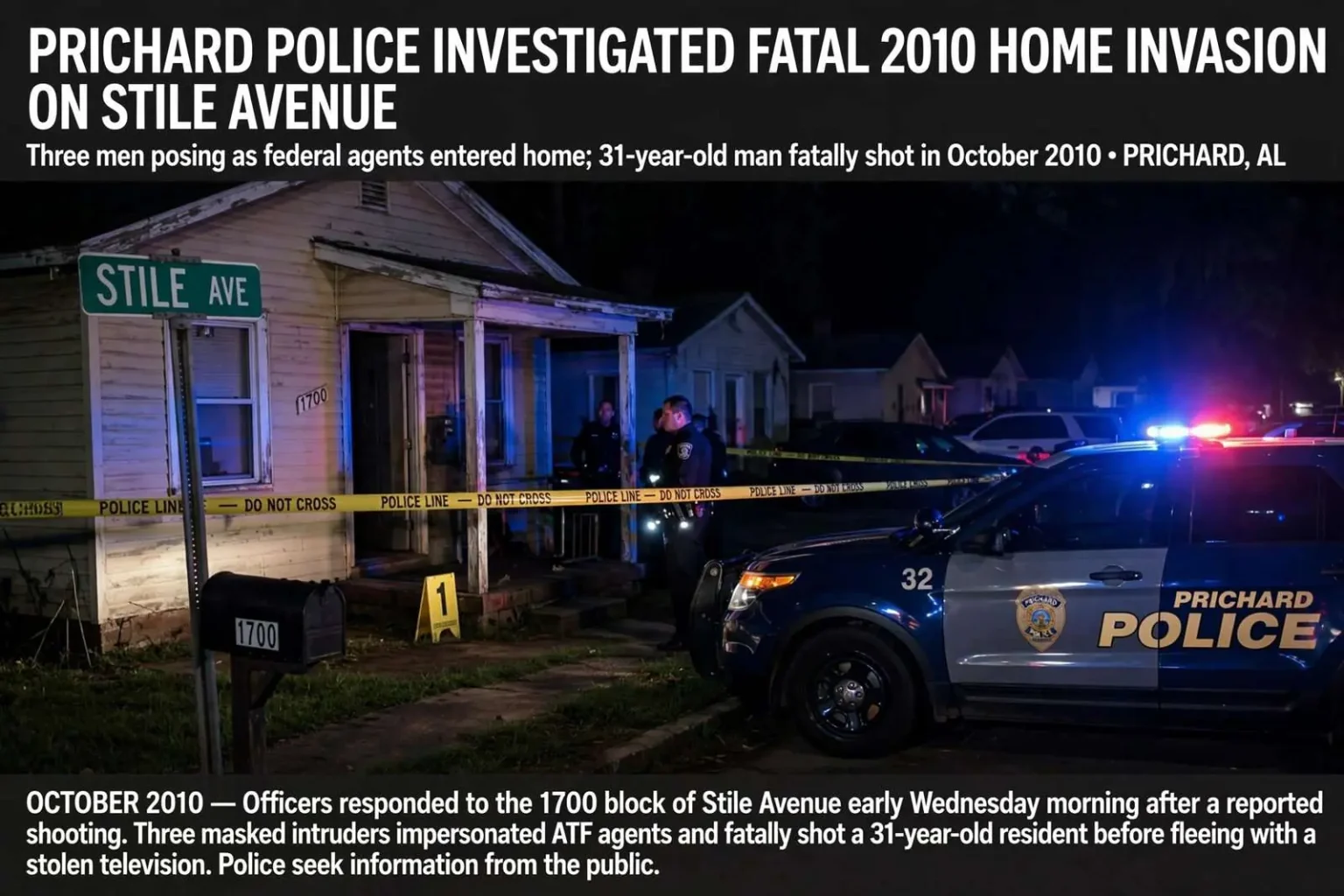
Prichard police investigated a fatal home invasion in October 2010 after intruders allegedly entered a Stile Avenue residence while posing as federal agents. The case turned on a disguise few residents are prepared to question — a claim of law-enforcement authority used as the opening move of a robbery that ended in a homicide investigation.
Officers responded early on a Wednesday morning to a report of a shooting in the 1700 block of Stile Avenue. Inside the home, they found a 31-year-old man with a fatal gunshot wound to the torso. Medical personnel pronounced him dead at the scene.
The early-morning hour and the residential block set the terms of the investigation. Stile Avenue runs through a working-class section of Prichard, the city that sits just north of Mobile in Mobile County — a community that has contended for decades with the economic strain that follows job loss and population decline, and with the property crime and violence that strain feeds. For the officers who took the call, the report of a shooting on Stile Avenue was the start of a night’s work; what they found inside turned it into a case with an unusual and alarming signature.
Investigators’ account
Police said three men dressed in black and with their faces covered forced their way into the residence. According to investigators, the intruders identified themselves as agents with the Bureau of Alcohol, Tobacco, Firearms and Explosives before searching the home for money.
The claim of federal identity transformed the opening moments of the crime. A resident confronted by a forced entry has seconds to decide how to respond — and a home invasion launched under the name of a federal agency is designed to freeze exactly that decision. Legitimate law enforcement officers carry credentials, warrants, and uniforms; an occupied home at night has no way to verify any of it before the door is breached. The invaders, according to the account police assembled, counted on that confusion to get inside and take control of the house before anyone thought to resist or call for help.
The search for money, followed by the shooting, followed by the theft, laid out the crime’s progression: an intended robbery that became a homicide when violence escalated, capped by the removal of a flat-screen television — a detail that captured the invasion’s mixture of calculation and carelessness, targeting cash but settling for whatever could be carried.
Authorities said the suspects then shot the victim and left with a flat-screen television. Other people were inside the house during the invasion but were not physically injured, according to the initial police report.
Those witnesses — uninjured but present — became the case’s most valuable resource. People inside a home during a violent invasion see more than any forensic processing can recover: voices, heights, build, the sequence of events, what was said and when. Their accounts, along with the physical evidence inside the residence, formed the foundation of the investigation in its first days.
The impersonation tactic
The case illustrated the particular danger of criminals impersonating law-enforcement officers, a tactic that can create confusion and delay a victim’s ability to recognize a threat. Every layer of protection a household has — locked doors, hesitation with strangers, the decision to call 911 — presumes that the person on the other side of the door is who they claim to be. Impersonation attacks that presumption at its root.
Federal agencies are especially effective cover, because they carry the double weight of authority and unfamiliarity. A city police officer’s uniform is a known quantity; a federal agent’s raid jacket is not, and most residents have no basis for challenging one. That gap between authority claimed and authority verifiable is the space in which this kind of crime operates — and it is why agencies themselves take impersonation seriously, treating the false use of their name as both a crime and a direct threat to the public trust their real work depends on.
For Prichard’s investigators, the ATF claim also gave the case a lead it would not otherwise have had: the intruders had, in effect, volunteered a subject — weapons, federal enforcement — that suggested what they wanted residents to believe they were looking for, whatever they were actually after. Investigators pursuing the case could work that thread alongside the more ordinary ones of a mobile county: the television’s disposal, the suspects’ movements through a city where many streets know their own, and the possibility that someone in the neighborhood saw the men in black arrive or leave.
The request for information
Investigators asked anyone with information about the crime to contact the Prichard Police Department. The appeal is the standard instrument of a case like this one — and in a neighborhood crime, it is often the decisive one. Tip lines, quiet conversations with officers residents already know, and the steady pressure of a case that stays in the local news all feed the same channel: information moving from the people who hold it to the detectives who need it, before the trail of a stolen television and three unidentified men goes cold.
Homicides committed by intruders who arrived masked and left quickly leave few threads for detectives to pull from the scene alone. What such cases depend on instead is the surrounding community: a resident who heard voices or a car in the early-morning hours, someone who later recognized a description, or a person who knows where a stolen flat-screen television changed hands. Public appeals convert a city’s private observations into investigative material, and departments that maintain credibility with their neighborhoods tend to get the calls that break cases.
The article records the facts released during the initial investigation and does not identify suspects or describe a later arrest, charge or court result. That boundary is part of the historical record: what Prichard police said in October 2010 was an account of what they believed happened, assembled in the first hours and days of an active case, and this account preserves it as such — distinct from any findings that investigators, prosecutors, or courts may have produced later.
The case illustrated the particular danger of criminals impersonating law-enforcement officers, a tactic that can create confusion and delay a victim’s ability to recognize a threat. It also prompted a public appeal for information as investigators worked to identify the people involved.
Prichard and its police department
The city the crime touched is no stranger to hard news. Prichard, which borders Mobile to the north, spent the years around this case working through challenges that made headlines well beyond the city limits — most prominently the pension crisis that pushed the city into bankruptcy proceedings, and the persistent economic disinvestment that has reshaped the city’s population and commercial base over recent decades. A police department operating under that kind of municipal strain carries heavy caseloads with limited resources, and its detectives work cases the way departments its size do: through the neighborhood, the file, and the slow accumulation of information.
For residents of Stile Avenue and the streets around it, the case raised questions that outlasted the news cycle — who the men in black were, whether they were locals, and whether the federal-agents trick would be tried again on someone else’s door. Those are precisely the questions a public appeal is designed to answer, and the reason investigators kept the invitation to call open as the case matured.
What the case left behind
This historical report is based on the Prichard Police Department’s statements at the time. It distinguishes those investigative statements from any final findings that may have emerged later — an important distinction in any criminal case, and never more so than in one that began with a lie about who the killers claimed to be.
The facts as police gave them in October 2010 remain the documented core: a 31-year-old man found shot to death in his home in the 1700 block of Stile Avenue early on a Wednesday morning; three intruders in black with covered faces who had identified themselves as agents of the Bureau of Alcohol, Tobacco, Firearms and Explosives; a search of the home for money; a fatal gunshot to the torso; a flat-screen television carried out; and other occupants of the house left physically unharmed in its aftermath.
Around that core, the case became an example of a crime pattern that law enforcement agencies across the country warn about: the home invasion launched under a false claim of official authority. The pattern’s danger lies in its first seconds — the moment when a household must decide whether the people at the door are officers or criminals, with no reliable way to check. Prichard’s case ended in the worst outcome that moment can produce, and the department’s appeal for information was, in the end, the community’s principal tool for answering the question the intruders’ disguise had posed: who they were, and how to make sure the next knock at a neighbor’s door gets the skepticism it deserves.