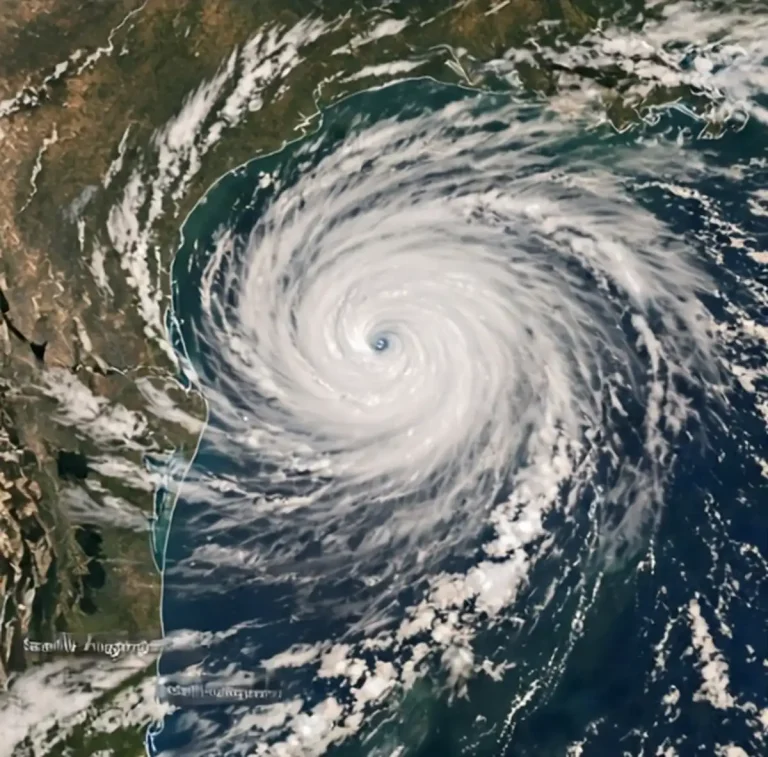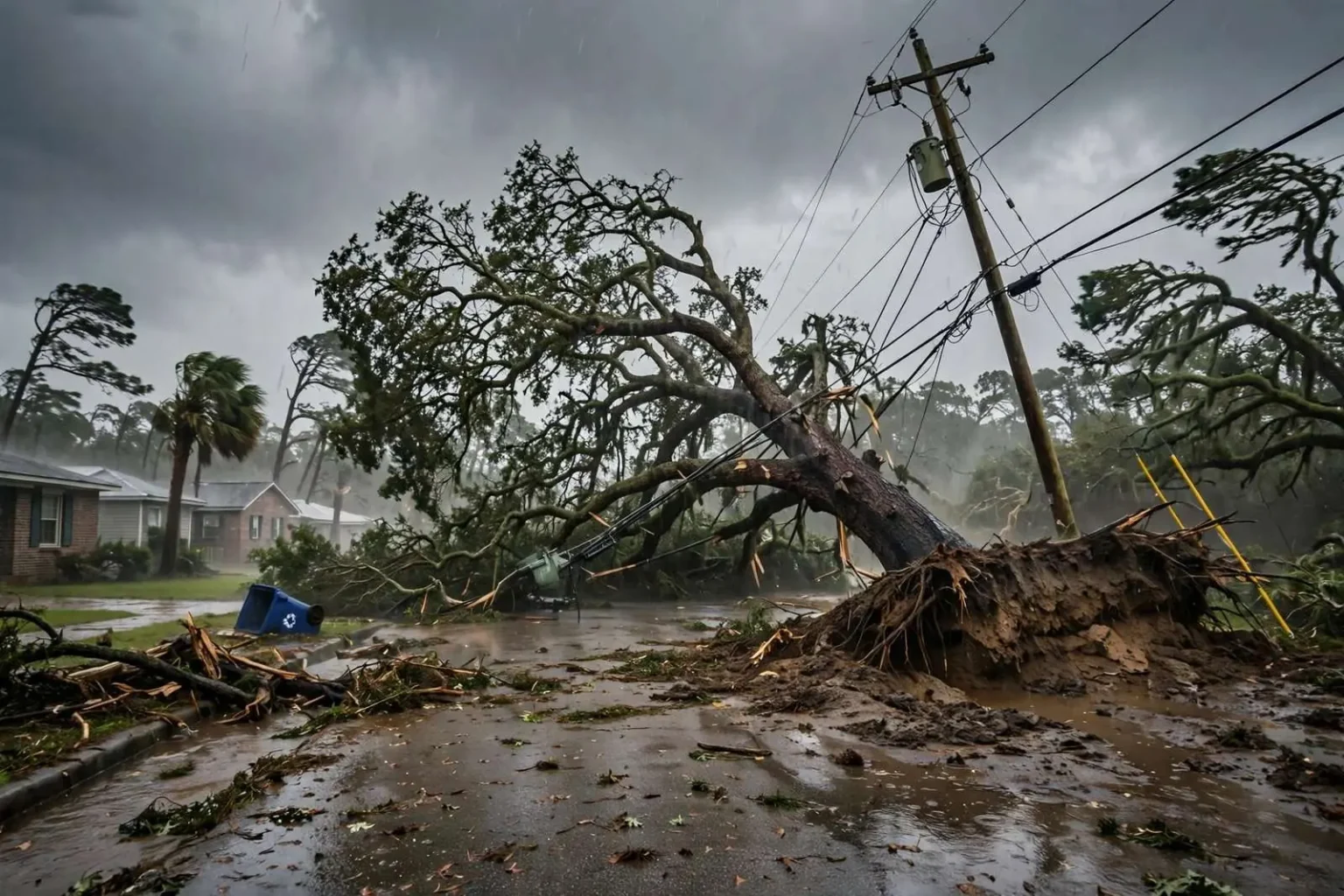
MOBILE, Ala. — Strong winds moving across the Gulf Coast could bring down trees and power lines, setting the stage for significant power outages across the region. The warning comes as a substantial storm system approaches, and the threat is magnified by what has already fallen from the sky: recent rains have saturated the ground across south Alabama, and soil that has soaked for days loses its grip on root systems. A tree that stood firm through months of ordinary weather can tip when gusts push against a waterlogged anchor, and when it falls across a distribution line, every home fed by that line goes dark.
Meteorologists and utility crews track exactly this combination when a wet pattern meets a wind event. Gusts of up to 50 miles per hour are forecast in some areas, a speed that snaps healthy branches, uproots shallow-rooted species like pines and water oaks, and turns loose debris into airborne hazards. On the Gulf Coast, where sandy soils and shallow water tables already leave large trees less stable than they appear, saturated ground is the difference between a storm that rattles windows and one that rewrites the map of neighborhood outages for days.
How outages spread in coastal Alabama
The region’s electrical grid depends on a spine of high-voltage transmission lines and a web of local distribution lines, many of them running pole to pole through residential streets and under the canopy of old neighborhoods. Mobile and Baldwin County communities with mature oaks and pines are especially vulnerable in wind events, because a single falling tree can take out lines serving dozens of homes. When winds reach damaging speeds across a wide area, crews face not one repair but hundreds, spread across two counties, and restoration becomes a triage exercise that prioritizes hospitals, water systems and the largest numbers of customers first.
Residents should prepare for possible outages before the wind arrives. Practical steps are familiar but effective: charge phones and other devices in advance, fill containers with water where wells or electric pumps are in use, set refrigerators and freezers to colder settings to hold temperature through an interruption, and keep flashlights and batteries where they can be found in the dark. Households that depend on powered medical equipment should confirm backup plans with their suppliers and check on neighbors who may need help. Generators, when they are used, belong outdoors and away from windows, since generator exhaust kills families every storm season.
Downed lines are live lines
The single most important safety rule in any windstorm is the one that costs lives when it is ignored: anyone who encounters a fallen power line should treat it as live and report it to utility crews or emergency services immediately. Lines that look dead can be energized by the grid or by a home generator feeding back into a damaged system, and electricity can travel through wet ground, fences, tree limbs and standing water. Motorists should never drive across a downed line, and a vehicle that comes into contact with one should be stayed inside until rescue workers clear the scene. The same caution applies to anything touching the line, including tree branches and sagging guide wires.
Residents should also give leaning or cracked trees a wide berth during the event, since trees that have shifted in saturated soil can continue to fall long after the strongest gusts pass. Emergency management officials recommend reporting hazards rather than attempting to clear them, as chainsaw work around storm-damaged trees and power lines injures homeowners every year. Local governments typically activate debris crews after the wind subsides, and blocked roads should be reported so first responders can keep access routes open.
The storm system moving across the Gulf Coast carries the familiar warning that coastal Alabama knows by heart: the wind alone rarely hurts anyone who stays indoors, but its aftermath, the dark intersections, the dangling lines, the fallen limbs, is where the danger waits. Charge the devices, secure the yard, stay away from anything that has come down, and give the utility crews room to work. The lights will come back on; the task until then is to make sure no one becomes part of the storm’s cost.
Utilities in the region prepare for wind events with a playbook that residents rarely see. Line crews are staged in advance, damage assessment teams stand ready to move behind the weather, and mutual aid agreements allow utilities to call in bucket trucks and workers from neighboring states when the outage map spreads. Customers can usually report outages by phone, app or text, and modern utility systems use those reports, along with smart-meter data, to pinpoint where the grid has failed. Restoration is sequenced deliberately: transmission lines and substations first, then the feeder lines that serve neighborhoods, then the individual service drops that connect single homes, which is why one customer’s lights may wait while the street around them is already bright.
The saturated-ground element of this storm deserves specific attention from homeowners with large trees on their property. A tree that is leaning new, heaving soil at its base, or showing cracked earth around its roots is a tree in the process of failing, and the hours of strongest wind are exactly the wrong time to stand near it and assess. Arborists recommend watching from inside during the event and arranging professional evaluation afterward; pines, in particular, can drop without warning once their root plates lose their hold. Property owners in Mobile and Baldwin County have seen this pattern repeatedly in recent years, when wind events arriving on the heels of heavy rain produced tree damage out of proportion to the measured gusts.
What to do while the wind blows
During the event itself, the safest place is an interior room away from windows, and the wise course is to treat the outdoors as closed until the wind has passed. Drivers face particular hazards in a windstorm: downed limbs across roadways, signals dark at busy intersections, and debris appearing suddenly at highway speed. An intersection with a dead traffic light should be treated as a four-way stop, a rule that collapses quickly when drivers forget it. High-profile vehicles are especially susceptible to gusts on bridges and open causeways, and the region’s bridges and bayways become precarious before the rain even arrives.
Communication planning matters too, since outages can knock out both power and, eventually, cell service as backup batteries at towers drain. Families should agree on how they will check on one another if texts stop delivering, and those outside the affected area can serve as the contact point for scattered relatives. Local radio and official social media accounts from county emergency management agencies remain the most reliable sources for shelter information, road closures and recovery announcements once the storm passes.
The Gulf Coast has lived through this sequence often enough that much of it is muscle memory, but the arithmetic of saturated soil and 50-mile-per-hour gusts leaves no room for complacency. The trees that fall in the next round of wind will fall for reasons that began with weeks of rain, and the lines they bring down will leave pockets of darkness that outlast the weather by days. Prepare as though the outage will be inconvenient and long, stay clear of everything the wind has put on the ground, and let the crews do the work that brings the region back.
Food safety becomes an immediate concern in any extended outage, and the guidance from health officials is simple to remember. An unopened refrigerator holds safe temperatures for roughly four hours, and a full freezer can keep food frozen for about two days, so keeping doors closed stretches those windows considerably. Once perishables have warmed above safe temperatures for more than a couple of hours, the standard advice applies: when in doubt, throw it out. Households in coastal Alabama that weather repeated storm seasons often keep coolers, block ice and a stocked emergency pantry precisely because the region’s grid is tested by wind every year.
Sump pumps and well pumps are frequent hidden casualties of power outages, and homeowners in low-lying parts of Mobile and Baldwin County know to watch water levels in crawl spaces and yards when the electricity is out. Basements are rare on the Gulf Coast, but slab homes can still suffer under the run of a soaked landscape, and drainage ditches that overflow during heavy rain compound the problem when pumps cannot run. Anyone using a portable generator to power a pump or a refrigerator should keep the unit outside, connected by properly rated cords, and never back-feed power into a wall outlet, a practice that endangers line crews working on supposedly dead wires.
After the wind passes
The recovery phase of a wind event carries its own hazards, and the statistics show that injuries spike after the storm rather than during it. Downed lines are the dominant danger, but they are joined by unstable trees, improvised ladder work, carbon monoxide from poorly placed generators and candles that start house fires. Emergency officials urge residents to photograph damage before making temporary repairs, both for insurance purposes and for the assistance applications that follow larger events. Roofs damaged by wind should be covered with tarps only if the work can be done safely from a stable surface, since falls from ladders are among the most common storm aftermath injuries.
Utility crews will appreciate one simple accommodation from the public: room to work. Parked cars that block bucket trucks, onlookers near work zones and property owners who trim trees near workers all slow restoration and increase risk. Crews working a line in a dark neighborhood are concentrating on electricity and rigging, not foot traffic, and a few extra minutes of patience at a work zone translates directly into a faster return of power for the whole street. Patience also applies to the sequence of restoration itself, which can feel arbitrary from a dark living room but follows a logic of infrastructure that every crew in the convoy is following.
Coastal Alabama has absorbed wind, water and outages often enough to know that preparation is mostly a matter of doing the obvious things before they become urgent. The storm system now crossing the Gulf Coast brings gusts strong enough to test saturated trees and tired poles, and the region’s best response is the one it has practiced: charged devices, secured yards, treated-cautiously lines and neighbors checking on neighbors until the map of outages empties and the trucks go home.