Washington County Hemp Farmer Eyes Alabama’s New Medical Cannabis Market With Caution
As Alabama prepares to open applications for its new medical cannabis industry on Sept. 1, a Washington County hemp farmer with a Daphne processing facility explains why he plans to sit out the first licensing round and watch how the fledgling market develops.
Alabama’s medical cannabis industry is about to open its doors to applicants, and one Washington County hemp farmer who has already lived through the growing pains of a new state-regulated crop is taking a measured approach before jumping in.
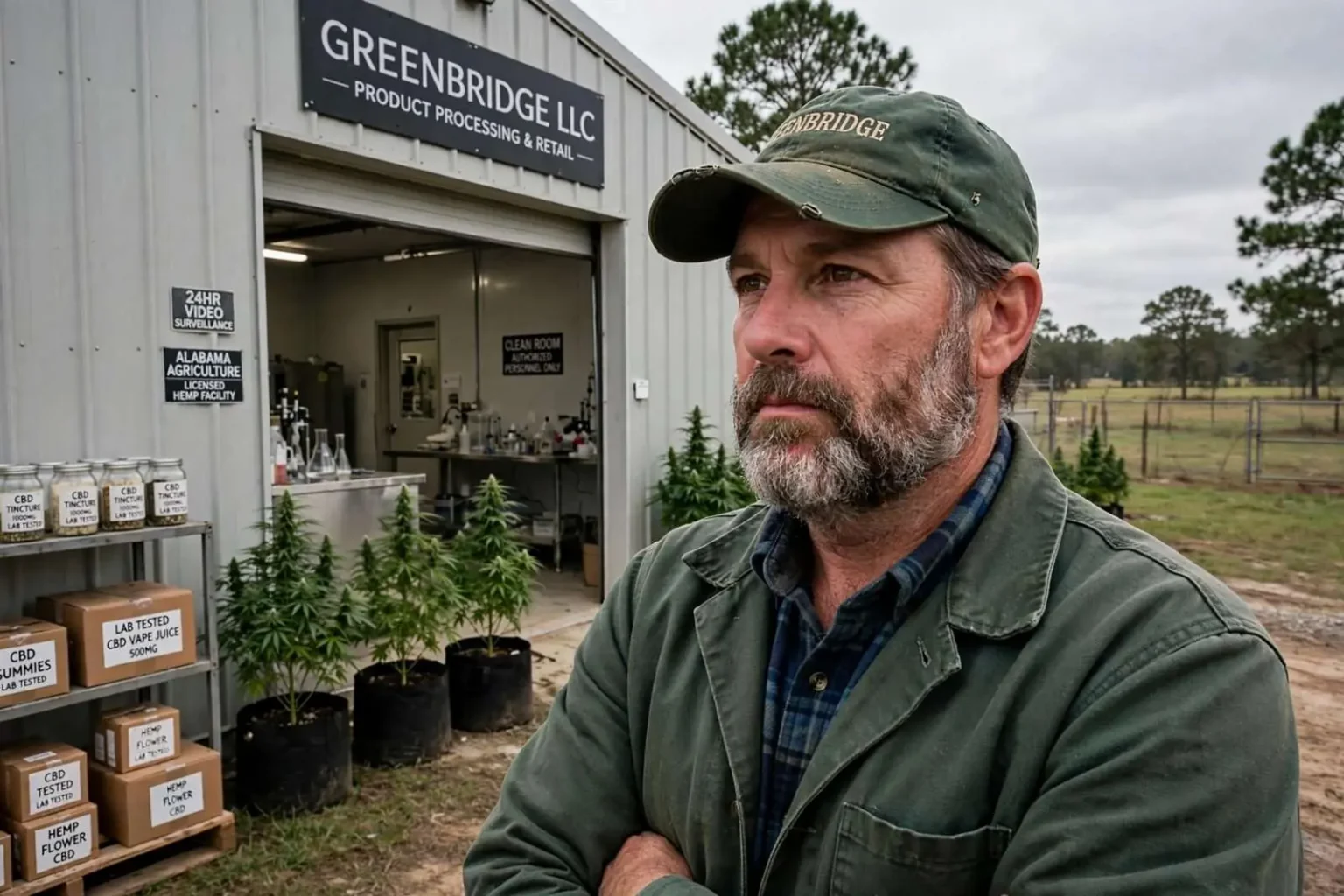
Allen Sirmon owns a hemp farm north of Citronelle and became a partner roughly eight months ago in Greenbridge LLC, a product processing and retail operation in Daphne. The 13,000-square-foot facility, formerly known as Cyclops, produces CBD vape juices, gummies, tinctures and other hemp-derived products. It includes a clean room for finishing products, a development lab for creating new flavors, a flower room where CBD is processed, and an unused radio studio Sirmon hopes to eventually revive, possibly as an educational broadcast outlet.
Despite being well-positioned within the hemp and CBD industry, Sirmon says he isn’t rushing to apply for a medical cannabis processing or retail license when Alabama’s application window opens Sept. 1. He remembers the confusion that surrounded the rollout of the state’s hemp program years ago, including paperwork mix-ups that still create headaches today.
“We will probably wait this licensing period out, as there’s not enough licenses for all the competition,” Sirmon said. “We want to see how the market shakes out.”
The Alabama Medical Cannabis Commission will begin accepting applications Sept. 1 from doctors, cultivators, processors, transporters and retailers who want to participate in the state’s newly legalized medical cannabis program. Each category carries its own detailed requirements under state law.
Physicians who want to certify patients for medical cannabis must hold an active medical license, complete a four-hour training course, pay an application fee of up to $300, and satisfy additional requirements set by the Alabama Board of Medical Examiners.
Cultivators must grow their crop inside an enclosed, locked facility under 24-hour video surveillance, and the Alabama Department of Agriculture will have inspection authority over those sites. Employees of licensed cultivators cannot have a controlled-substance felony or misdemeanor conviction within the past decade.
Processors will be required to use medical-grade equipment and manufacturing practices that meet state standards. Regulators have also made clear that finished products cannot be made to appeal to children — meaning nothing shaped or flavored like candy, cartoons or pop-culture characters will be allowed. The commission plans to set a single approved flavor profile for processed products statewide.
Retail dispensaries face their own set of rules: products must be lab-tested before sale, purchases can only be made by a registered patient or caregiver, storefronts must sit at least 1,000 feet from a school, and products may only be used off the premises.
Alabama Medical Cannabis Commission Executive Director John McMillan said applications will remain open through the end of the year, giving the state time to gauge interest before licenses are awarded.
“I’m interested in what we’re going to get as an initial response,” McMillan said.
To qualify, an applicant organization must be at least 51 percent Alabama-owned. McMillan acknowledged that smaller operators like Sirmon could struggle to break into the medical cannabis space because the state effectively requires a minimum $2 million investment to meet licensing and facility requirements.
Sirmon said he worries about large out-of-state conglomerates dominating Alabama’s new industry, but credited McMillan and state regulators for structuring the rules in a way that tries to keep the door open for homegrown businesses.
“They’re doing their best to help Alabama residents,” Sirmon said.
Unlike medical cannabis laws in many other states, Alabama’s law does not require cities and counties to opt out of allowing dispensaries. Instead, local governments must affirmatively opt in through a resolution before a dispensary can operate within their limits. McMillan said that provision wasn’t necessarily by design — it emerged from the horse-trading that comes with passing complex legislation.
“With the nature of medical cannabis in the state, it passed on the last day of the session,” McMillan said. “They accepted a lot of amendments in order to get it out.”
That opt-in structure has already prompted action in some Alabama communities. Montgomery became the first city in the state to approve a resolution allowing dispensaries, doing so in December. Both the city of Cullman and Cullman County followed with their own approved resolutions. The Tuscaloosa City Council has been considering a similar measure as well. A city must pass such a resolution before any dispensary can open within its limits, while a county resolution is required for a dispensary to operate in an unincorporated area.
Tuscaloosa City Attorney Scott Holmes said he expects that city’s measure to pass. If it does, Tuscaloosa plans to direct any tax revenue generated from medical cannabis sales into a dedicated public safety fund aimed at helping move the city’s police and fire pension obligations from a locally run fund into the Retirement Systems of Alabama.
“We have what’s called a public safety fund because we’re trying to switch our police and firefighter retirement pension to RSA,” Holmes said. “We’re dedicating any revenue from medical cannabis to the public safety fund.”
McMillan said the commission has been encouraged by how many cities and counties have moved to opt into the program, though he cautioned that discussions about earmarking tax revenue, like Tuscaloosa’s proposal, are premature this early in the process.
“I hope we’re slow about putting a tax on it,” McMillan said. “We think the show of interest is representative of people seeing that licensing is about to start. We’re happy to see the interest.”
The rollout of medical cannabis regulation comes as state officials also weigh what to do about Delta-8 THC, a hemp-derived compound that has surged in popularity even though it falls into something of a legal gray area. A bill that would have banned the product failed in the Alabama Legislature last year, but McMillan said he’d like lawmakers to revisit the idea now that a regulated medical cannabis system is taking shape.
“I’d like to see the Legislature take a look at banning it in the future,” McMillan said. “I have concerns about it.”
Sirmon, like many hemp farmers, began selling Delta-8 products himself to offset losses after the broader hemp market collapsed in recent years. He argues that banning a product that has become a lifeline for farmers wouldn’t serve growers or the consumers who prefer it.
“I think there’s a place for all these types of products,” Sirmon said, calling Delta-8 “wildly popular” among consumers who find its effects milder than those of Delta-9 THC, the primary psychoactive compound in traditional marijuana.
About the Law and the Licenses
Alabama’s program was created by the Darren Wesley “Ato” Hall Compassion Act, which lawmakers passed and Gov. Kay Ivey signed in 2021. The law caps the number of business licenses. It allows up to 12 cultivators, four processors and four dispensaries, each dispensary with up to three sites. It also allows up to five integrated facilities that can grow, process, transport and sell cannabis at up to five dispensary sites each. That cap is the limited supply of licenses Sirmon referred to.
The licensing process proved slow. The commission’s first license awards in June 2023 were rescinded because of problems with how applications were scored, and a second round of awards that August was also rescinded. Litigation over the decisions continued after that.