How a Chamber Coalition Kept the Mobile River Bridge Alive for Three Decades
With a federal TIFIA loan approved in early August and construction underway near I-10 and Virginia Street, the Mobile River Bridge is finally moving. Behind it sits the Mobile Chamber's Build the Bridge Coalition, formed in the late 1990s and led for decades by maritime logistics executive Mike Lee.
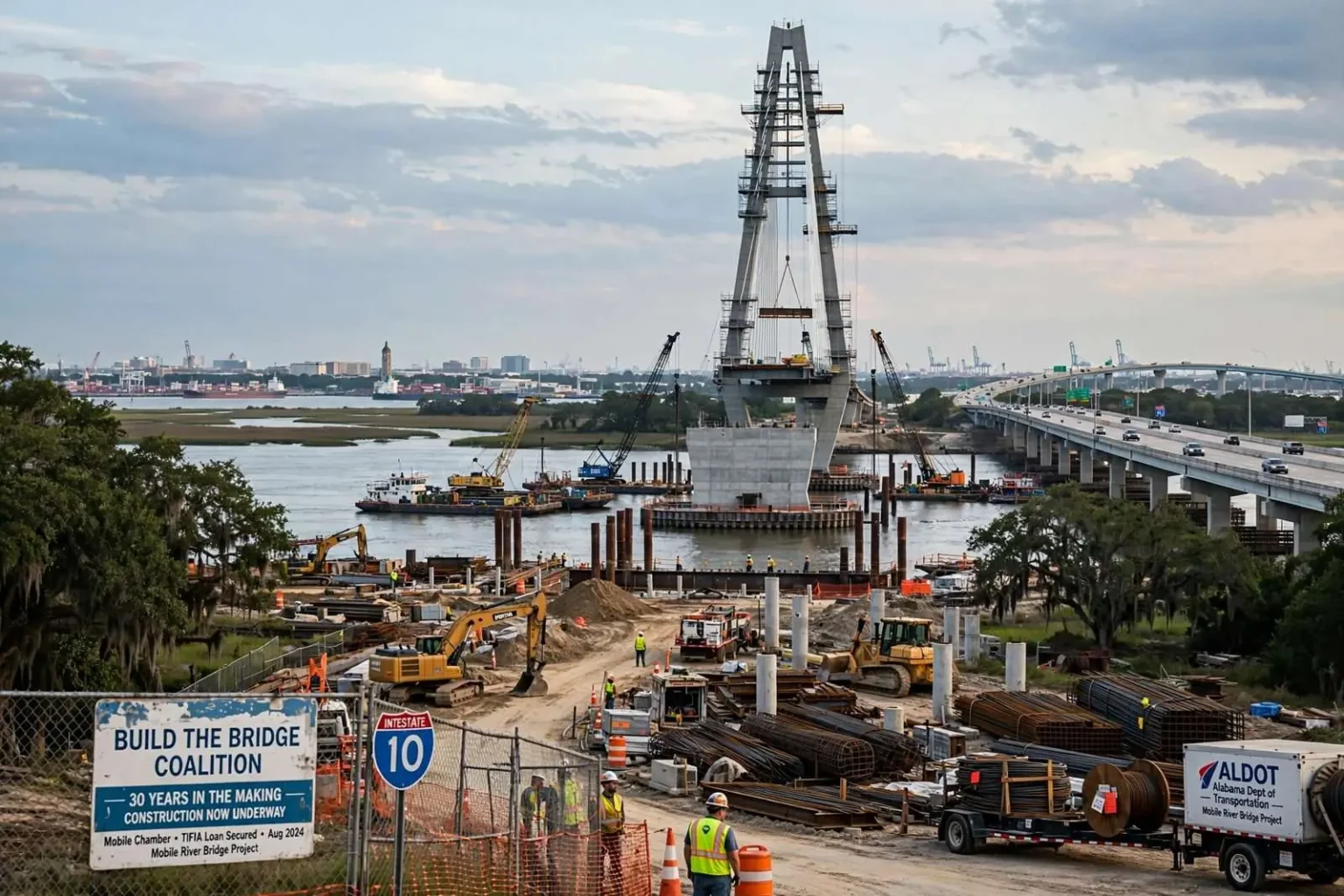
MOBILE, Ala. — The heavy equipment that has appeared along Interstate 10 near Virginia Street over the past several months represents something more than the start of another road job. It is the physical proof of an argument that a group of Mobile business people, civic leaders and elected officials have been making, in one form or another, since the last years of the 20th century.
The Mobile River Bridge — a 215-foot-tall cable-stayed span that will carry Interstate 10 over the river and, with an expanded Bayway, reshape how the two sides of Mobile Bay connect — is the largest transportation project in Alabama history. It is also a project that has started and stopped repeatedly across nearly 30 years, surviving redesigns, regulatory reviews, funding gaps and a long rotation of mayors, governors and federal transportation secretaries.
In early August, the long-anticipated approval of a federal loan was announced, a financing step widely regarded as the decisive one. The loan, made under the Transportation Infrastructure Finance and Innovation Act — known by the acronym TIFIA — will finance up to 49 percent of the project cost. With that piece secured, construction can proceed in earnest on the span rising near the I-10 and Virginia Street interchange.
When it does, it will vindicate the patient, unglamorous work of dozens of public officials and private citizens who kept the idea alive through decades when it would have been far easier to let it lapse. Much of that work ran through a single organization: the Build the Bridge Coalition, created in the late 1990s by the Mobile Chamber under then-President and CEO Win Hallett.
A traffic problem the federal government put in writing
The coalition did not emerge from wishful thinking. It emerged from a diagnosis. In the mid-1990s, the U.S. Department of Transportation documented severe volume overload on the stretch of Interstate 10 running through Mobile and Baldwin counties — specifically the Bayway and the Wallace Tunnel.
The numbers explain why the finding landed with such force. Those routes were originally designed to carry an average of roughly 35,000 vehicles per day. In practice they were routinely carrying double that figure, and on holidays the count topped 100,000 vehicles. Infrastructure built for one era was absorbing the traffic of another.
The consequences were not confined to the interstate itself. Summer weekends and holiday travel produced gridlock that spilled outward into neighboring communities. On the Eastern Shore, U.S. Highway 98 has historically ground to a halt in the vicinity of the I-10 interchange, a familiar frustration for Baldwin County residents whose local errands collide with regional through-traffic.
That was the problem the Mobile Chamber decided to take on directly. And when Hallett set out to build a coalition around it, he had a particular person in mind to lead the effort.
The logistics executive who took the job
Mike Lee is president and CEO of Page & Jones, a Mobile-based maritime logistics firm that has been in continuous operation since 1892. As early as 1997, at Hallett’s urging, Lee began meeting with maritime executives across the local waterfront economy — shipbuilders, stevedores and the operators whose businesses depend on efficient movement in and out of the Port of Mobile — working to assemble a broad base of support.
The reward for that groundwork was more work.
“No good deed goes unpunished,” Lee joked in a recent interview with the Chamber. “They said that since I’d helped so much with all those maritime companies, would I like to head the Bridge Coalition?”
Accepting the role launched what the Chamber describes as a nearly 40-year arc of advocacy and collaboration on Lee’s part, an arc that has touched a striking range of Gulf Coast developments — cruise operations, global steel investment, aerospace manufacturing and a good deal besides.
His method, at the outset, was unremarkable and effective: he sat down with people. In those early meetings around the port, Lee listened to operators working alongside Page & Jones, absorbed their objections and helped resolve them. As a veteran businessman, he traded in compromise, using the convening power and resources of the Chamber to pull business leaders, state and federal officials and other key decision-makers toward a shared answer to a regional transportation crisis.
Lessons borrowed from St. Louis
Across three decades, the bridge proposal changed shape more than once. Designs were revised. Regulatory hurdles appeared and had to be cleared. Local, state and federal administrations turned over. Through all of it, the Build the Bridge Coalition served as the project’s most consistent anchor — the institution that remembered why the thing mattered when individual officeholders came and went.
Lee credits Hallett’s vision for one of the coalition’s most useful habits: going to look at how other cities had done it. Through the Mobile Chamber’s Leaders Exchange, local delegations traveled to communities that had successfully delivered major bridge projects, among them Savannah, Georgia, and St. Louis, Missouri.
The St. Louis trip proved especially influential. It centered on the Clark Bridge, a 4,620-foot cable-stayed structure that opened in 1994 and is often called the “Super Bridge.” The span crosses the Mississippi River, linking Alton, Illinois, with West Alton, Missouri.
“They’d spent 20 years getting their bridge,” Lee said. “It was an interstate bridge, and they told us that one of the things they found useful was that they formed a Build a Bridge Coalition.”
Mobile’s version was led by Lee, Hallett and Ginny Russell, who served as the Chamber’s vice president of community and government affairs. Russell handled the connective tissue of the operation — coordinating advocacy efforts, managing communications and organizing the support the campaign needed to hold together. Around that core, the structure was reinforced by civic leaders, municipal planners, the Mobile Metropolitan Planning Organization and, eventually, the Eastern Shore MPO.
Hallett has described the work in terms that could serve as a job description for the institution he ran.
“What a chamber really does is identify where the opportunities are and then try to bring the interested parties together to work to affect the outcome,” he said.
Counting votes, then carrying them to Washington
Once the coalition was moving, Lee said, it became clear that maritime support alone would not be enough. The list of groups he approached reads like a census of the region’s institutional life.
“I started meeting with associated contractors and road builders, realtor associations, universities like South Alabama, hospital systems, the Port Authority and every single county commissioner and every single mayor in the whole region,” he said. “Once everyone had signed off on supporting the Coalition, then we took those groups with us to Washington, where we met with the highway department, congressional delegations and everybody else.
“All so they could see these are people who carry a huge number of votes.”
That is the essential logic of the coalition model. A single chamber of commerce asking for a multibillion-dollar federal commitment is one voice among many. A delegation representing contractors, realtors, a university, hospital systems, a port authority and the elected leadership of an entire metropolitan region is a constituency — and constituencies are what federal transportation policy responds to.
The bridge’s path also adapted to changing political leadership at home. It drew early support under Mobile Mayor Mike Dow, and later benefited from Mayor Sandy Stimpson’s pivotal role, as chairman of the MPO, in keeping the region’s infrastructure plan updated and on schedule — an administrative task that sounds minor until a project misses a programming deadline and loses years.
Thirteen possible sites, narrowed to one route
Where the bridge should actually go was, for a long time, an open question. At the outset, planners floated as many as 13 potential sites, spread across a geography running from Dauphin Island to the Cochrane-Africatown USA Bridge. Narrowing that field required sustained and constructive dialogue with local shipyards, whose operations depend on clearances and channel access that a poorly placed span could compromise.
That process eventually produced three finalists near the city center, labeled A, B and C. According to Lee, when ground is broken later this year the final design will follow the ‘B Prime’ route — the alignment reflected in the architectural renderings now in circulation.
Funding, meanwhile, never stopped being a challenge, and the passage of time made it a steeper one. Organizers point to inflation and to sharply rising material costs in the post-pandemic period as the forces that inflated the projected price tag over three decades.
Lee puts the cost of delay in plain arithmetic.
“When I started working on this before 2000, the first estimates were $680 million,” he said. “Now it’s over $3 billion. That is what 27 years of waiting will do.”
How the money finally came together
The first major funding component arrived in 2024, when the Biden administration awarded a $550 million grant through the U.S. Department of Transportation’s Bridge Investment Program. The recent TIFIA loan approval covering up to 49 percent of costs supplied the second and larger piece.
Announced alongside the loan was the plan for repaying the construction debt: tolls. The structure is designed to keep costs affordable for people who cross frequently, both on the new bridge and on the restriped Bayway, which is to be expanded to three lanes in each direction.
Under the plan as unveiled, commuters using ALGO Passes to cross between the western and eastern shores of Mobile Bay will pay $3 each way. Existing toll-free alternatives are to remain free and fully available to motorists — the Wallace Tunnel, the Bankhead Tunnel, the Causeway and the Cochrane-Africatown USA Bridge.
A blueprint that outlasted its original purpose
Nearly 30 years after it was formed, the Mobile Chamber’s Build the Bridge Coalition has carried the project to the edge of groundbreaking. Along the way it produced something else of durable value: a working blueprint for regional collaboration that has been applied repeatedly to other ambitions.
Lee was elected chairman of the Chamber’s board of directors in 2002. He later chaired the Cruise Task Force, work that helped realize Mayor Dow’s vision of bringing a cruise terminal to the Port City in 2004. The same collaborative machinery has since helped Mobile secure Carnival Cruise Line and absorb hard industrial reversals — most notably the loss of the KC-46 tanker contract, after which the region pivoted and landed Airbus’s largest North American assembly plant, now employing thousands at the Brookley Aeroplex.
For Lee, the change in the city’s self-image is as striking as any single project.
“Growing up, all I heard about Mobile was its ‘perpetual potential,” he said. “And then we made it over the hump at some point, and it seems like we’ve had success after success after success.”
He returns, in the end, to the mechanism rather than the monuments.
“When it comes to economic development, international trade and all-around support for the port, we’ve built some really strong coalitions,” Lee said. “The groups we are able to pull together so fast – that are so effective and so experienced – it’s hard to match that anywhere in the state.”
The bridge, when it stands, will be visible from much of the city. The habit of organization that produced it will not be. But by the account of the people who built both, the second is what made the first possible.