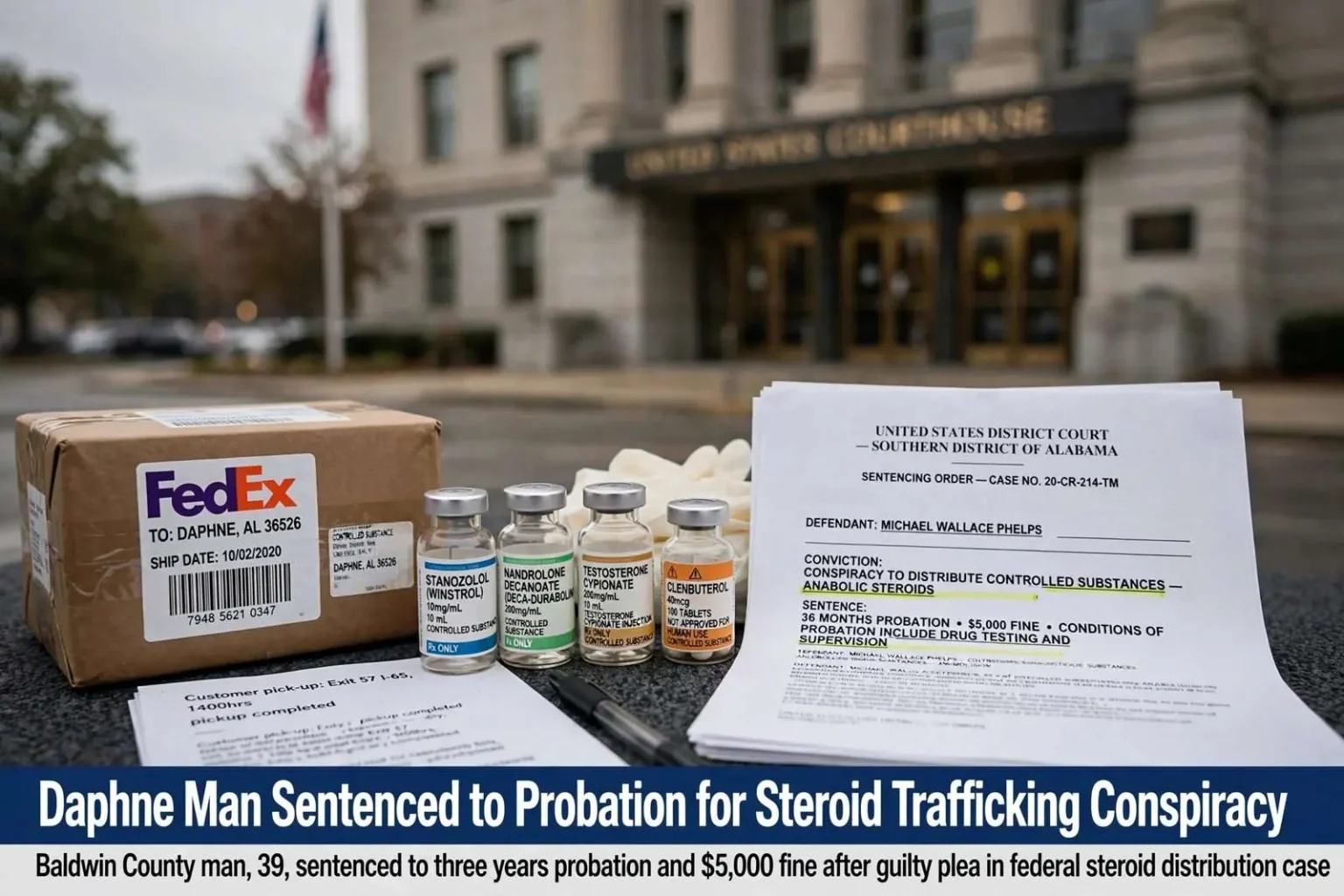
A Baldwin County man has been sentenced to three years of probation after admitting he took part in a conspiracy to sell anabolic steroids to people working out at local gyms. U.S. District Judge Terry Moorer handed down the sentence, which also included a $5,000 fine for Michael Wallace Phelps of Daphne. The case, built on shipping records, surveillance and the cooperation of a former client, offers an unusually detailed look at how performance-enhancing drugs move through the informal economy of Gulf Coast gyms — and how federal investigators follow them.
Phelps pleaded guilty to the conspiracy charge in January. According to his written plea agreement, he advertised his services as a coach, trainer and consultant through Facebook posts starting in October 2020. He admitted to distributing steroids from his home and other locations, including stanozolol, sold under the brand name Winstrol, and nandrolone decanoate, sold under the brand name Deca-Durabolin, along with testosterone cypionate and testosterone enanthate. The substances named in the agreement are among the most commonly used anabolic steroids in the underground fitness trade — each requiring a prescription when used legitimately, and each classified as a controlled substance when sold outside medicine.
Court records show Phelps routinely placed orders for the illegal steroids and had them shipped directly to his home. That habit became the thread investigators pulled: what began as an inquiry into packages arriving at a Daphne residence grew, record by record, into a federal conspiracy case stretching across county lines and two years of transactions. The paper trail of online commerce — order confirmations, carrier records, text message logs — now forms the backbone of prosecutions that once would have hinged entirely on undercover buys.
Investigators built their case in part using shipping records: federal agents obtained records from FedEx confirming a package had been delivered to the Daphne address, and agents observed Phelps driving away from the home in a Nissan Rogue on Oct. 2, 2020, before visiting several parking lots around Baldwin County. The parking-lot circuit was significant to the investigation because it matched the pattern of hand-to-hand distribution the government alleged — packages in, brief meetings out, no storefront and no paper sale. Surveillance of that kind, unremarkable on any single day, builds the mosaic prosecutors need to show a continuing operation rather than personal use.
The packages from Florida
The following week, the Drug Enforcement Administration received information about two additional packages mailed from Jupiter, Florida, both addressed to the same Daphne residence. A U.S. postal inspector obtained a search warrant to open the second package and discovered three bottles of Clenbuterol and one bottle of Letrozole inside. Clenbuterol is frequently paired with steroids and other performance-enhancing drugs because of its ability to increase muscle mass, while Letrozole, a hormone-based chemotherapy drug that reduces estrogen production, is commonly used by body builders to help offset the side effects of anabolic steroid use. The pairing is a signature of the trade: the drugs that build muscle arrive together with the drugs that manage the damage the muscle-building causes.
Neither Clenbuterol nor Letrozole is approved for the uses gym customers put them to. Clenbuterol, developed as a respiratory drug for livestock, is not approved for human use in the United States at all, and Letrozole belongs to a class of medications whose legitimate patients are breast cancer patients — a fact that underscores how far the underground supply chain reaches into legitimate pharmaceutical channels to serve the enhancement market. Packages like the two mailed from Jupiter move through the mail in the millions each year, which is why postal inspectors — the investigative arm of the U.S. Postal Service — appear so often in these cases alongside the DEA.
According to the plea agreement, a cooperating witness working with federal investigators met Phelps at Exit 57 off Interstate 65 in Escambia County near Atmore to pick up steroids that had been ordered as part of a workout program Phelps recommended. The witness, who trained at a local gym in Atmore, began working with Phelps in 2017. The interchange at Exit 57 — a truck stop and fuel exit north of Mobile where Interstate 65 crosses the county line — is the kind of location chosen precisely because it is ordinary: easy to find, easy to leave, and unremarkable to anyone watching.
The investigation itself is worth understanding for what it shows about modern drug enforcement. Nothing in the case began with a raid or an arrest; it began with records — a carrier’s delivery log, a tip about mailed packages, a warrant application to a federal magistrate. Postal inspectors and DEA agents assembled the timeline from documents before they ever followed Phelps out of his driveway, and the Oct. 2 surveillance simply confirmed what the paper trail already suggested. By the time the cooperating witness met Phelps at Exit 57, investigators were verifying a pattern they had already documented rather than searching for one they hoped to find. Cases built this way are shorter in court and harder to fight, because the defense is negotiating against exhibits rather than recollections.
The geography of the case is also instructive. The steroids moved from a source in Jupiter, Florida, through the mail to a residential address in Daphne, and out again to buyers across Baldwin County and beyond — including a customer from a gym in Atmore, nearly an hour up the interstate. A single trainer with a phone and a shipping habit served customers across three counties, and none of the transactions required anything more exotic than a mailbox, a car and a mobile payment app. That is the scale at which the enhancement-drug trade now operates along the Gulf Coast, and it is why federal prosecutors treat it as a distribution problem rather than a collection of small personal cases.
Phelps admitted he offered to train the witness for a fee and provided workout routines, diets, and the specific type and quantity of steroids needed to make progress. That bundled offer — training plan, nutrition plan, drug protocol — is what converts a personal trainer into a drug distributor in the eyes of federal law. Prosecutors across the country have used the same template in cases against online coaches and gym trainers: the programs sold on social media where the “supplements” column of the plan turns out to be controlled substances shipped in packages with phony labels.
The plea agreement also includes transcripts of text messages exchanged between Phelps and others involved in the scheme. In one message from 2019 included in the court record, Phelps told a customer, “I have another 500 for you.and if I don’t get to come up I’ll Venmo it (although I’d rather give you cash because I hate a trail).” The irony of the message — a digital payment discussed as a way to avoid leaving a trail, in a conversation preserved forever in a federal case file — is the kind of detail prosecutors relish, and it illustrates how thoroughly the smartphone has become the prosecution’s best witness in drug conspiracies. Every arrangement, every price, every complaint about delivery is written down somewhere.
A rare prosecution on the Gulf Coast
Federal prosecutions involving performance-enhancing drug distribution are relatively uncommon in South Alabama, and the case highlights how informal coaching and gym relationships can sometimes cross into illegal drug distribution when unregulated substances are involved. The region’s fitness scene — commercial gym chains, strength sports clubs, and the competitive bodybuilding circuits that run shows along the Gulf Coast — operates on relationships of trust between trainers and clients, and those relationships are exactly the channel through which steroids historically move. Most customers never question where the drugs come from; they simply follow the program their coach wrote.
The sentence Phelps received reflects the federal calculus in first-offender distribution cases of this kind. Probation terms for non-violent drug conspiracies are shaped by sentencing guidelines that weigh the quantity involved, the duration of the conduct and the defendant’s cooperation, and judges retain discretion to depart from the advisory range. A three-year probation term with a fine, rather than a prison sentence, signals that the government’s interest here was primarily in shutting down the distribution network and documenting the harm — and in sending a message to the trainers who might be considering the same side business.
That message matters beyond the courtroom. Anabolic steroid use carries documented health risks — cardiovascular strain, liver damage, hormonal disruption and psychiatric effects — risks multiplied when the products are manufactured in unregulated labs and shipped without any quality control, exactly as the Jupiter, Florida, packages in this case were. Medical providers in Baldwin and Mobile counties see the consequences, and public health messaging has struggled to reach the young men most likely to buy, because the market lives in private messages and parking lots rather than in plain sight. Cases like this one, with their detailed public records, are one of the few windows most gym members will ever get into what actually happens on the other side of a coach’s supplement recommendation.
For now, the case ends where most federal drug cases do: with a plea, a sentence and a record that remains public. The Facebook posts that advertised the business are gone, but the court file — the shipping records, the surveillance notes, the text transcripts — remains available to anyone who wants to understand how a coaching practice in Daphne became a federal conspiracy case, one package at a time.