Downtown Mobile Restaurants Lean on Loyal Customers to Weather COVID-19 Shutdown Orders
After a Mobile County Health Department order limited restaurants to to-go and drive-thru service only, downtown Mobile business owners say loyal customers have stepped up to help them stay afloat during the COVID-19 shutdown.
Restaurant and bar owners in downtown Mobile spent the past week scrambling to adapt after county health officials ordered dining rooms closed in response to the spreading coronavirus outbreak, forcing many small businesses to lay off staff and rethink how they could stay open at all. The order arrived with no playbook, no timeline and no guarantee that the businesses it disrupted would still be standing when it lifted.
The Mobile County Health Department directed all restaurants and bars in the county to suspend dine-in service and limit operations to to-go and drive-thru orders only. The move, aimed at slowing the spread of COVID-19 by reducing close contact between customers, landed hard on a downtown restaurant scene that depends heavily on lunch crowds, happy hour regulars and evening diners. Several owners described revenue drops of as much as 90 percent within just three or four days of the order taking effect.
For businesses that operate on thin margins even in normal times, a decline of that size threatened to be the difference between staying open and shutting down for good. A restaurant’s economics leave little cushion: rent, insurance, suppliers and payroll are due on schedule, while the revenue to cover them arrives — or doesn’t — one service at a time. Strip away the dining room, and most of the business model goes with it.
Closing, then a change of heart
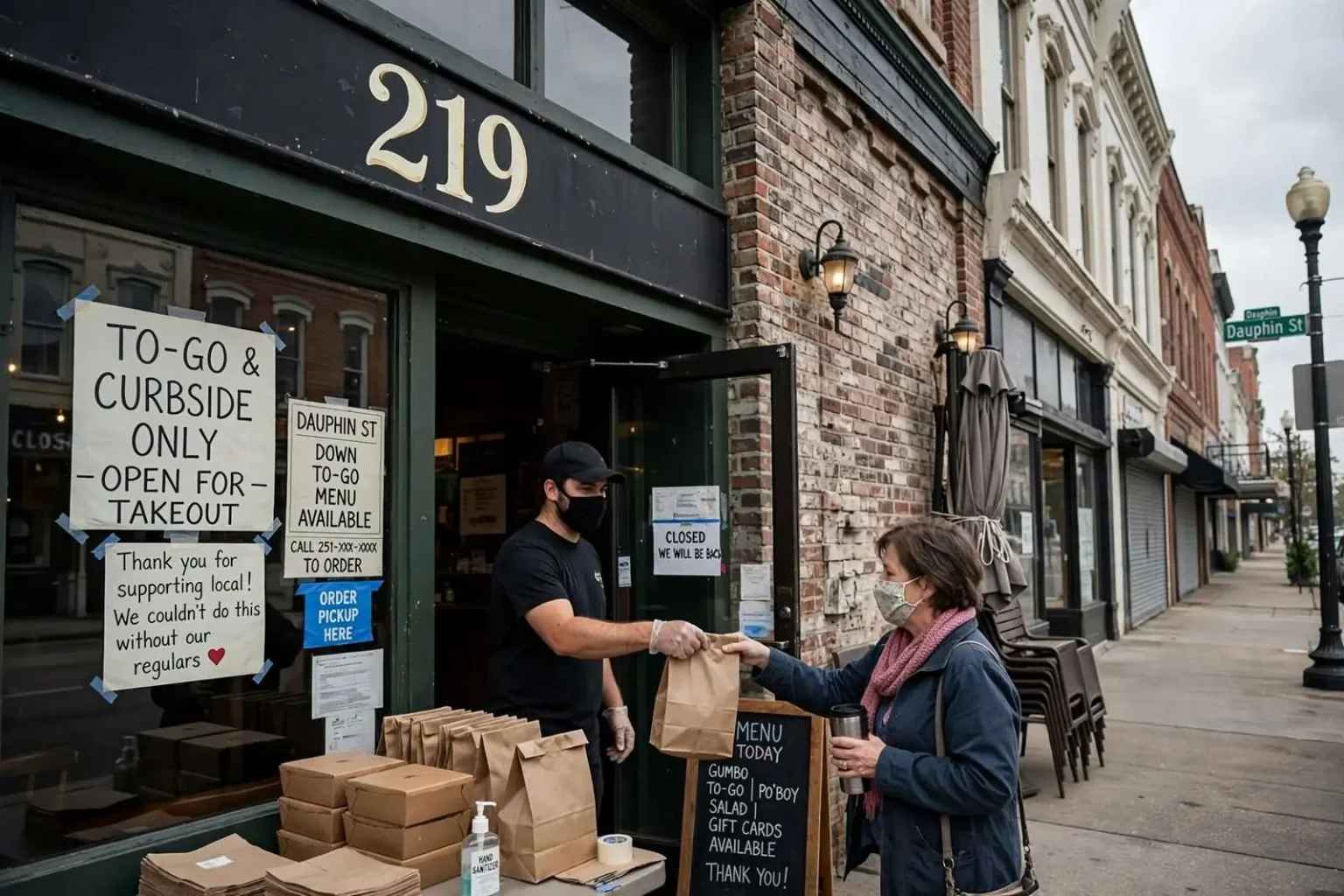
Todd Henson, owner of the downtown restaurant 219, was among those who felt the impact almost immediately. With dine-in service no longer an option and foot traffic downtown drying up, Henson made the difficult call to close his doors indefinitely rather than try to limp along on take-out orders alone.
Word of the closure spread quickly among his regular customers, many of whom had made 219 a fixture of their weekly routine. Henson said his phone started ringing with calls from longtime patrons urging him to reconsider and reopen, even if only for carry-out service. That outpouring of support convinced Henson to reverse course and reopen the restaurant for to-go orders, betting that the same loyal customer base that built the business over the years would show up to help carry it through the crisis.
The bet captured something real about downtown Mobile’s dining culture. Establishments along and around Dauphin Street are not interchangeable with their suburban counterparts; they are places where regulars are known by name, where anniversaries and after-work gatherings recur on the calendar, and where the relationship between owner and customer is personal in a way chain restaurants never replicate. When the pandemic threatened those businesses, the response came not from marketing but from loyalty.
Henson was not alone. Several other downtown restaurants and bars that had initially shut their doors after the health department order followed a similar path, reopening for limited service once owners heard from customers determined to keep supporting their favorite local spots.
Rebuilding a business model overnight
The scramble to adjust business models on short notice reflects a broader challenge facing small business owners across Mobile as the coronavirus outbreak upends daily routines. Restaurants that never offered delivery or curbside pickup before were forced to build those capabilities almost overnight, while employees who normally waited tables or tended bar shifted to packaging orders and running food out to cars.
The operational shift was larger than it sounds. Kitchens designed for plated service had to be reorganized for volume takeout; menus were trimmed to dishes that travel well; point-of-sale systems were reconfigured for phone and online orders; and bars, stripped of their purpose, became packaging stations. Staff who remained on the clock took on jobs they had never been hired to do, working in masks, at distance from one another, for a fraction of the tips that had made their wages livable.
The layoffs that preceded the reopenings were the human core of the crisis. Servers, bartenders and kitchen workers across Mobile County filed for unemployment in numbers the state’s systems had never processed before, and many of them returned to work — when they could — to jobs with unpredictable hours and no guarantee the demand would hold. For restaurant workers living paycheck to paycheck, the gap between the health order and the first wave of takeout income was measured in utility bills and groceries.
A community answering the call
For many owners, the response from neighbors and regulars in the days since the order took effect has offered a measure of reassurance that the downtown restaurant community can adapt, even as the full economic toll of the outbreak remains uncertain. Community members have encouraged one another on social media to order takeout, buy gift cards and tip generously as a way of helping local restaurants and their employees make it through the disruption.
Each of those gestures does different work. A takeout order produces immediate revenue and keeps kitchen staff employed; a gift card delivers cash now for meals later, effectively a small loan to the business; and a generous tip on a $15 order partially replaces the service income that vanished with the dining rooms. The combined effect, repeated night after night, is the difference between a restaurant ending the month solvent or closed — and it costs each participant less than a night out used to.
The long road ahead
City and county officials have said the restrictions on dine-in service are expected to remain in place as public health authorities continue monitoring the spread of COVID-19 in the region, leaving restaurant owners bracing for an extended period of reduced operations. That is the hard arithmetic underneath the community goodwill: takeout and drive-thru orders, however loyal, cannot fully replace dining rooms, bar stools and happy hours, and no one knows how long the substitute will have to carry the load.
The history of the restaurant business is a history of resilience through disruption — hurricanes, recessions, road construction and now a pandemic — and downtown Mobile has rebuilt before. Owners talk about the weeks after a major hurricane the way veterans talk about basic training: the supply lines, the shuttered dining rooms, the slow return of customers. The pandemic’s difference is its duration and its reach; a hurricane passes, but a virus can force the same conditions for months on end.
What the past week demonstrated, though, is that the downtown scene’s most important asset survived the initial shock. The regulars are still there — calling, ordering, buying cards and tipping as if the tip itself were a civic act. The owners who reopened on that goodwill have bought their businesses time, and the customers who sustained them have made a statement about what kind of city Mobile intends to be on the other side of the outbreak: one where the restaurants that anchored its evenings are still standing, still staffed by familiar faces, and still pouring the drinks their regulars will be back to order in person when the dining rooms finally reopen.
Until then, the to-go boxes keep moving — out the doors of Dauphin Street kitchens, across parking lots and into car trunks — one order, one tip and one act of loyalty at a time.
How the order landed
The health department’s directive came as public health authorities across Alabama and the nation escalated their response to the outbreak, following the flow of federal guidance down to county health officers who hold broad emergency authority over food service establishments. In Mobile County, that authority translated into a notice that gave owners little runway: dining rooms were to close and the takeout-only regime was to begin, with health department inspectors empowered to enforce compliance.
Downtown felt the order differently than the rest of the county. The central business district’s restaurant economy is built on office workers at lunch, convention and event traffic, and the evening crowds that fill Dauphin Street blocks on weekends — customers, in other words, who are downtown for something other than dinner and decide to stay. When offices emptied and gatherings were canceled, that whole ecosystem of incidental traffic vanished at once, leaving only residents of nearby blocks and deliberate drive-in customers to sustain a dozen businesses at once.
Bars faced the steepest version of the problem. An establishment built around pours rather than plates had, under the order, nothing left to sell but whatever kitchen it happened to run — and many downtown bars ran none. Some converted to bottle and can sales to go where regulations allowed; others simply closed and waited, burning cash reserves while their staffs filed for unemployment.
What owners are watching for
In the days since the reopenings, owners have been tracking a handful of numbers that will decide whether the goodwill holds: nightly order counts, average tickets, the pace of gift card sales and the cost of keeping skeleton crews on payroll. A takeout-driven week looks nothing like a dining room week, but for the moment it produces something the closed doors did not — cash flow, and evidence to lenders and landlords that the business is still alive.
The landlords, for their part, became part of the story in many blocks, as tenants sought rent relief for the duration of the restrictions. Commercial leases signed in better times assumed a functioning economy, and owners who had spent years building equity in their restaurants suddenly found themselves negotiating for patience as much as for money. How those conversations resolve will shape which signs are still hanging on Dauphin Street when the order lifts.