Downtown Mobile’s Apartment Boom: 10 Residential Projects Now Underway or Planned
A Chamber of Commerce report finds 10 new residential developments reshaping downtown Mobile, plus other local business and community news.
Downtown Mobile’s residential building boom continued through 2017, according to the Mobile Area Chamber of Commerce’s State of the Economy report, which found 10 new multifamily housing developments in the planning phase, under construction or already available for lease across the downtown area over the previous 12 months. As those properties open, city and business leaders expect a surge in demand for new services downtown, bringing steadier, higher-volume foot traffic to both new and existing businesses in the area. The report also found downtown Mobile’s office market held steady in 2016, with 1.9 million square feet of office space spread across 28 buildings. Overall occupancy rose from 76 percent to 78 percent compared with 2015, and the market absorbed more than 49,000 square feet of office space. Average asking rents rose 58 cents, ranging from about $18 to more than $20 per square foot. Roughly 80,000 square feet of residential space was removed from the 2015 count after two properties were sold and are now being redeveloped.
The ten projects reshaping downtown
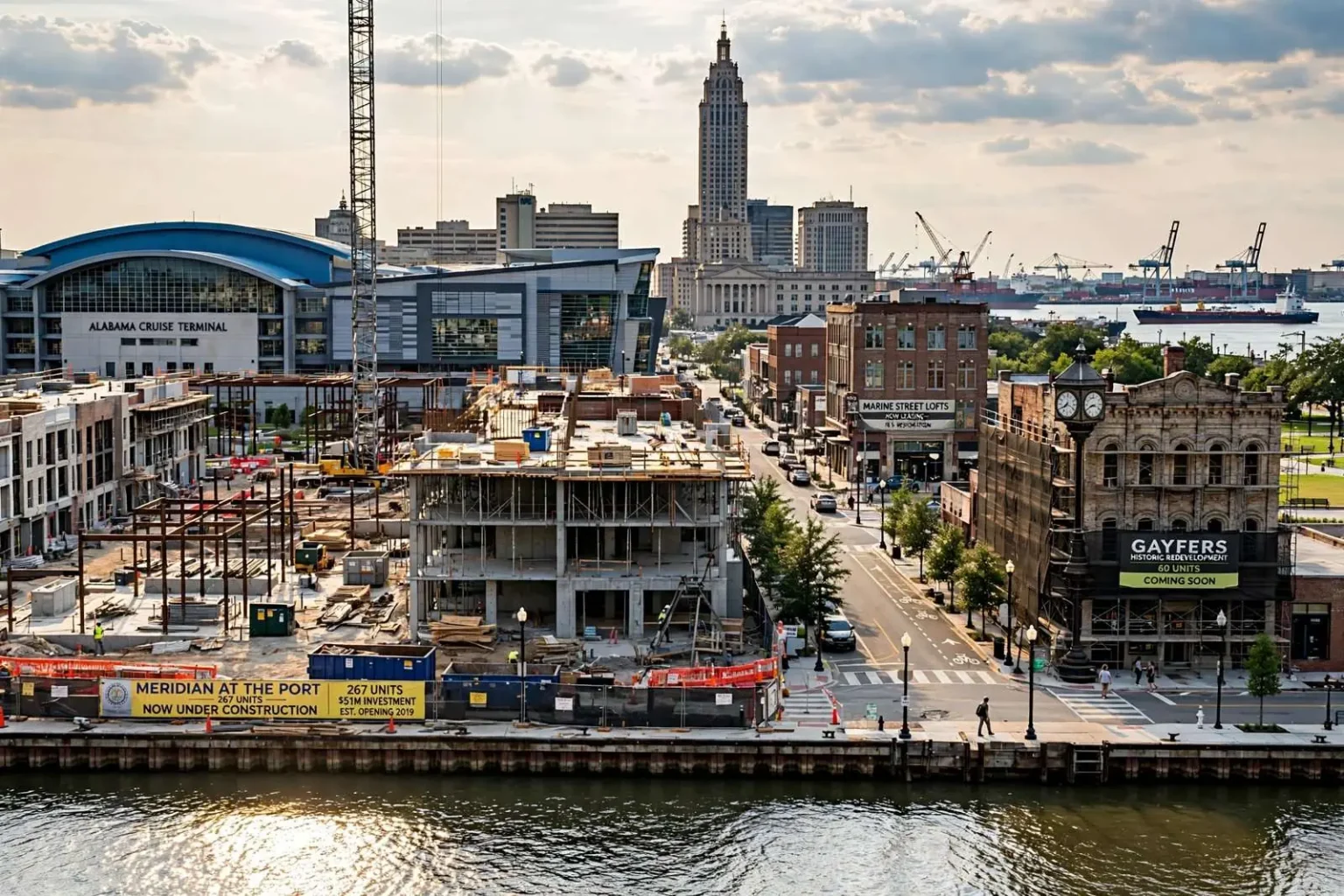
The 10 downtown residential developments identified in the report include: Meridian at the Port, 300 N. Water St., 267 units in preconstruction, a $51 million investment; Temple Lodge, 558 St. Francis St., 12 units under construction, a $2.7 million investment; Gayfers, 165 Dauphin St., 60 units in design, an $11.9 million investment; 360 Dauphin Street, eight units available for lease, a $1.5 million investment; Russell School, 304 S. Broad St., 26 units available for lease, a $4.6 million investment; the Staples Pake property, 100 N. Royal St., 20 units under construction, a $6 million investment; Marine Street Lofts, 901 Government St., 48 units now being leased, a $6 million investment; The Fort of Colonial Mobile, address still to be determined, 131 projected units in design, a $58 million investment; Seamen’s Bethel, 350 St. Joseph St., 60 units in the design phase, a $6 million investment; and Merchants Plaza, 100 St. Francis St., 84 units in design, a $12 million investment.
Together, these projects represent more than 700 new residential units and approximately $159 million in investment. The scale marks a dramatic acceleration from the previous decade, when downtown housing consisted largely of a handful of converted loft buildings and the RSA-owned Battle House Tower condominiums. The Chamber’s report framed the boom as both a cause and effect of downtown’s revival: new residents create demand for restaurants, retail, and services, which in turn make downtown more attractive to the next wave of residents. The virtuous cycle, long observed in cities like Charleston, Savannah, and Greenville, appeared to be taking hold in Mobile.
Water Street and the port proximity premium
Meridian at the Port, the largest project at 267 units, occupies a prime Water Street address overlooking the Mobile River and the working port. The site, formerly a surface parking lot for port workers and cruise passengers, sits between the Alabama Cruise Terminal and the Arthur C. Outlaw Convention Center. Its developer, a Birmingham-based multifamily firm with experience in Gulf Coast markets, bet on the appeal of river views and walkable access to the convention center, the Maritime Museum, and the emerging entertainment district along the Dauphin Street corridor. The $51 million price tag reflects both the site’s premium and the construction costs of a mid-rise concrete structure designed to withstand hurricane-force winds and floodplain requirements.
The Water Street corridor has seen the most dramatic transformation. Once a utilitarian thoroughfare serving the state docks and the CF Industries nitrogen plant, it now hosts the cruise terminal, the convention center, Cooper Riverside Park, and the GulfQuest National Maritime Museum. The city’s 2013 Waterfront Development Plan, commissioned from the urban design firm Cooper Robertson, envisioned a continuous public realm from the cruise terminal to the Brookley complex, with residential density as the engine of activation. Meridian at the Port represents the first major private-sector response to that plan.
Historic preservation meets new construction
Several projects leverage historic structures, tapping federal and state historic tax credits that can cover twenty percent of qualified rehabilitation costs. The Gayfers building at 165 Dauphin St., a landmark department store that anchored Mobile’s shopping district from 1929 until its closure in 1998, will become sixty residential units. The building’s Renaissance Revival facade, its marble staircases, and its iconic corner clock — a meeting point for generations of Mobilians — are being preserved. The $11.9 million budget includes structural reinforcement, window restoration, and the insertion of modern mechanical systems into a building designed for natural ventilation and gas lighting.
The Russell School at 304 S. Broad St., a 1915 elementary school designed by Mobile architect George Bigelow Rogers, is being converted to twenty-six loft-style units. The school, named for a prominent Mobile physician and civic leader, closed in the 1970s and sat vacant for decades, its auditorium and classrooms slowly succumbing to water intrusion. The conversion preserves the original heart-pine floors, tall windows, and transom-lit corridors while inserting a central courtyard for resident amenities. The $4.6 million investment is modest by downtown standards, reflecting the building’s sound structural bones and the efficiency of adaptive reuse.
The Seamen’s Bethel at 350 St. Joseph St. carries a different history. Built in 1857 as a chapel for mariners, the Greek Revival structure served the Mobile Seamen’s Bethel Society, an ecumenical ministry that provided spiritual counsel, reading rooms, and temporary lodging to sailors in port. The building survived the Civil War, the 1906 hurricane, and the urban renewal that cleared much of the surrounding neighborhood. Its conversion to sixty units, at a projected $6 million, requires navigating both historic preservation guidelines and the archaeological sensitivity of a site that may contain burials from the 1853 yellow fever epidemic. The developer, a nonprofit housing partnership, has committed to maintaining the chapel’s sanctuary as a community space.
The Fort of Colonial Mobile: ambition on the fringe
The most ambitious project, The Fort of Colonial Mobile, projects 131 units at a $58 million investment on a site still to be determined near the original Fort Condé footprint. The fort, a reconstructed 1720s French colonial fortification that serves as a museum and welcome center, anchors the eastern edge of downtown. The project’s scale — nearly double the next largest — suggests a developer targeting the workforce housing gap for employees of the nearby federal courthouse, the Mobile County offices, and the growing medical district along Spring Hill Avenue. The “address still to be determined” notation in the Chamber report indicates the project was in early entitlements, with site assembly and zoning approvals pending.
The Fort project also highlights the tension between downtown’s historic core and its expanding boundaries. The area between Fort Condé and the I-10 overpass — a zone of surface parking, low-rise commercial, and vacant lots — has long been identified as a connection gap. Successful development there would stitch the tourist-oriented waterfront to the institutional employment centers to the west. But the same zone contains remnants of the city’s earliest settlements, French and Spanish colonial artifacts, and the archaeological record of Mobile’s first century. Any large-scale excavation triggers Section 106 review under the National Historic Preservation Act, adding time, cost, and uncertainty.
Market dynamics and the demand question
The Chamber report’s optimism rested on absorption data: the forty-eight units at Marine Street Lofts (901 Government St.) were leasing at a pace that suggested pent-up demand for downtown living. The lofts, a conversion of a 1920s warehouse in the De Tonti Square historic district, offered exposed brick, timber beams, and industrial windows at rents ranging from $1,100 to $1,800 — premium pricing for Mobile but competitive with comparable units in peer cities. The tenant mix, according to the leasing agent, skewed toward young professionals in healthcare, legal, and tech sectors, many relocating from larger markets where similar units commanded twice the rent.
The office market’s stability — 78 percent occupancy, 49,000 square feet of positive absorption — provided a demand anchor. Downtown’s employment base, concentrated in government, legal services, banking, and the port authority, generates a daytime population of roughly 25,000 workers. The RSA (Retirement Systems of Alabama) portfolio, which includes the RSA Battle House Tower, the RSA Trustmark Building, and the RSA Riverview Plaza, dominates the Class A inventory. RSA’s practice of below-market lease rates for state agencies creates a floor for occupancy but compresses the rent growth that typically signals a healthy speculative market.
Roughly 80,000 square feet of residential space was removed from the 2015 count after two properties were sold and are now being redeveloped. This churn — older, often subsidized units converting to market-rate — reflects the economic pressure on downtown’s existing housing stock. The Mobile Housing Authority’s traditional public housing sites, concentrated north of the downtown core, have been gradually replaced by mixed-income developments under HUD’s Choice Neighborhoods and RAD (Rental Assistance Demonstration) programs. The net effect on affordable housing availability remains a point of contention among advocates.
Infrastructure and the next phase
The 2017 boom did not occur in a vacuum. The city had invested in streetscape improvements along Dauphin, Royal, and St. Francis streets — narrowed travel lanes, widened sidewalks, pedestrian-scale lighting, and bike lanes. The Wave Transit system reconfigured its downtown routes to serve the emerging residential clusters. The Mobile Police Department increased foot and bike patrols in the entertainment district. The Downtown Mobile Alliance, a business improvement district funded by property owner assessments, deployed “ambassadors” in bright shirts to provide directions, report maintenance issues, and project a sense of safety.
But gaps remained. Grocery access downtown was limited to a small neighborhood market; the nearest full-service supermarkets were in Midtown or on the causeway. The public school options for downtown residents — Old Shell Road Magnet, Phillips Preparatory, and the magnet programs at Barton Academy — required navigation of the district’s choice system. The I-10 overpass, a physical and psychological barrier between downtown and the southern neighborhoods, lacked safe pedestrian crossings at several key intersections. The city’s 2040 Comprehensive Plan, adopted in 2016, identified these as priorities, but implementation timelines stretched beyond the election cycle.
The boom in retrospect
Viewed from 2024, the 2017 pipeline delivered mixed results. Meridian at the Port opened in 2019 and leased quickly. Marine Street Lofts stabilized at full occupancy. The Gayfers conversion, delayed by tax credit syndication complexities, opened in 2021. Russell School welcomed residents in 2020. The Fort of Colonial Mobile never broke ground; the developer could not assemble the site at the projected economics. Seamen’s Bethel remains in design. Temple Lodge, 360 Dauphin, Staples Pake, and Merchants Plaza completed on schedules ranging from on-time to two years late. The aggregate unit count fell short of 700 by roughly 15 percent.
But the directional signal was clear. Downtown Mobile, which had lost population every census from 1960 to 2010, recorded a residential increase in the 2020 count. The daytime population now has a nighttime counterpart. Restaurants that would not have risked a downtown location in 2015 — upscale concepts, chef-driven independents, craft breweries — cluster on Dauphin, St. Francis, and lower Government. The Chamber’s 2017 report, whatever its precise numerical accuracy, captured a real inflection point. The apartment boom was not the cause of downtown’s revival, nor was it merely a symptom. It was the visible leading edge of a demographic reversal that Mobile had waited half a century to see.