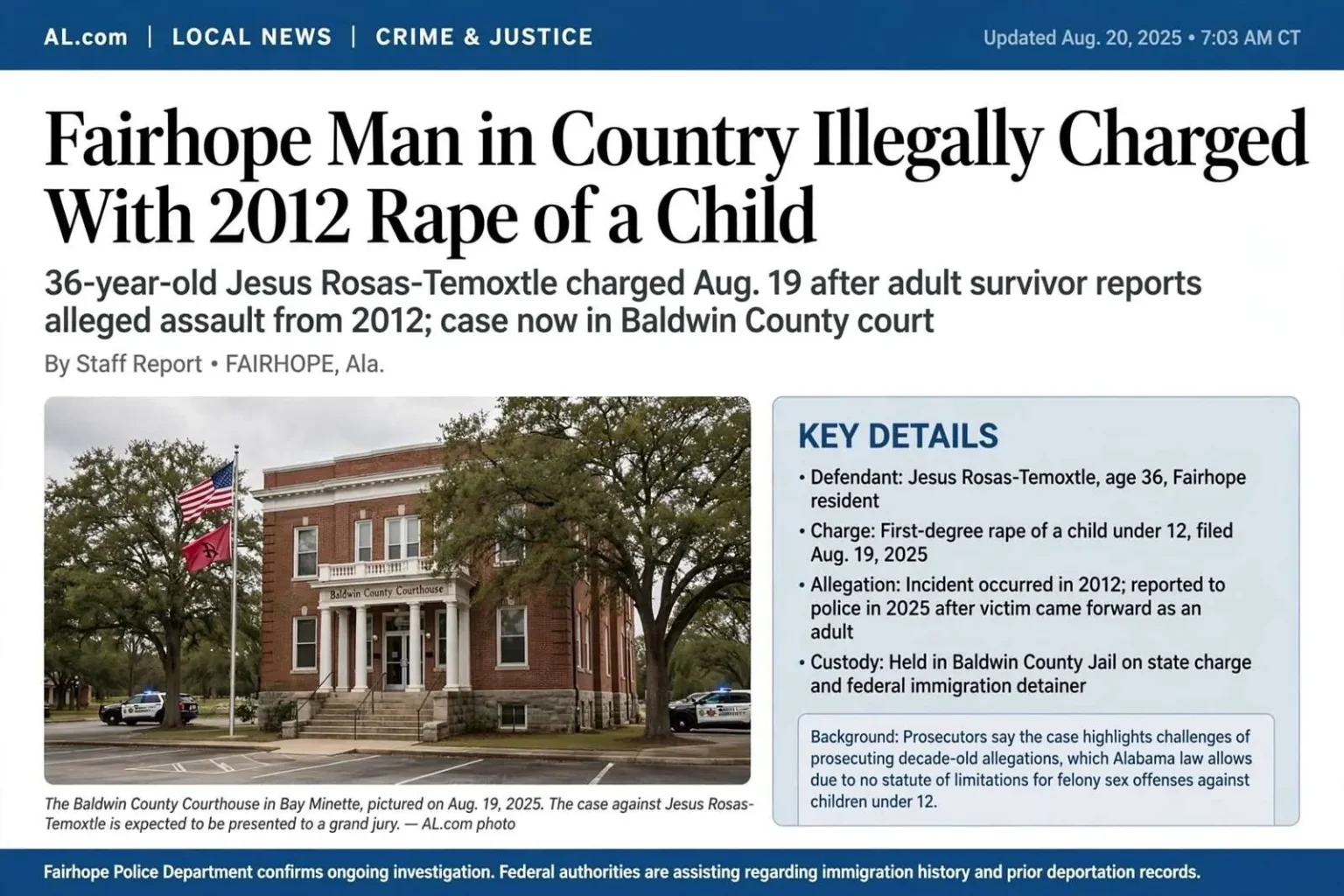
A Fairhope man in the country illegally is facing a rape charge stemming from an alleged assault on a child under the age of 12 more than a decade ago, according to court records.
Jesus Rosas-Temoxtle, 36, was formally charged on Aug. 19, court documents show. The charging paperwork indicates the alleged crime occurred back in 2012, but the case only recently came to the attention of investigators after the victim, now an adult, came forward to report what happened. Fairhope police confirmed the victim’s report set the case in motion.
A Case More Than a Decade in the Making
Sex crimes investigators have long noted the pattern this case follows. Assaults on young children frequently go unreported for years, sometimes decades, because victims are too young to report when the abuse occurs, may not fully understand what happened to them, or suppress the memory until adulthood. It is common for prosecutors to charge such cases once an adult survivor comes forward, and the passage of time does not bar prosecution under Alabama law, which allows felony sex offenses against children to be brought years after the offense.
The practical challenges, however, are considerable. Evidence from more than a decade ago must be assembled from old records, and investigators rely heavily on the account of the now-adult victim to establish the timeline and circumstances. Prosecutors in Baldwin County will handle the case as it moves through the court system, with the age of the alleged victim at the time of the offense a central factor in the charges and in any eventual sentencing.
A Long Record of Encounters With Law Enforcement
Court records show this is not the first run-in with law enforcement for Rosas-Temoxtle. Immigration and criminal history detailed in the documents paints a picture of a man who has repeatedly come into contact with the justice system over nearly two decades.
Back in 2008, he received a traffic citation for driving without a license; the citation noted he also did not have a Social Security number. A decade later, in 2018, he was convicted of stealing construction equipment from a building company.
Immigration records cited in a since-dismissed protection-from-abuse petition show that Rosas-Temoxtle was deported from the United States in 2018, only to illegally re-enter the country the following year, in 2019. Re-entry after deportation is itself a federal offense, though the court records cited in the local case do not indicate whether federal prosecutors pursued a separate charge for the 2019 return.
Earlier this year, in April, jail records show he was booked into Mobile Metro Jail on an immigration hold before being transferred two days later to the Baldwin County jail.
How Immigration Holds Work
The sequence of bookings in April illustrates the routine mechanics of federal-local immigration enforcement. When local jails book someone whose records suggest an immigration violation, U.S. Immigration and Customs Enforcement can place a hold — a request that the jail notify federal authorities and delay release so agents can take custody. Detainees held on immigration detainers are frequently moved between facilities as federal agents arrange interviews, travel documents and transfer logistics, which is what the two-day stay at Mobile Metro before the move to Baldwin County reflects.
Mobile Metro Jail serves as the primary intake facility for arrests across Mobile County, and the Baldwin County jail in Bay Minette houses inmates awaiting trial in the county’s courts. The April movement placed Rosas-Temoxtle in the county where the new charge was eventually filed.
What Happens Next
The rape charge now adds to that record and could carry significant prison time given the age of the alleged victim at the time of the offense. Alabama law treats sexual offenses against children under 12 as among the most serious felonies on the books, with sentencing ranges that run to decades in prison, and a defendant’s prior record factors into sentencing exposure.
Investigators have reached out to federal Homeland Security officials to gather more background information on Rosas-Temoxtle’s immigration history, and additional details are expected as the case develops.
The cooperation between Fairhope investigators and federal authorities reflects how such cases typically proceed when a defendant’s history spans multiple jurisdictions. Local police pursue the criminal charge; federal records help establish the timeline of the defendant’s presence in the country, his prior deportations and any prior contact with immigration enforcement. That background can matter at trial and at sentencing, and it frames the broader record that court documents in the case now describe.
The Investigation Ahead
For Fairhope police, the work now shifts to building a case that can survive the challenges inherent in a decade-old allegation. Detectives will be reconstructing the circumstances described by the victim, identifying anyone who can corroborate details, and pulling records from the years in question. Older cases of this kind often turn on the specificity of the survivor’s account and on documents — employment records, phone records, property records — that can place the parties where the victim says they were.
The Baldwin County District Attorney’s office, which presents felony charges to a grand jury for indictment, will review the evidence once investigators complete their work. Cases charged by complaint, as this one was, typically move to an indictment phase before trial scheduling. Defense attorneys in delayed-report cases routinely challenge the reliability of memories formed in early childhood, and prosecutors anticipate those challenges when they screen such cases for charges.
Advocates for survivors of childhood sexual abuse note that cases like this one are a large part of why extended statute-of-limitation rules matter. Many survivors report only when they are adults, after years of processing what happened to them, and jurisdictions that allow late prosecution keep the courthouse door open for exactly those reports. The decision by the victim in this case to come forward more than a decade after the alleged assault is what moved the matter from the past into the present.
As with any criminal charge, the allegations remain allegations until proven in court. The defendant is entitled to the presumption of innocence, and the case will move forward through the Baldwin County court system in the months ahead, with additional details expected as investigators finish gathering background from federal Homeland Security officials.
Fairhope and the County’s Court System
Fairhope, the Baldwin County city on the eastern shore of Mobile Bay, maintains its own police department, which handles felony investigations within the city limits before handing cases to the county for prosecution. The department, like others across Baldwin County, has seen its caseload grow alongside the city’s rapid population growth, and investigations involving old allegations require a different kind of detective work than the incidents that fill most police blotters.
Baldwin County’s court system, centered in Bay Minette, processes the felony dockets for the entire county, including the fast-growing communities along the Eastern Shore and the resort corridor to the south. Cases involving charges against children are among the most closely scrutinized on those dockets, both by prosecutors who screen them and by the judges who oversee them, and they frequently involve victim-support services that the county’s court system provides through advocacy programs.
The Records Behind the Case
The paper trail cited in court documents spans years and jurisdictions. The 2008 traffic citation established early contact with local law enforcement; the 2018 theft conviction in which he stole construction equipment from a building company produced a criminal record in state court; and the immigration records cited in the protection-from-abuse petition — a civil filing later dismissed — documented the 2018 deportation and the 2019 return.
Protection-from-abuse petitions in Alabama are civil proceedings that allow individuals to seek court-ordered protection from household or family members, and the records filed in them often include background information that becomes part of the public record even when the petition itself is dismissed. In this case, it was those filings that surfaced the immigration history now cited in coverage of the criminal charge.
A Broader Pattern Officials Watch
Cases that combine a serious felony charge with a record of illegal re-entry after deportation are the kind that draw attention from federal as well as local authorities. Federal prosecutors along the Gulf Coast regularly pursue re-entry charges, and the coordination requested by Fairhope investigators with Homeland Security officials is the standard first step in determining whether an additional federal case is warranted alongside the state prosecution.
For Baldwin County officials, the case also lands amid ongoing public discussion about how local agencies handle defendants who are in the country illegally — a topic that spans jail intake procedures, detainer compliance and communication with federal authorities. The April booking sequence, from Mobile Metro to the Baldwin County jail, followed the established channels between local facilities and federal agents.
The court process will now determine the outcome. Until then, the documented facts are narrow: a charge filed Aug. 19, an alleged offense in 2012 against a child under 12, a victim who came forward as an adult, and a defendant whose nearly two decades of contact with the justice system are laid out in the court records now attached to the case.