Federal Judge Fines Loxley Lawyer After AI Program Cited Fake Cases in Court Filing
A federal judge fined a Loxley lawyer and imposed sanctions after finding that an AI program he used to draft a court filing cited cases that do not exist.
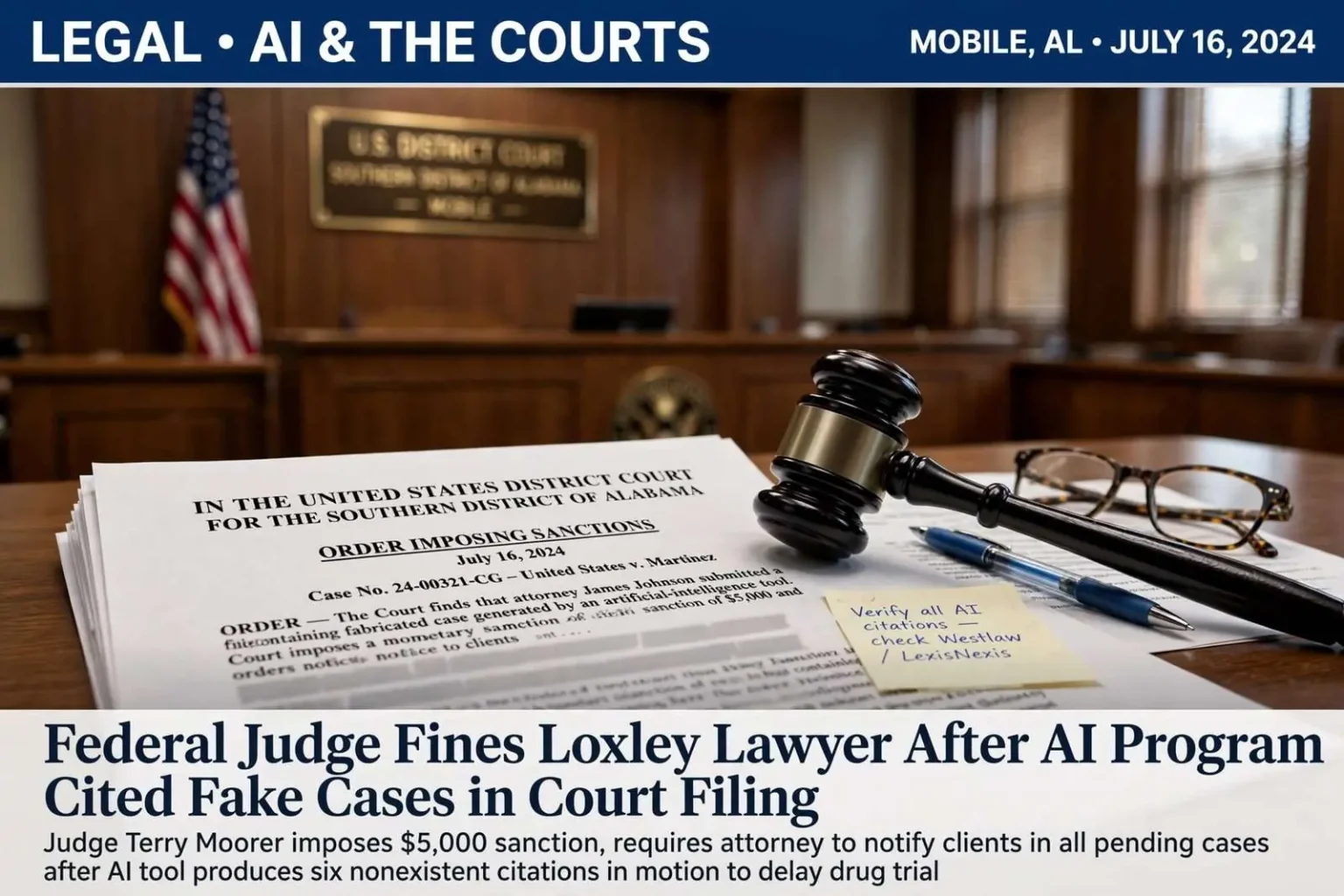
A federal judge has come down hard on a Loxley attorney, months after learning the lawyer had used an artificial intelligence program to draft a court filing riddled with fabricated case citations. U.S. District Judge Terry Moorer issued an 18-page order fining attorney James Johnson and directing him to notify his current and future clients of the sanction. Moorer acknowledged that lawyers and judges alike can make honest mistakes, but wrote that Johnson’s conduct went well beyond that.
“The Court further has no difficulty finding that Mr. Johnson’s misconduct was more than mere recklessness. … The insertion of bogus citations is not a mere typographical error, nor the subject of reasonable debate,” Moorer wrote. “It is just wrong.” Ian Rosental, an attorney representing Johnson, did not immediately return a phone call seeking comment.
The episode centers on a filing
The episode centers on a filing that asked for a postponement of a federal drug trial. Johnson, who practices law in Loxley, admitted during a July hearing that an AI program he used to draft the filing had cited cases that do not exist. Moorer ordered Johnson to pay a $5,000 fine and to file a copy of the sanctions order in all of his pending cases, as well as in any new cases he takes on over the next 12 months in every jurisdiction where he is licensed to practice.
The judge also directed the clerk of the federal court in Mobile to forward a copy of the order to the general counsel of the Alabama State Bar and to the chief judges of Alabama’s Middle and Northern federal districts. Moorer additionally referred Johnson to the court’s advisory panel to determine whether he should be removed from the roster of lawyers eligible to receive court-appointed criminal cases.
Background on the case
The underlying case, United States v. Martinez, involved a multi-defendant drug trafficking prosecution in the Southern District of Alabama. Johnson represented one of the defendants charged with conspiracy to distribute methamphetamine. The trial had been scheduled for August, but Johnson filed a motion for continuance in June, citing the need for additional time to review discovery materials that had been produced late by the government. The motion cited six federal appellate decisions supposedly supporting the argument that late discovery warranted a continuance as a matter of due process.
When the government’s response pointed out that none of the six cases could be found in Westlaw, LexisNexis, or the Federal Reporter, the court ordered Johnson to provide copies of the opinions. At a July 15 hearing, Johnson acknowledged that he had used an AI legal research tool — he declined to specify which one — to draft the motion, and that the tool had generated the citations. He stated that he had not verified the cases before filing.
Loxley, where Johnson maintains his practice, is a town of roughly 3,500 in Baldwin County, about 30 miles east of Mobile. Johnson has been licensed in Alabama since 2011 and has built a practice focused on criminal defense, family law, and personal injury. He is a solo practitioner with no associates, and court records show he has appeared in both state and federal courts across the southern half of the state.
An ‘epidemic’ of AI-generated fake cases
Johnson is far from the first lawyer nationally to run into trouble over AI-generated errors. False citations produced by artificial intelligence programs have become common enough to earn their own nickname: “hallucinations.” In June 2023, a federal judge in New York sanctioned two attorneys who submitted a brief written with ChatGPT that cited six nonexistent cases. In January 2024, a Colorado attorney was suspended after an AI-generated motion included fabricated quotes from real cases. The Fifth Circuit Court of Appeals has issued a standing order requiring attorneys to certify that any AI-assisted filings have been verified by a human.
The problem stems from how large language models work. Trained on vast corpora of legal text, these models learn the patterns of legal citation — the format of case names, the structure of reporter citations, the conventions of legal argument — but they do not have access to a verified database of actual cases. When asked to find cases supporting a legal proposition, they may generate plausible-sounding citations that follow all the formal rules but correspond to no real decision. The citations often include real judges’ names, real courts, and realistic docket numbers, making them difficult to spot without direct verification.
Judge Moorer’s order surveys this national landscape and concludes that the legal profession is at an inflection point. “The Court does not doubt that artificial intelligence tools will become a routine part of legal practice, just as Westlaw and LexisNexis replaced the physical reporter volumes,” Moorer wrote. “But the transition requires a new professional discipline: verification. An attorney who signs a filing certifies its accuracy. That certification cannot be delegated to an algorithm.”
Reaction from the Alabama bar
The Alabama State Bar has not yet issued formal guidance on AI use, but the Ethics Committee has been studying the issue since late 2023. In a preliminary opinion circulated to committee members in March, the committee suggested that existing rules — particularly Rule 1.1 (competence), Rule 3.3 (candor toward the tribunal), and Rule 5.3 (supervision of non-lawyer assistance) — already encompass the obligations of attorneys who use AI tools. The committee is expected to issue a formal advisory opinion before the end of the year.
Several of Alabama’s larger firms have adopted internal policies requiring attorneys to disclose AI use on any filing and to maintain a verification log documenting which assertions were checked against primary sources. Bradley Arant Boult Cummings, Maynard Nexsen, and Lightfoot Franklin White have all issued firm-wide memoranda on the topic. Solo practitioners and small firms, which make up the majority of Alabama’s legal market, have been slower to adopt formal protocols, often lacking the resources for dedicated technology officers or continuing education on emerging tools.
The Alabama Law Institute, the state’s law reform agency, has convened a working group to study whether statutory or rule changes are needed to address AI in legal practice. The group includes judges, practitioners, law professors, and representatives from the state bar. Their interim report, released in April, recommended that the Alabama Supreme Court adopt a rule requiring certification of AI-assisted filings, similar to the Fifth Circuit’s standing order.
Implications for the legal profession
The sanctions against Johnson carry consequences beyond the $5,000 fine. The requirement to file the sanctions order in all pending and future cases for 12 months means that every judge, opposing counsel, and potential client who searches Johnson’s name in the federal docket will see the order. The referral to the court’s advisory panel on court-appointed criminal cases could result in Johnson losing a significant source of income — court-appointed defense work in the Southern District often provides a steady stream of cases for solo practitioners.
Johnson’s admission that he did not verify the AI-generated citations before filing reflects a broader challenge for the profession. A 2024 survey by the American Bar Association found that 42 percent of attorneys had used generative AI tools for work-related tasks in the previous year, but only 28 percent reported having formal training on the limitations and risks of those tools. Among solo practitioners, the training rate dropped to 14 percent.
The Southern District of Alabama, which covers the southern third of the state from the Mississippi border to the Georgia line, has not yet issued a standing order on AI use. Chief Judge Emily Marks has indicated that the court is monitoring developments in other districts and expects to issue guidance later this year. The district’s local rules currently require attorneys to certify that filings are not presented for improper purposes and that legal contentions are warranted by existing law or a non-frivolous argument for extension — language that Moorer’s order suggests already encompasses the duty to verify AI-generated content.
A cautionary precedent
For Johnson, the case represents a professional crisis. For the legal community in south Alabama, it serves as a cautionary precedent. The Loxley attorney’s mistake — using an AI tool to draft a routine motion and failing to check the citations — is exactly the kind of error that experts warn will become more common as AI tools are integrated into legal research platforms, document drafting software, and case management systems. Westlaw and LexisNexis have both launched AI-assisted research features in the past year, and Microsoft’s Copilot for Office 365, which many law firms use, includes AI drafting capabilities in Word.
Moorer’s order concludes with a directive that resonates beyond the specifics of Johnson’s case: “The practice of law is a public trust. The tools change. The obligation does not.” For the lawyers of the Southern District — from the large firms in Mobile to the solo practitioners in Loxley, Robertsdale, and Monroeville — the message is clear. The technology may generate the citations. The lawyer must still answer for them.