Federal Prosecutors Say Co-Conspirator Evidence Is Fair Game in Prichard Water Board Fraud Case
Federal prosecutors are pushing back against a defense motion to limit evidence in the fraud case against a contractor charged in a multimillion-dollar scheme to defraud the Prichard Water Works and Sewer Board.
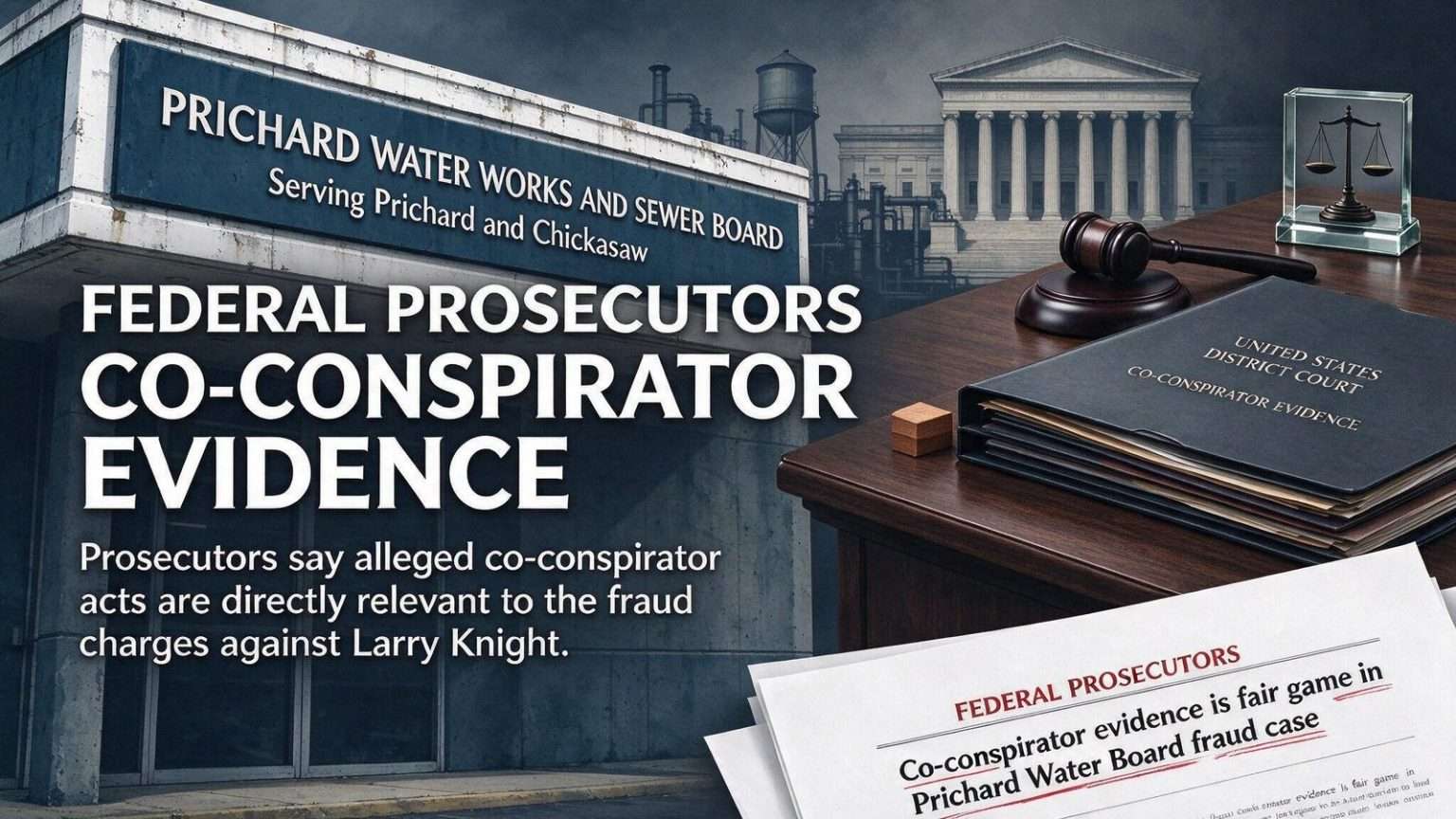
Federal prosecutors on Monday asked a federal judge to reject a defense request to bar certain evidence in the case against a man charged with defrauding the Prichard Water Works and Sewer Board, arguing in a new court filing that the actions of alleged co-conspirators are directly relevant to the charges he faces.
Larry Knight, a painting contractor hired to do work for the utility that serves Prichard and Chickasaw, is accused of receiving more than $700,000 for allowing his company to be used in fraudulent billing records. He is one of five defendants named in the federal indictment, which also names former operations manager Nia Malkia Bradley, who has pleaded guilty and is awaiting sentencing. Prosecutors contend the allegations against Knight are one piece of a larger, multilayered fraud scheme that Bradley and others ran, allegedly with help from at least one board member, to steal money from the financially troubled utility. The total fraud is estimated at about $2.5 million.
Knight’s attorneys argue that prosecutors intend to present evidence and testimony from “unrelated codefendants and unrelated schemes to defraud the City of Prichard,” maintaining that those defendants have no knowledge of Knight or his dealings with the utility. The defense contends that material tied to schemes Knight was never accused of joining should be kept from the jury because it would prejudice the panel against him without proving anything about the counts in his indictment.
The U.S. Attorney’s Office countered in Monday’s filing that actions taken by co-conspirators remain relevant to Knight’s case. “As a part of a conspiracy, the actions taken by co-conspirators are directly relevant — and admissible — as to the charges against Knight,” the filing states. “It is well established precedent that co-conspirators do not have to know each other to be a part of the same conspiracy.”
The legal fight over co-conspirator evidence
The dispute centers on a familiar battleground in federal conspiracy prosecutions: how much of the alleged scheme a jury may hear about when a single defendant goes to trial. Under longstanding principles of federal criminal law, a conspiracy is a single unlawful agreement, and each participant is generally held responsible for the acts of the others that were done in furtherance of that agreement. Prosecutors argue that presenting those acts in isolation — stripped of the surrounding scheme — would misrepresent the nature of the alleged conspiracy itself.
That is why, in the government’s view, testimony from defendants who never met Knight or dealt with him directly can still be admissible. If several people contributed, knowingly or unknowingly, to a common scheme to divert money from the water board, the government maintains that the jury cannot fairly evaluate Knight’s alleged role without seeing how his piece fit into the whole. Federal courts have repeatedly allowed co-conspirator statements and conduct into evidence when the government shows that the conduct occurred during and in furtherance of the same conspiracy.
Defense attorneys in these situations typically argue that so-called “other acts” evidence invites the jury to convict on guilt by association. In Knight’s case, his lawyers have drawn a sharp line between schemes aimed at the water board and schemes aimed at the City of Prichard itself, arguing that evidence from the latter category cannot show anything about his state of mind in this case. Prosecutors, conversely, treat those strands as branches of the same root conspiracy, and the admissibility fight will turn on whether the court agrees the alleged conduct was connected by a common unlawful agreement.
The defense view is the mirror image of that argument. Knight’s lawyers maintain that “unrelated” schemes — frauds allegedly carried out by other defendants against the City of Prichard rather than the water board — say nothing about what Knight knew or intended, and that parading them before the jury would amount to trying him for someone else’s conduct. The judge will now weigh where that line falls as the October trial approaches.
A utility under strain
The case has drawn attention in part because of the condition of the defendant institution. The Prichard Water Works and Sewer Board serves residents of Prichard, one of Mobile County’s older industrial cities, along with neighboring Chickasaw, providing drinking water and sewer service to thousands of households. The board has struggled financially for years, a fact cited repeatedly by both sides in the criminal proceedings as the backdrop against which the alleged fraud unfolded.
When a public utility of that size loses money to fraud, the costs do not stay on a ledger. Ratepayers ultimately bear them through higher bills, deferred maintenance grows more expensive, and public confidence in the board’s oversight erodes. Prosecutors have framed the indictment as an effort to hold accountable everyone who benefited from the scheme, from insiders at the utility to outside contractors who allegedly allowed their companies to be used as conduits for fraudulent payments.
Knight’s charge fits that pattern, according to the government: he was a legitimate vendor doing legitimate work, and the allegation is that his company’s invoices became a vehicle for fraudulent billing records through which more than $700,000 flowed to him. Whether that money was knowingly obtained or merely routed through his business is expected to be a central question at trial.
The wider indictment and Bradley’s guilty plea
Knight is one of five defendants named in the indictment returned in the case, a scope that reflects what investigators described as a scheme with many moving parts. Former operations manager Nia Malkia Bradley stands at the center of the government’s account. She has pleaded guilty and is awaiting sentencing, and her cooperation and her detailed knowledge of the utility’s inner workings are expected to loom large over the remaining defendants’ cases.
According to prosecutors, the fraud was not a single transaction but a multilayered arrangement carried out over time — fraudulent billing records, payments routed through outside companies, and the alleged involvement of at least one member of the water board itself. The total fraud is estimated at about $2.5 million, a figure that represents the combined alleged losses across the various strands of the scheme rather than the amount tied to any single defendant.
That structure is precisely what the government says justifies presenting the full picture to a jury. In its Monday filing, the U.S. Attorney’s Office described the allegations against Knight as “one piece” of the larger scheme that Bradley and others allegedly ran. The defense, for its part, will press the court to keep the jury’s attention fixed on Knight’s individual conduct and on whether the government can prove he knowingly joined the conspiracy rather than being used by others.
What happens next on the court calendar
Knight’s trial is scheduled for October, and he is set to face the jury alongside co-defendant Dejuan Lamar, whose case will be tried at the same time. Bradley, having resolved her case with a guilty plea, is set to be sentenced later that same month. The sequencing matters: defendants who plead guilty typically are sentenced after their cooperation has been assessed, and the outcome of Bradley’s sentencing could shape how the remaining defendants and their attorneys approach their own cases.
Before the jury is seated, the court will have to resolve the evidentiary questions raised by the defense motion — including what testimony from other defendants and about other schemes, if any, will be allowed. Rulings on such motions often determine the shape of a conspiracy trial. If the government is permitted to present the full arc of the alleged fraud, its case will lean heavily on the connections among the defendants; if the evidence is limited, prosecutors will need to prove Knight’s knowledge and intent more directly.
For residents of Prichard and Chickasaw, the proceedings offer the clearest public accounting yet of how money intended to support a struggling community utility allegedly was diverted. The October trial, and the sentencings that follow, will determine how much of that story is told in open court — and what consequences follow for those charged with taking part in it.
Why the stakes extend beyond one defendant
Federal fraud prosecutions involving public boards tend to produce consequences that outlast the criminal cases themselves. Indictments of this kind routinely prompt internal reviews, changes in procurement and invoicing procedures, and closer scrutiny from state and federal overseers of public utilities. For the water board, the exposure of a scheme estimated at $2.5 million raises unavoidable questions about the controls that allowed fraudulent billing records to move through the system and about who was watching as the money flowed.
The case also illustrates the practical reach of federal conspiracy law in public-corruption matters. As the government’s Monday filing emphasized, a participant in a conspiracy need not know every other participant, and the acts of any conspirator in furtherance of the scheme can support the charges against each of them. That principle gives prosecutors flexibility to charge a contractor, an operations manager, and a board member in the same case even when their paths never visibly crossed.
Whether that theory carries Knight’s case to conviction will be decided by a jury in October. Until then, the fight over co-conspirator evidence will help determine just how much of the alleged scheme the jury gets to see — and that question, more than any other, is what Monday’s filing put squarely before the court.