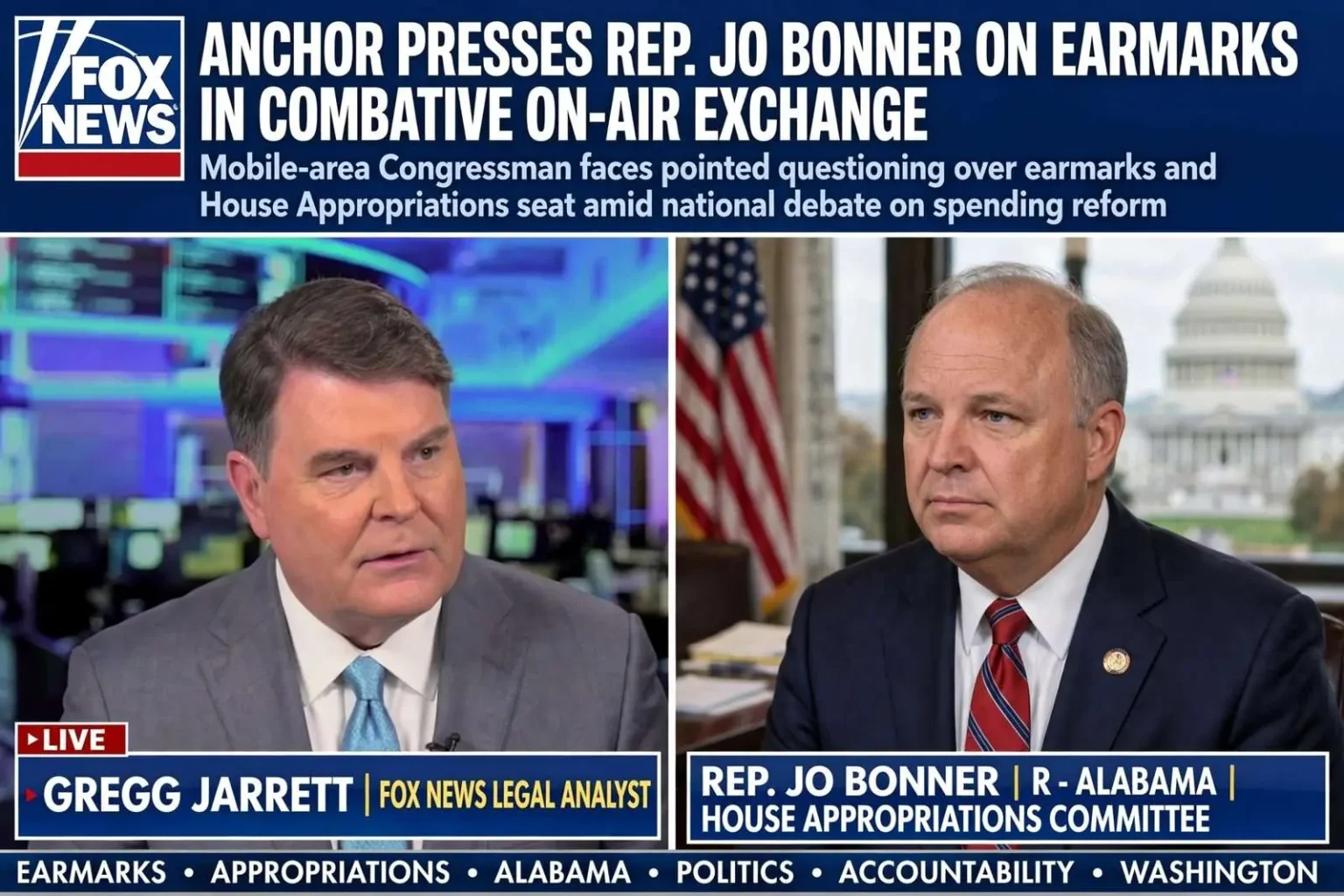
Mobile-area Congressman Jo Bonner faced a pointed round of questioning from Fox News anchor Gregg Jarrett over his use of earmarks and his recent appointment to the powerful House Appropriations Committee, in an exchange that renewed scrutiny of the congressman’s spending record amid a broader national debate over earmark reform. The appearance put a national spotlight on a fight that had been simmering inside both parties for years, and it cast Bonner, a Republican whose district stretched from Mobile through southwest Alabama’s Gulf Coast communities, as a defender of a practice that critics in both parties had come to view as a symbol of Washington’s problems.
Jarrett opened by noting that when a Republican seat opened on the Appropriations Committee, it went to Bonner rather than Arizona Rep. Jeff Flake, widely regarded as Washington’s most persistent anti-earmark crusader. Flake had built a national reputation by taking to the House floor to name individual earmarks and their sponsors, and his exclusion from the appropriations panel while Bonner was elevated told viewers on both sides of the debate exactly where the party’s leadership stood. For good-government groups, the choice was proof that the committees controlling federal spending remained a preserve of members willing to use it; for defenders of earmarking, it was simply a matter of seniority and party norms working as designed.
Jarrett pointed out that Bonner had himself been criticized for directing earmarks toward projects tied to lobbyist-connected clients, asking whether the practice was appropriate given that some of those same lobbyists had gone on to contribute to Bonner’s campaigns. The question touched on the core criticism that reformers had leveled at the earmark system for years: that the line between a member’s legislative choices and his political fundraising could become uncomfortably thin, even when no law was broken.
Bonner rejected any suggestion of wrongdoing, telling Jarrett, “It’s not illegal. And I don’t believe it is inappropriate,” and adding that most of the contributions he receives come from individual constituents who support his positions rather than from special interests seeking favors. Pressed further on whether the broader practice was ethically sound, Bonner acknowledged the risks earmarks pose to the legislative process more generally, saying, “It can be an addiction and it can be a cancer that can corrupt the process. Now, that said, all earmarks are not bad.” The answer captured the position many appropriations members struck in that era: conceding the system’s dangers while insisting that the alternative, a White House and career bureaucracy controlling every federal dollar, was worse.
Controversies beyond Alabama’s First District
The interview also touched on earmark controversies involving other members of Congress. Jarrett raised the case of former House Speaker Dennis Hastert, who had earmarked $207 million for a highway project near land Hastert had purchased, then sold at a substantial profit after the funding bill was signed. The Hastert example, drawn from the suburb-stretching growth corridor west of Chicago, had become one of the most-cited illustrations of how an earmark could move markets as surely as it moved traffic.
Bonner responded that Hastert had disputed the facts as Jarrett described them, but added, “If that is in fact true, then not only was it wrong, it would be indefensible.” On a separate case involving Rep. Paul Kanjorski, who had earmarked $10 million over four years for a company run by his family, Bonner said he could not comment because it potentially involved the Department of Justice and his own role on the House Ethics Committee. The explanation reflected a real constraint: members of the ethics panel are expected to avoid public commentary on matters that could come before it, and Bonner declined to break that wall even under direct questioning.
When Jarrett pushed Bonner to weigh in on Rep. Ken Calvert, who set up a transportation center within two miles of properties he owned, Bonner declined to render judgment on individual colleagues, saying, “I’m not going to answer questions about members of Congress and what they have allegedly done.” He argued that while the pattern of questions might lead many Americans to conclude the worst, the vast majority of the 435 members of Congress are not using earmarks for personal enrichment.
The distinction Bonner was drawing, between earmarks that benefit a member personally and earmarks that fund a district’s infrastructure, was the same one Alabama’s congressional delegation had long emphasized. Federal spending directed through the appropriations process had built roads, improved harbors and supported research institutions across the state, and Gulf Coast lawmakers pointed to Port of Mobile dredging, highway improvements along the Interstate 10 corridor, and university research programs as examples of the practice working as intended. Critics countered that whatever the merits of any individual project, the process itself, in which a single member could insert funding without public hearings or competitive bidding, was the problem.
Reform proposals and a stalled moratorium
Bonner used the interview to highlight steps he says he has taken toward greater transparency, noting that he has personally cut his earmark requests in half this year and that Republicans have proposed a one-year moratorium on all earmarks. The moratorium had been adopted by House Republicans as a conference-wide rule, a striking reversal for a party that had used earmarks liberally during its years in the majority, and it reflected the pressure that tea party-era activists and watchdog groups had brought to bear on members in both parties.
He said that effort stalled because Democratic leadership, under Speaker Nancy Pelosi, would not meet Republicans halfway on the proposal. The exchange illustrated the political geography of the earmark fight at the time: each party found it easier to attack the practice while out of power than to give it up while in control of the spending process, and each accused the other of bad faith when voluntary restraint failed to become binding law.
Bonner also pointed to disclosure rules that had tightened considerably during his tenure. Earmark requests were increasingly required to be posted online with the requesting member’s name attached, and certifications that neither the member nor his family held a financial interest in the project had become standard practice. Those changes fell short of what groups like Citizens Against Government Waste and Taxpayers for Common Sense wanted, which was a permanent ban, but they made the process more visible than it had been when earmarks could be slipped into spending bills without attribution.
What earmarks meant for southwest Alabama
The exchange arrives amid a broader national reckoning over congressional earmarking, an appropriations practice that lets individual lawmakers direct federal money to specific projects, often in their home districts, without going through the standard competitive process. For the First District, that practice had a concrete meaning. Mobile’s port, one of the busiest on the Gulf, depended on regular federal navigation and dredging work that only Congress could authorize, and the Army Corps of Engineers projects that kept the channel deep enough for oceangoing vessels moved through the appropriations cycle that Bonner had just joined.
Transportation projects told a similar story. Baldwin and Mobile county officials had long relied on federal matching funds for bridge replacements, road widening and ferry service along the coast, and an appropriations seat gave the district’s congressman influence over which of those projects advanced. Defenders of the system argued that a congressman who knows which bridge is structurally deficient and which port channel is silting in can direct money more intelligently than a formula written into a federal bureaucracy; opponents replied that every member believes the same thing about his own district, and the result is a spending free-for-all settled by seniority rather than merit.
Critics across the political spectrum have argued the practice invites corruption and wasteful spending, while defenders, including many Alabama lawmakers, say targeted earmarks let members bring federal resources home for legitimate local needs such as roads, ports and economic development projects. Watchdog organizations published annual catalogs of the most notorious requests, and individual earmarks became shorthand in campaign advertising for a culture of backroom dealing, giving the issue a resonance far beyond the small share of the federal budget it actually represented.
The stakes of an appropriations seat
Bonner’s appointment to the Appropriations Committee carried weight that went well beyond his own district. Alabama’s delegation historically prized appropriations seats because federal installations, shipbuilding contracts and water projects across the state depend on decisions made in those committee rooms. Mobile’s shipyard and aerospace employers, the port’s harbor-deepening ambitions, and research dollars flowing to the state’s universities all traced back to the appropriations process, which is why the competition for the seat, and the choice of Bonner over a noted earmark critic, drew attention back home as well as on cable television.
For Bonner personally, the interview was an early test of how he would defend that role in a political climate turning sharply against the practice. His answers, defending the legality of the system while conceding its capacity for abuse, mirrored the posture of most appropriations members of both parties, who argued that transparency and discipline could cure the system’s ills without surrendering Congress’s constitutional power of the purse. Whether that argument would hold with voters, many of whom had come to view any earmark as a scandal in miniature, was the question the exchange left hanging, and it was the question that would ultimately reshape the way Congress funded local projects in the years that followed.