Hundreds of Mobile Public Works Employees Left Out of $500 Bonus Program
Mobile City Council members learned that several hundred Public Works employees are ineligible for a $500 bonus other city workers receive, a side effect of a separate incentive pay program tied to attendance and driving credentials.
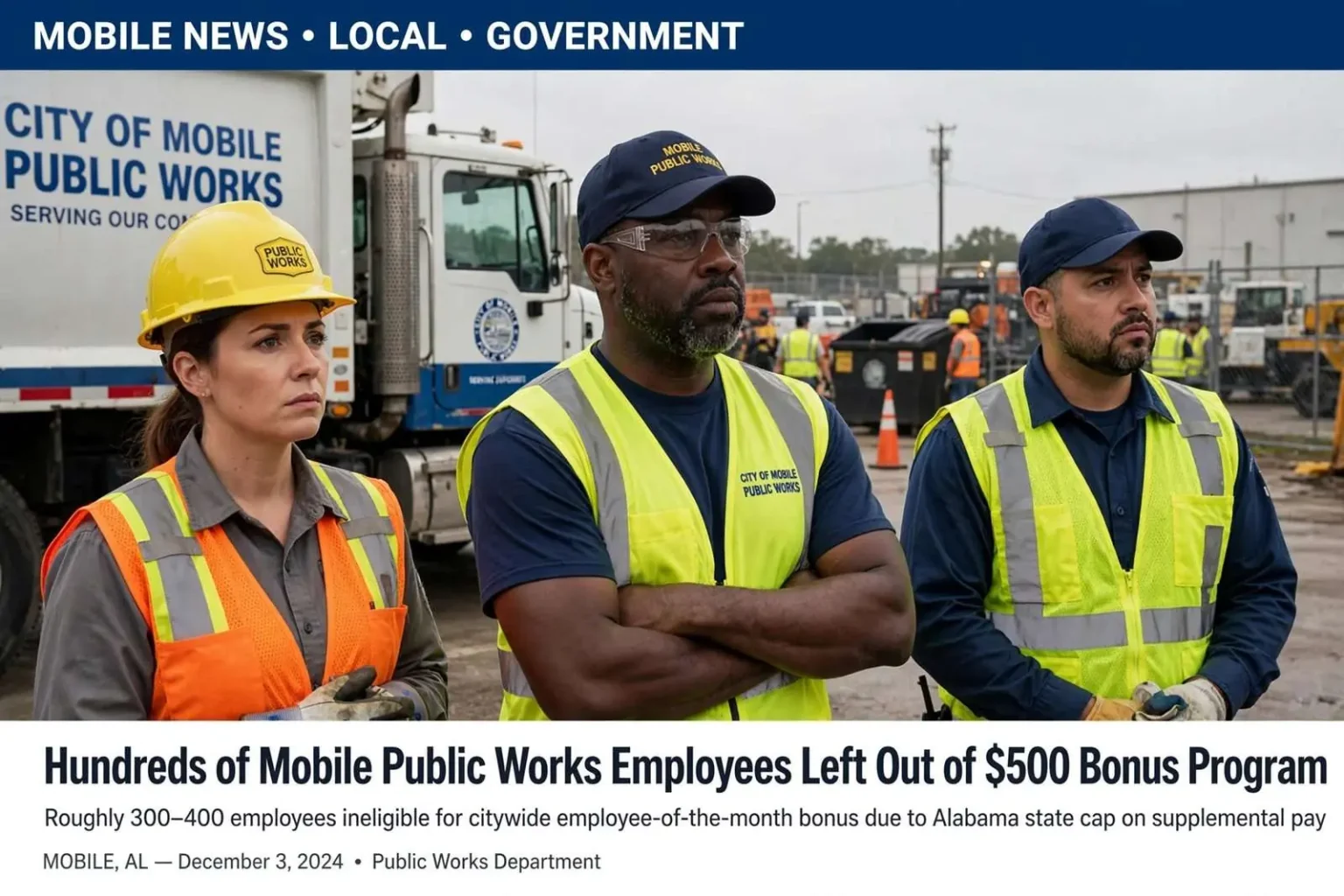
Roughly 300 to 400 employees in the city of Mobile’s Public Works Department are currently ineligible for a $500 employee-of-the-month bonus available to workers in other departments, members of the Mobile City Council learned during a pre-conference meeting held Tuesday. City Attorney Ricardo Woods told the council that workers in the department’s public services division cannot receive the bonus because they already receive payments the state of Alabama classifies as bonuses through a separate incentive program. That program was created by Mayor Sandy Stimpson’s administration after months of employee complaints about harassment and working conditions on the job. Because state law caps the total amount of bonus money a single employee can receive in a given period, workers already collecting incentive pay have effectively been locked out of the citywide recognition bonus.
The Incentive Program’s Origins
The incentive program has been a point of friction between the council and the mayor’s office for roughly two years. The council amended the fiscal year 2019 budget to include raises for public works employees, but the administration instead rolled out a system that lets workers boost their pay based on attendance, working conditions and whether they hold a commercial driver’s license. Some council members have long argued that approach treats public works employees differently than workers in every other city department, and that frustration resurfaced during Tuesday’s discussion. “I don’t think it’s legal to treat employees differently,” Councilman Fred Richardson said. “Treat them all the same.”
Councilwoman Gina Gregory noted that the incentive program was put in place instead of the raises the council had approved, while employees in other departments receive the employee-of-the-month bonus on top of their regular salary. “I think that’s where we’re having trouble with this,” Gregory said. “The incentives should not be counted against them.” Executive Director of Public Works Nick Amberger defended the incentive program as a targeted response to the department’s specific challenges — high turnover, difficulty filling CDL positions, and safety concerns that had drawn OSHA attention. The program pays up to $1.50 per hour extra for perfect attendance, up to $1 per hour for working in designated difficult conditions, and up to $2 per hour for holding a CDL. These payments are classified as supplemental pay, not base salary adjustments.
State Law and the Bonus Cap
The legal constraint comes from Alabama Code § 36-25-10, which limits the total supplemental compensation a public employee can receive from all sources to $500 per month (or $6,000 annually) without specific legislative authorization. The statute, originally enacted to prevent double-dipping and pension spiking, defines “bonus” broadly to include any payment beyond base salary that is not overtime, longevity, or certification pay. The city’s employee-of-the-month bonus — $500 for one employee per department per month — falls under this cap. Because the public works incentive payments can exceed $500 per month for eligible workers, they consume the entire bonus allowance, rendering those employees ineligible for the recognition bonus.
City Attorney Woods explained that the cap applies per employee, not per program. An employee receiving $600 monthly in incentive pay has already exceeded the statutory limit, so the additional $500 bonus would push them further over. The city cannot legally pay it without amending the state law or restructuring the incentive payments to fall under an exempt category (such as certification pay for CDL holders). Woods said his office had explored whether the CDL supplement could be reclassified as certification pay — which is exempt from the cap — but concluded that the attendance and working-condition components could not be similarly reclassified.
Council vs. Administration: A Recurring Conflict
The dispute reflects a deeper structural tension in Mobile’s governance. The city operates under a mayor-council system adopted in 1985, replacing the three-commissioner form of government. The council holds legislative and budgetary authority; the mayor holds executive authority. Budget amendments require council approval, but the administration controls implementation. When the council amended the 2019 budget to include raises for public works, it exercised its legislative power. When the administration substituted an incentive program, it exercised its executive discretion over personnel policy. The result was a policy outcome neither side fully wanted: the council didn’t get the across-the-board raises it voted for, and the administration got an incentive program that now blocks its own employees from a citywide recognition program.
Councilman Richardson’s legal challenge — “I don’t think it’s legal to treat employees differently” — touches on equal protection principles. Alabama public employees are not covered by a collective bargaining agreement (Alabama is a right-to-work state with no public-sector collective bargaining), so their protections come from civil service rules, state statutes, and constitutional guarantees. The Alabama Constitution’s equal protection clause (Art. I, § 1) and the Fourteenth Amendment to the U.S. Constitution require that similarly situated employees be treated alike unless there is a rational basis for the distinction. The administration’s argument — that public works employees face unique hazards and retention challenges — would likely satisfy rational basis review, but the council’s frustration is political, not just legal.
The Public Works Workforce
Mobile’s Public Works Department employs approximately 600 people across divisions: public services (garbage, trash, recycling, right-of-way maintenance), engineering, traffic engineering, flood control, and administration. The public services division, where the 300-400 affected workers are concentrated, performs the most physically demanding and hazardous work in the city — driving garbage trucks in traffic, operating heavy equipment, handling waste in all weather. Turnover in these positions has historically exceeded 20% annually, compared to single-digit turnover in clerical and administrative roles. The CDL supplement targets the most acute shortage: the city competes with private waste haulers, construction firms, and the port for commercial drivers, all of whom offer higher base pay.
The attendance incentive addresses a chronic absenteeism problem that the administration says peaked at 15% daily absence rates in some crews before the program. The working-conditions supplement applies to crews assigned to the most hazardous routes — major thoroughfares with high-speed traffic, areas with known illegal dumping, and the landfill operation. Amberger said the program had reduced turnover to 12% and improved attendance metrics, though he acknowledged the bonus exclusion was an unintended consequence. The administration had not anticipated that the state bonus cap would be interpreted to include the employee-of-the-month recognition bonus, which the council created after the incentive program was already in place.
Proposed Solutions and Political Dynamics
At Tuesday’s meeting, council members floated several fixes. Councilman C.J. Small suggested asking the Legislative Delegation to sponsor a local bill exempting the employee-of-the-month bonus from the cap — a common mechanism in Alabama, where the Legislature routinely passes local laws for specific municipalities. Councilwoman Gregory proposed restructuring the incentive program so that the CDL supplement becomes certification pay (exempt from the cap) and the attendance and conditions supplements are folded into base pay through a reclassification study. Councilman Joel Daves urged the administration to simply pay the $500 bonus from departmental funds and accept the risk of a state audit, arguing the recognition value outweighed the legal exposure.
Mayor Stimpson’s office, through a spokesperson, said the administration was “reviewing options” and would work with the council to find a resolution. The mayor has historically resisted council attempts to micromanage personnel policy, viewing the incentive program as an executive success story — it addressed a crisis the council had failed to solve with its raises-only approach. The council, for its part, sees the bonus exclusion as a broken promise: they created the recognition program to reward exemplary service across all departments, and now find its most deserving candidates — the garbage crews working through hurricanes, the drainage crews clearing flood debris — disqualified by a technicality.
Broader Context: Public Sector Compensation in Alabama
Mobile’s dilemma is not unique. Across Alabama, municipalities struggle with a compensation framework designed for a different era. The state’s bonus cap, enacted in 1995 as part of ethics reform legislation, was aimed at preventing the pension-spiking scandals that plagued some county governments in the 1980s and 1990s. It was not designed for a world where cities use targeted incentive pay to compete for skilled labor in a tight market. The $500 monthly cap has not been adjusted for inflation in nearly 30 years; in 1995 dollars, $500 was worth roughly $1,000 today. The cap’s rigidity forces cities into creative accounting — reclassifying payments, splitting bonuses across fiscal years, or simply accepting that their most innovative compensation tools will trigger statutory violations.
The employee-of-the-month bonus itself is a modest program: $500 per department per month, awarded by the department head based on criteria that vary by department. In a city with 20+ departments, the annual cost is roughly $120,000 — a rounding error in a $250 million general fund budget. But its symbolic value is outsized. It is the only citywide mechanism for recognizing frontline workers who don’t have access to performance bonuses, merit increases, or the political visibility of appointed officials. For a public works crew member who shows up every day, works in the rain, and keeps the city clean, the $500 check and the certificate from the mayor represent a rare moment of public acknowledgment.
The Path Forward
The council’s Personnel Committee has been tasked with developing a legislative package for the 2025 session (the article’s context suggests this was written in 2024). The delegation — Mobile’s representatives in the Alabama House and Senate — has historically been receptive to city-requested local legislation, but the bonus cap is a statewide statute. A local bill could exempt Mobile specifically, but that risks accusations of special treatment. A statewide amendment to raise the cap or exclude recognition bonuses would be cleaner but faces a heavier lift in a Legislature wary of expanding public employee compensation.
In the interim, the administration could restructure the incentive program administratively. Converting the CDL supplement to certification pay is straightforward — CDL holders already undergo testing and renewal that qualify as certification. The attendance and conditions supplements are harder. One option: convert them to shift differentials, which are treated as base pay for cap purposes. Another: absorb them into a general wage increase for public works classifications, funded by the savings from reduced turnover and overtime. Both require council approval for the budget impact, but both would free up the bonus cap for the employee-of-the-month recognition.
The 300-400 workers caught in the middle — the garbage collectors, the street sweepers, the drainage crews, the landfill operators — continue to show up. They are eligible for the incentive pay that disqualifies them from the bonus, but they are not eligible for the bonus that recognizes them. The council’s frustration, the administration’s defensiveness, the attorney’s statutory interpretation — all of it plays out in a conference room while the trucks roll out at 5 a.m., the same as every day. The fix, when it comes, will be technical: a statutory amendment, a reclassification memo, a budget line item. But the question underneath — whether a city values its essential workers enough to align its laws with its intentions — remains the one that matters.
National Perspective on Essential Worker Recognition
Mobile’s struggle mirrors a national conversation about essential worker compensation that intensified after the COVID-19 pandemic. Cities across the country implemented hazard pay, retention bonuses, and recognition programs for frontline workers, only to confront the same structural constraints: budget caps, civil service rules, pension limitations, and the difficulty of sustaining temporary measures. The “hero pay” of 2020-2021 largely expired; the structural inequities it highlighted remain. Mobile’s employee-of-the-month bonus, modest as it is, represents an attempt to institutionalize recognition rather than treat it as emergency response. The fact that it excludes the very workers whose essential status was most visible during hurricanes, pandemics, and everyday crises is the paradox the council and administration must resolve.