Mobile Council Delays Vote on Old Seaman’s Hotel Apartments, Extends Carnival Cruise Deal
The Mobile City Council delayed a vote on converting the old Seaman's Hotel into 67 downtown apartments while approving an extended Carnival cruise ship contract and a new Auburn University design partnership.
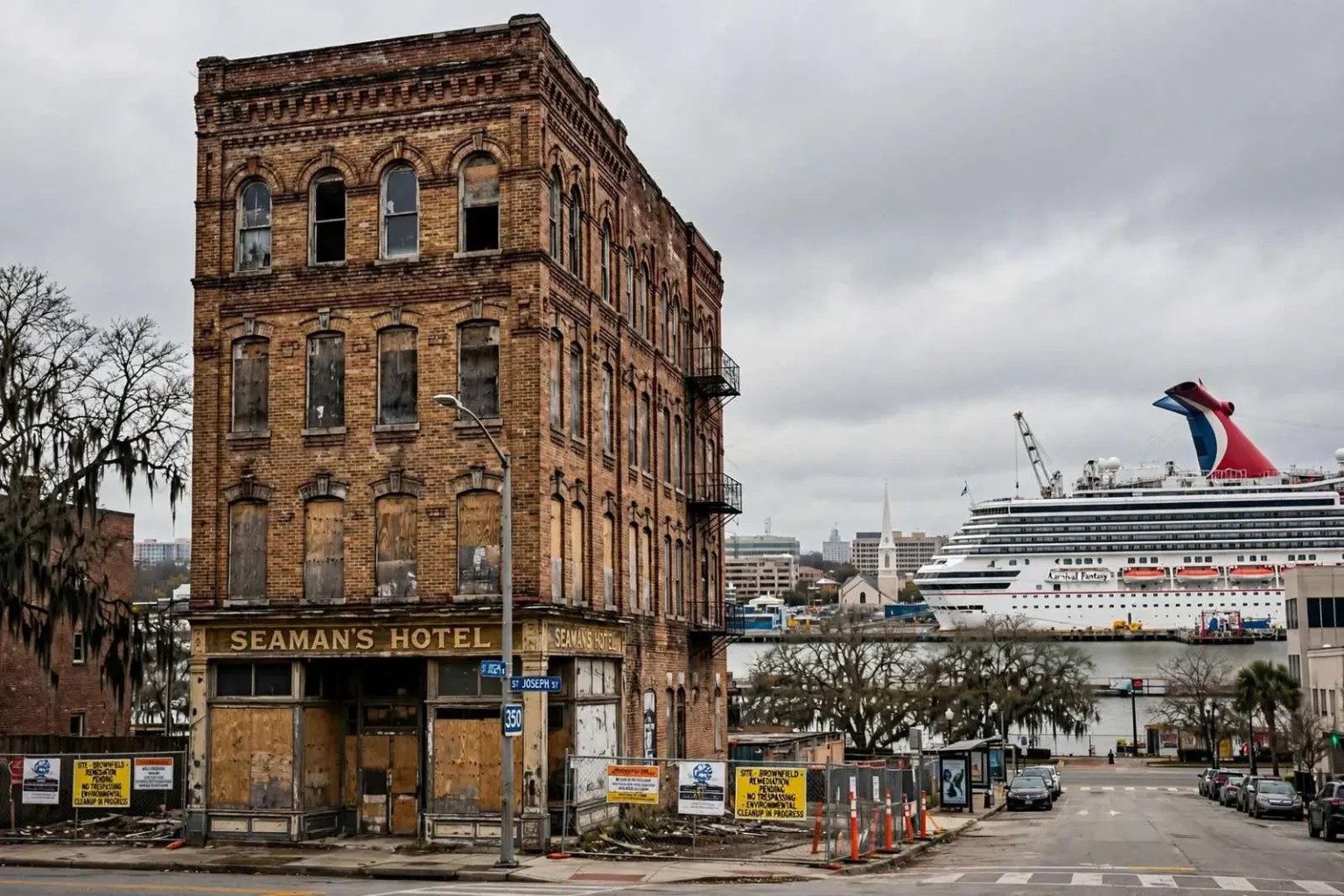
Downtown Mobile’s push to convert historic buildings into housing hit a brief procedural pause this week, as the Mobile City Council delayed a vote on the sale of a long-vacant brownfield site known informally as City Hall North. Under the council’s own rules, the vote on the property at 350 St. Joseph Street was pushed back at least one week before members can take it up again. The delay gives members another week to review the proposed terms and gives the public additional notice, a routine step that can nonetheless unsettle a project’s financing timeline.
If ultimately approved, the sale would send the building — the former Seaman’s Hotel — to developers for $548,000, which city officials say reflects its fair market value. Brad Christensen, the city’s director of asset management, presented the figure to the council as part of the proposed deal. The price puts the burden of an expensive restoration onto private developers rather than the city, which has been working through a backlog of surplus downtown properties in recent years.
Developers plan to transform the aging hotel into 67 apartments spread across the building’s four floors, mixing one-bedroom studios with larger two-bedroom units, according to historic preservation consultant Steve McNair. A project of that size would add dozens of households to a downtown residential base that has been growing steadily as old office buildings and hotels are converted to apartments, feeding restaurants and shops that depend on evening and weekend traffic.
Plans also call for a rooftop patio, a stand-alone coffee shop and a dog park, general contractor Michael Coumanis told the council. Amenities of that kind have become standard equipment in competitive downtown apartment markets, where new conversions compete not just on rent but on lifestyle. A ground-floor coffee shop would also activate the street level, a priority urban planners emphasize for blocks with long-vacant frontage.
Conversions of historic hotels carry both opportunity and risk. The floor plates and window lines that make an old hotel charming also impose constraints on how apartments can be arranged, and unexpected conditions behind plaster and brick can inflate budgets mid-construction. Developers who take on these buildings typically lean on experienced preservation architects and contractors — precisely the expertise McNair and Coumanis bring to the Seaman’s Hotel team — to keep a restoration faithful without letting costs spiral beyond what downtown rents can support.
Remediation and tax credits
Before any renovation work can begin, McNair said the site will first need environmental remediation to address its brownfield status. Brownfield designation typically signals contamination from past industrial or commercial uses, and cleanup must be documented and approved before residential conversion can proceed. The expense is often the first major line item in a project like this one, undertaken before a single wall is moved.
The project’s developers are expected to compete for both federal and state historic tax credits in early 2018, financing that would help offset the cost of restoring the aging structure. The credits reward developers who preserve the historic character of qualifying buildings, requiring adherence to restoration standards in exchange for equity that can make a marginal project pencil out. Alabama’s own credit program was created to unlock exactly this kind of downtown revival, and the competition for each year’s allocation is stiff.
A pipeline of downtown projects
The proposal is one of several downtown Mobile housing projects moving through the pipeline. Roughly a week after this council meeting, developers behind Meridian At The Port — another new residential complex — are scheduled to hold a groundbreaking ceremony downtown. Groundbreakings of that kind mark the transition from paper plans to construction hiring, with the payroll and purchasing that follow.
Separately, developers have also announced Merchants Plaza, a mixed retail, commercial and residential project anchored by the renovation of the historic Merchants National Bank building. Combining street-level retail with upper-floor housing and offices, the project follows the mixed-use playbook that has reshaped downtowns across the South, placing daily errands and apartments within walking distance of one another.
Taken together, the projects signal confidence in a downtown that two decades ago emptied out at dusk. Each conversion brings permanent residents back to the core, and each new resident is a customer for the bars, restaurants, and service businesses that have opened along Dauphin Street and the surrounding blocks. City Hall’s willingness to sell surplus buildings cheaply is part of the same calculation: get the structures back on tax rolls and populated, and the returns arrive through the tax base rather than the sale price.
Carnival stays another year
In other business, the council approved an extension of the city’s contract with Carnival Cruise Line, keeping Mobile as a port of call for the company’s Carnival Fantasy ship through December 2018 — a deal that keeps the cruise line’s presence, and the tourism dollars that come with it, anchored at the Alabama Cruise Terminal for at least another year.
The extension matters beyond the terminal itself. Cruise passengers arriving at the port fill hotel rooms the night before sailings, park in city garages, and buy fuel, food, and souvenirs downtown. The Fantasy’s presence also keeps the Alabama Cruise Terminal busy in a market where ports compete hard for homeported ships, and a lapse in a cruise contract can leave a costly facility idle. Port cities up and down the Gulf know the arithmetic: a homeported ship generates hundreds of embarkation-day visitors every week of the sailing season, and each departure day is a small economic event for the surrounding blocks.
City officials have long counted cruise traffic among the anchors of the downtown tourism economy, and the extension through the end of 2018 gives hotels and tour operators a planning horizon through another full booking season. For the Stimpson administration, the vote was a quiet piece of continuity in a meeting otherwise focused on new investment.
Auburn designers come downtown
Mayor Sandy Stimpson also used the meeting to announce a new partnership with Auburn University that will bring 15 to 17 industrial and graphic design students into a city-owned downtown building known as the Fuse Factory. Randall Bartlett, a Mobile native and post-baccalaureate program chair at Auburn, said students will initially work part-time in the space over the next two semesters, collaborating with local businesses on real design projects, with hopes of expanding the arrangement into a full-time program within the year.
“We like Mobile because of the recent progressive attitude that exists in the city, and we believe our design students can bring innovative solutions, which will bolster the forward thinking to an even greater level,” Bartlett said. “Our plan is to offer a unique educational experience by immersing our students in the culture that surrounds a particular problem and design a solution that fulfills a need.”
The arrangement gives Auburn students something classrooms cannot: clients with real budgets, deadlines, and constraints. For the local businesses on the receiving end, it offers design help that many small firms could not otherwise afford, and for the city it plants a cohort of young creative talent in a downtown building with the express hope that some of them stay after graduation.
The Fuse Factory takes its name from its industrial past and has become part of the city’s innovation infrastructure, a place where the lines between education, entrepreneurship, and city government blur. Hosting a university design studio fits the pattern of cities trying to hold onto the graduates their universities produce by embedding students in the local economy before diploma day.
The bigger picture for the urban core
Together, the council actions reflect a broader wave of downtown Mobile investment — from historic-building housing conversions to design partnerships aimed at keeping young talent engaged with the city’s urban core. The Seaman’s Hotel sale, the Carnival extension, and the Auburn partnership arrived on the same agenda, but they are pieces of a single strategy: put people downtown, give them reasons to stay, and let the tax base and the culture follow.
Each element reinforces the others. Apartment conversions create residents who patronize the downtown businesses that cruise passengers and design students also frequent; a busier urban core makes historic buildings easier to redevelop; and university partnerships supply the young workforce that fills apartments and staffs startups. City officials have spent years assembling the pieces, from tax credit legislation in Montgomery to the sale of surplus properties.
The one-week delay on the Seaman’s Hotel vote barely dents that momentum. If the sale is approved and the tax credits follow in early 2018, the former hotel at 350 St. Joseph Street will join a growing list of downtown structures brought back to life — 67 apartments, a rooftop patio, a coffee shop, and a dog park where a brownfield sat vacant, one more sign that Mobile’s center is filling in from the ground up.